Pricing is one of the biggest growth levers for SaaS companies. Charging too low can result in lost revenue. Set prices too high, and buyers may choose another tool.
That is why many SaaS companies are moving away from static pricing and using dynamic pricing instead.
Dynamic pricing in SaaS helps teams adjust prices based on demand, customer behavior, market conditions, product usage, and business goals. This approach can increase revenue, protect margins, and respond faster to market demand.
In this article, we will discuss the main types, benefits, risks, and best practices when employing dynamic pricing models.
TL;DR
- Dynamic pricing is a SaaS pricing strategy that adjusts rates based on factors like market demand, competitor pricing, product value, and timing.
- The main types include demand-based, competitor-based, value-based, time-based, cost-plus, segmented, bundle, price skimming, and penetration pricing.
- Dynamic pricing can help SaaS companies maximize revenue, remain competitive, react faster to market changes, and make smarter pricing decisions.
- For better results, teams should research the market, understand customers, offer different pricing, provide transparency, and use the right dynamic pricing software.
- Schematic helps SaaS and AI companies manage dynamic pricing by decoupling pricing logic from the application. Teams can update pricing and packaging without code changes.
What Is Dynamic Pricing in SaaS?
Dynamic pricing, also known as surge pricing, is a pricing strategy where a SaaS business constantly executes price changes based on real-time market conditions.
Instead of charging a fixed fee, SaaS teams align prices with market demand, product value, customer feedback, competitors' pricing strategies, and other relevant factors to stay competitive.
A successful dynamic pricing strategy relies on algorithms and data analysis to iterate continuously on SaaS monetization.
SaaS companies can raise, lower, or adjust prices for certain plans, users, or offers. This can be done by a pricing team, through set pricing rules, or with dynamic pricing software.
Dynamic pricing aims to keep prices aligned with the customers' perceived value of a product and willingness to pay.
9 Different Types of Dynamic Pricing in SaaS
SaaS companies can choose from several types of dynamic pricing. Let's break down each type below.
1. Demand-Based Pricing
Demand-based pricing changes prices based on how much buyers want a product at a given time. It follows the demand curve, where buyer interest affects customers' willingness to pay for the product.
When customer demand rises, a SaaS business can set higher prices. When demand drops, prices may go down or include a discount.
In SaaS, this dynamic pricing approach applies to limited seats, high-demand features, seasonal software needs, or special plan offers.
For example, a tax software company may increase SaaS prices during tax season because more customers need the product.
This pricing strategy works best when service or product demand fluctuates often.
2. Competitor-Based Pricing
Competitor-based pricing adjusts prices depending on what similar SaaS tools charge.
A company may make pricing adjustments after reviewing a competitor's pricing tiers, feature limits, discounts, and contract terms.
This type is common in crowded SaaS markets where buyers compare several tools before booking a demo or starting a trial.
By using competitive pricing, teams can stay close to market rates and avoid pricing far above or below similar options.
However, this does not mean that you should blatantly copy competitors. Each product has different features, a target market, and a unique value proposition. Your competitors should guide pricing decisions, not control them.
3. Value-Based Pricing
Value-based pricing sets prices based on the value that a SaaS product delivers. Pricing is tied to the outcome the customer gets instead of the cost of building or running the product.
For example, a sales automation tool that helps a company close more deals can set higher prices based on the value of that growth. A security platform may charge more if it lowers risk for IT teams.
This pricing method requires a deep understanding of how users value different features and benefits. That allows you to charge customers appropriately.
4. Time-Based Pricing
This type of dynamic pricing relies on time-related factors, such as day of the week, time of day, or seasonal trends, to make pricing adjustments.
For example, they may offer lower annual pricing before the end of a quarter to encourage customers to commit sooner.
Teams can also offer discounted rates for a soft product launch or an early access period.
It helps increase conversions during slower periods and create stronger demand during planned campaigns.
5. Cost-Plus Pricing
Cost-plus pricing starts with the cost of building, running, and supporting the software. Then, the company adds a profit margin.
Common expenses for SaaS products include cloud hosting, customer support, sales costs, product development, and onboarding.
Teams may adjust prices when these costs change to protect margins. It is useful when operational expenses are easy to track.
However, this dynamic pricing strategy doesn't reflect what customers are willing to pay. A SaaS product may be worth far more than its cost if it saves time, reduces manual work, or drives revenue.
6. Segmented Pricing
Segmented pricing offers different prices to various customer groups. These groups may be based on company size, business model, location, usage level, industry, or contract type.
Segmented pricing often depends on customer segmentation to match pricing with buyers' needs and budget.
For example, you may offer lower pricing for startups and higher pricing for large firms. You can also create different pricing tiers for small teams, mid-sized teams, and enterprise accounts.
By using segmented pricing, you can serve more buyers without forcing all of them into one plan.
According to a SaaS Pricing Benchmark Study, 91% of enterprise companies use dynamic pricing elements that change based on customer segments.
7. Bundle Pricing
Bundle pricing groups several products, features, or services into one package price. Instead of selling each item on its own, you combine them into a pricing plan or add-on bundle.
A good example is bundling analytics, automation, and premium support into one higher-tier plan.
Bundles can help attract customers by offering more value at one price point. It can also increase the average deal size and make buying simpler.
However, the bundle should make sense. If customers feel forced to pay for features they do not need, conversions may decrease.
8. Price Skimming
Price skimming is a dynamic pricing strategy where SaaS teams charge the maximum entry price that customers can afford. The price eventually drops once the clients' requirements are met.
In SaaS, this can work for new AI features, advanced analytics, enterprise tools, or high-value add-ons. Early buyers may pay more because they want access before others or need the feature right away.
This approach helps SaaS companies maximize profits from early adopters who are willing to pay a premium. It works best when the offer is clearly different from lower-priced options.
9. Penetration Pricing
Penetration pricing is the opposite of price skimming. You set lower introductory prices to win customers over and penetrate a highly competitive market.
For example, you can offer a free starter plan, launch discounts, or charge less for a first-year contract.
Once you've established a stable market position, you can increase service prices over time.
This type of dynamic pricing suits newer SaaS companies that want to grow fast and gain market share.
Key Benefits of Dynamic Pricing
Effective dynamic pricing can benefit SaaS companies in several ways.
Maximize Revenue
Dynamic pricing helps SaaS companies capture more revenue when demand is high. If interest in a product increases after a feature launch, market shift, or seasonal trend, pricing can adjust to match that demand instead of staying fixed.
You may raise prices for premium plans during periods of strong buyer activity or limit discounts when demand is already high. This helps you avoid selling valuable plans below market value.
Dynamic pricing also lets you test pricing changes across plans, contract lengths, and customer groups.
Over time, you can use those insights to optimize revenue without relying on one static pricing model for every customer.
Gain a Competitive Advantage
Many SaaS companies still rely on static pricing that stays the same over a long period. This can slow down pricing decisions and create gaps between product value and customer expectations.
Dynamic pricing gives SaaS businesses more flexibility. Teams can adjust pricing as customer demand changes, new features launch, or buyer behavior shifts. This helps companies remain competitive without waiting years to update pricing structures.
Those that adapt pricing faster often have a stronger chance of winning deals, protecting margins, and keeping pace with changing customer needs.
React Faster to Market Changes
SaaS markets can shift fast. Competitors may adjust pricing regularly. Demand can also increase after a product update or a new market trend.
Dynamic pricing lets you respond to these changes without a full pricing overhaul.
You may simply adjust a launch offer, change the bundle, update renewal terms, or test a new plan based on customer activity. This gives you more control over SaaS pricing and packaging at each stage.
Improve Decision-Making
Dynamic pricing helps you understand how customers react to different price points.
You can track which offers lead to more signups, upgrades, renewals, or drop-offs. This gives clearer insights into buying behavior and price elasticity.
A strong SaaS dynamic pricing strategy also lets you compare plans, discounts, and packaging to see what customers respond to most.
Pricing decisions are based on market analysis and various factors, like usage patterns, contract size, feature demand, and customer segment.
Over time, you can deploy pricing models that better match customer expectations and business goals.
Risks and Challenges in Dynamic Pricing
Dynamic pricing has clear benefits, but it can also create problems when SaaS teams use it without clear rules.
Loss of Customer Trust
Customers may lose trust if prices change too often or when charges are different across plans, users, or sales channels. A prospect may receive one quote while another company gets a lower rate for a similar package.
This can create friction during the sales process. Buyers may question the value of the product or push harder for discounts. Existing customers may also become frustrated if newer users receive better pricing or promotions.
Trust is hard to rebuild once pricing feels unfair. SaaS teams should explain the decision behind variable pricing and give advanced notice when needed.
Competitor Price Wars
Competitor-based pricing can help SaaS companies capture a large market share. But it can also lead to price wars if both organizations keep lowering prices to match rivals.
This can hurt margins and weaken the brand. If you only compete on price, you are training buyers to focus on discounts instead of product value.
Lower prices can also attract poor-fit customers. These customers may churn faster, need more support, or resist upgrades.
It's important to track your competitors, but do not let them control your pricing strategy.
Time-Consuming Process
Dynamic pricing requires constant market analysis and monitoring. SaaS teams may need to track competitor pricing, customer demand, feature changes, and buying trends before adjusting prices.
Without the right dynamic pricing tools, the process can become difficult to manage and take a lot of time.
Manual tracking may slow down pricing updates and pull teams away from core tasks. It can also lead to errors when the business relies on spreadsheets or scattered data.
Technical Complexity
Dynamic pricing can be hard to set up because it depends on many systems. A SaaS company may need pricing data from the billing tool, subscription management software, CRM, product analytics, and finance system.
If these systems do not connect well, pricing decisions may be based on missing or outdated data. This can lead to poor offers, wrong discounts, or prices that do not match customer value.
Technical setup also takes planning. Engineering needs clean data, clear pricing logic, testing, and approval steps. Without these, dynamic pricing can create more problems than it solves.
Best Practices for Implementing Dynamic Pricing
Here's how to implement dynamic pricing successfully.
Conduct Extensive Market Research
Before changing prices, analyze competing tools, plan limits, feature sets, contract terms, and common discount patterns.
This does not mean matching every competitor. Instead, it involves learning what buyers expect and how similar products are priced.
You should also review your current market position. If you have a premium product, you can charge more if you deliver stronger value, support, or results. If you're new to the market, you can offer low introductory prices to gain customer trust.
Proper research helps you set prices with more confidence.
Understand Your Customers
Dynamic pricing works best when you know who your customers are and what they value. A small team, a fast-growing company, and a large firm may all need your SaaS product for different reasons.
You should review onboarding feedback, renewal trends, support requests, and product adoption data. These signals can show where customers see value and where pricing may create friction.
Strong customer insight also supports better customer satisfaction. When pricing matches actual needs, customers are more likely to stay, upgrade, and trust your product over time.
Offer Different Prices
Different price points allow you to serve more customer groups. After all, not every buyer has the same budget, team size, or product need.
You can set service prices based on usage, features, support levels, or contract size.
For example, you can offer starter, growth, and enterprise plans. You can also provide annual discounts or volume pricing for power users.
This gives customers more choice and helps them pay for the value they need. On the other hand, your SaaS business can capture more revenue from larger accounts without blocking smaller teams.
Each price level should have a clear reason. Customers should understand why one plan costs more than another. Otherwise, they will stay on their current plan and never upgrade.
Be Transparent
Buyers want to know what they are paying for, what is included, and when prices may change.
Clear SaaS pricing pages, simple plan names, and plain terms can reduce confusion. If service costs change at renewal, customers should receive an advanced notice before the new rates apply.
You should let clients know that you are using dynamic pricing. This makes them more likely to accept changes and keep trusting your company.
Invest in the Right Dynamic Pricing Software
Dynamic pricing software helps SaaS companies adjust prices based on customer data, usage, demand, and pricing rules.
Instead of updating prices by hand, teams can use dynamic pricing systems to make pricing decisions in one place.
This software allows organizations to react to market changes quickly, reduce manual errors, and keep prices aligned with product value. It can also support faster pricing experimentations.
Look for a platform that matches your monetization model. It should support subscriptions, seats, usage-based billing, overages, credits, and other flexible pricing models.
A good dynamic pricing engine also connects to billing tools, CRM platforms, analytics tools, and finance systems.
Schematic Enables Dynamic Pricing Without Hard-Coded Logic
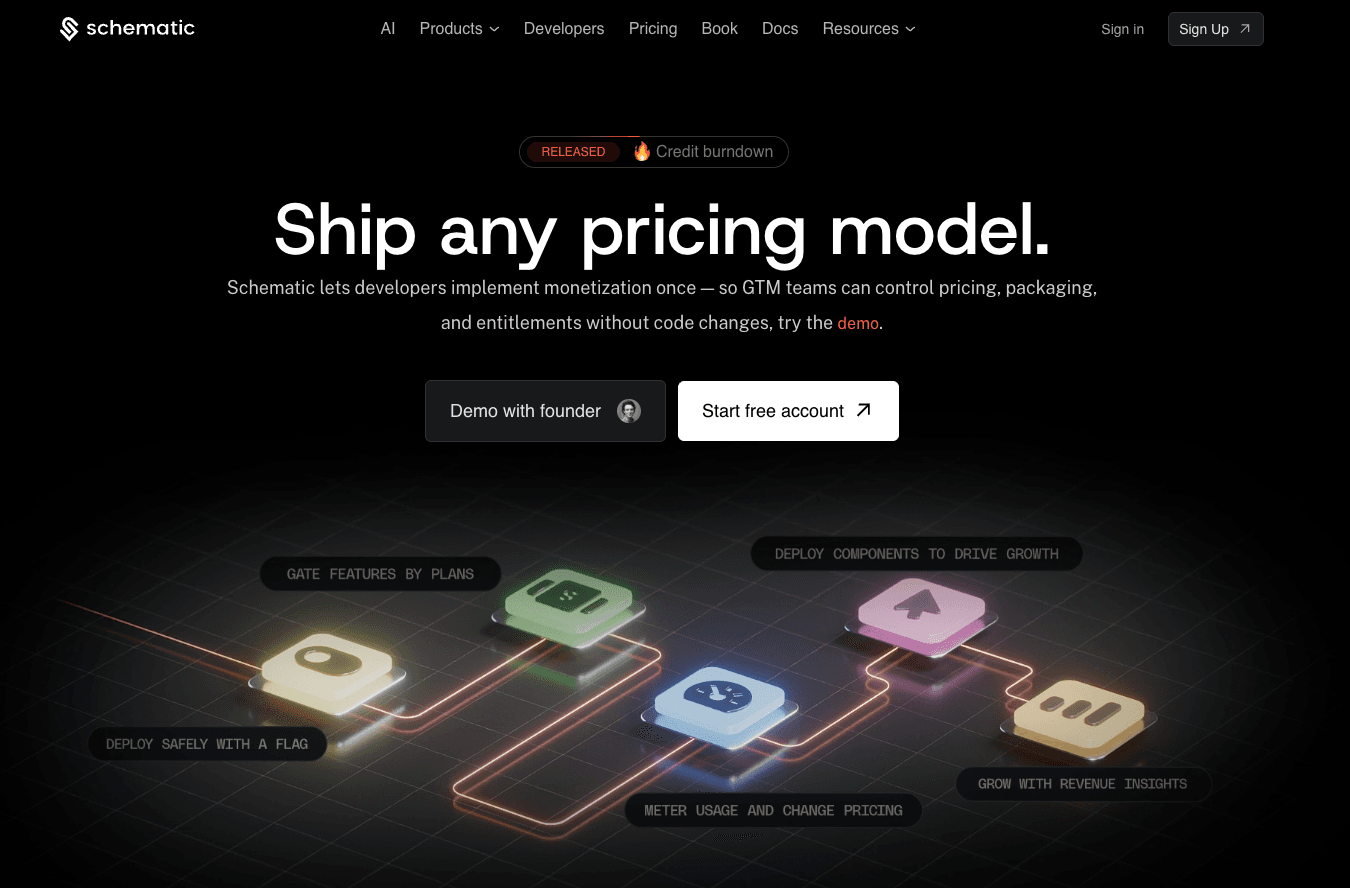
It's difficult to implement dynamic pricing when pricing rules live inside your application code. Schematic solves this by decoupling pricing logic from the product.
GTM teams can change pricing, packaging, limits, and software entitlements without waiting on developers.
Schematic, built on Stripe, helps you manage usage-based pricing, credits, add-ons, trials, and exceptions from one place. This makes it easier to support flexible pricing models while keeping billing and subscription status aligned with product access.
The platform also lets you create custom plans for sales-led deals, special contracts, or high-value accounts.
Engineering stops building one-off logic for every enterprise deal. Commercial teams can close deals faster, manage limits, issue more credits, and add new products.
FAQs About Dynamic Pricing SaaS
What is dynamic pricing?
Dynamic pricing is a pricing strategy where a company changes prices based on demand, customer behavior, market conditions, or product value. In SaaS, it can apply to plans, discounts, usage fees, add-ons, renewals, and custom deals.
Is dynamic pricing fair?
Dynamic pricing can be fair when prices are clear, based on value, and easy to understand. It becomes risky when customers feel surprised, misled, or treated unfairly. SaaS companies should clearly explain pricing changes to maintain trust and customer satisfaction.
What is the difference between dynamic pricing and price discrimination?
Dynamic pricing changes prices based on various factors, like demand, timing, usage, or market shifts. Price discrimination means charging customers different prices for the same product based on what they may be willing to pay.
How does dynamic pricing work?
Dynamic pricing works by using real-time data to guide price changes. SaaS teams may review product usage, demand, customers' perceived value, competitor pricing, and sales trends. Then, they adjust prices, discounts, or offers based on what they've learned.