 Ryan Echternacht
Amberflo is a specialized billing platform for understanding AI-driven costs and monetizing AI products. It helps companies track how much their AI workloads cost, see how those costs are split between teams or products, and bill customers based on actual consumption.
Businesses launching usage-based pricing find Amberflo a useful tool. However, it may not cover every billing infrastructure and product requirement.
Teams usually look for Amberflo alternatives that can support subscription pricing alongside usage-based models, plan management, and runtime access enforcement.
This article reviews the best Amberflo alternatives for AI monetization.
TL;DR
These are the top Amberflo alternatives in 2026:
- Metronome
- Stigg
- Orb
- Alguna
- Zuora
- Lago
How Does Amberflo Support AI Monetization?
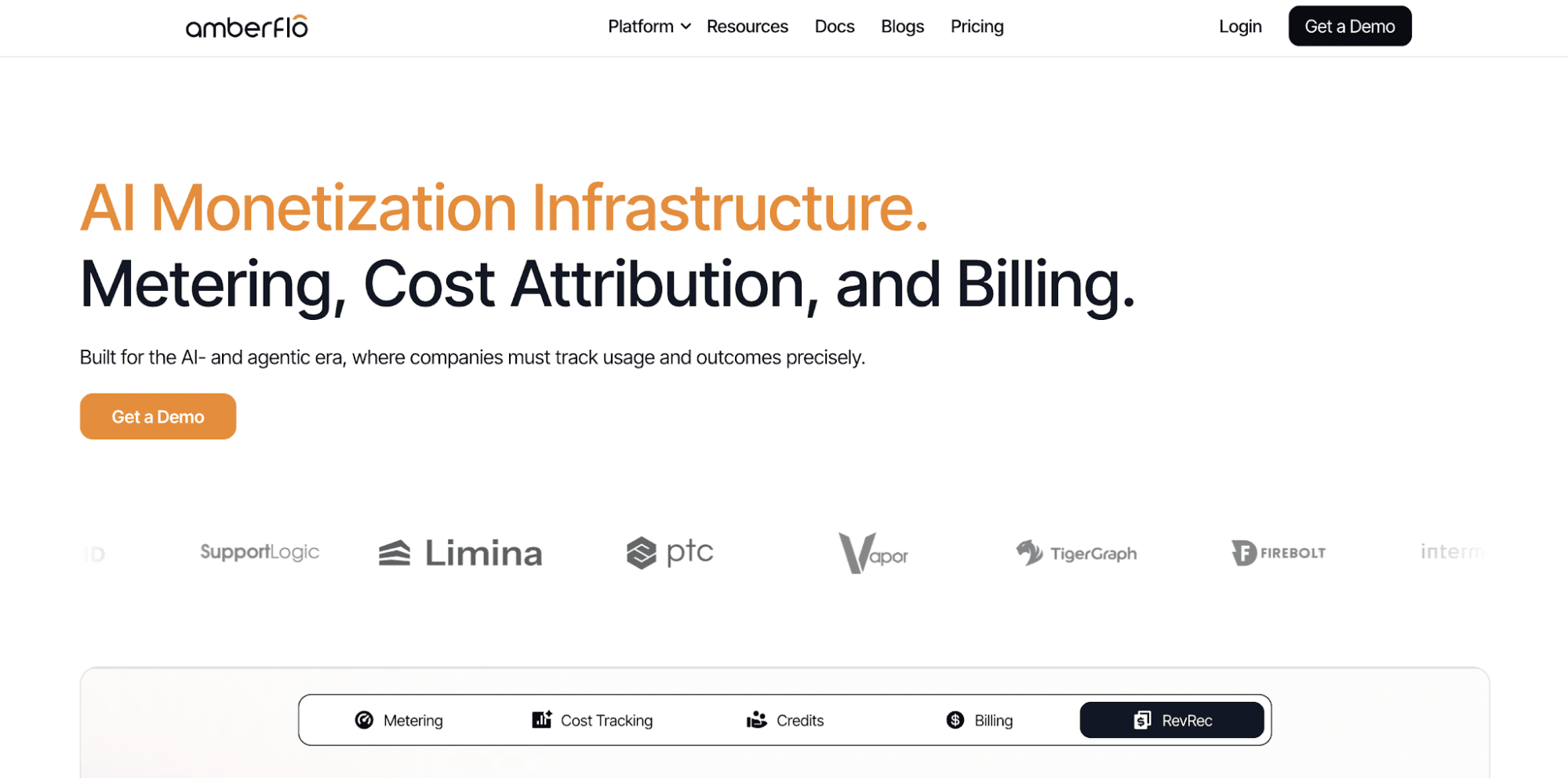
Amberflo combines usage metering, credit-based pricing, cost tracking, billing, and revenue recognition in one system. This helps companies monetize AI using any usage-based pricing model, such as prepaid credits, tiered pricing, and outcome-based pricing.
Source: Amberflo.io
Amberflo's metering and billing platform can ingest a high volume of usage events in real time. It translates product activity to accurate billing data and revenue-grade cost reports.
The software also conducts profit margin analysis, which breaks down revenue earned and the cost of serving one customer.
Revenue operations (RevOps) teams can then use Amberflo's built-in operational controls to prevent budget overruns, enforce billing logic, and maximize profitability.
Finance teams, on the other hand, can close the books faster without manual data reconciliation. Amberflo can automate revenue schedule generation to ensure compliance and audit-readiness.
Why Do AI Companies Replace Amberflo?
AI companies often replace Amberflo when their billing needs go beyond usage-based pricing and real-time metering.
Teams may need support for recurring subscriptions, custom plans, complex proration, payment recovery, customer-specific terms, and deeper finance integrations. Amberflo often falls short for businesses that ship hybrid pricing and other complex models.
Another shortcoming is the lack of entitlement management controls. Like most billing tools, Amberflo stops at usage metering and does not enforce product access at runtime.
Engineering teams end up hardcoding entitlement logic inside application code. This approach works when pricing is simple (e.g., the company ships good-better-best pricing tiers). However, once the business offers multiple products, custom pricing, and negotiated terms, in-house entitlement management systems break at scale.
Amberflo also relies on a single payment processor, Stripe. Companies that may need Adyen, PayPal, or other payment solution providers may prefer a platform that supports other payment options.
Top 7 Amberflo Alternatives in 2026
Here are the best Amberflo alternatives worth considering.
1. Schematic
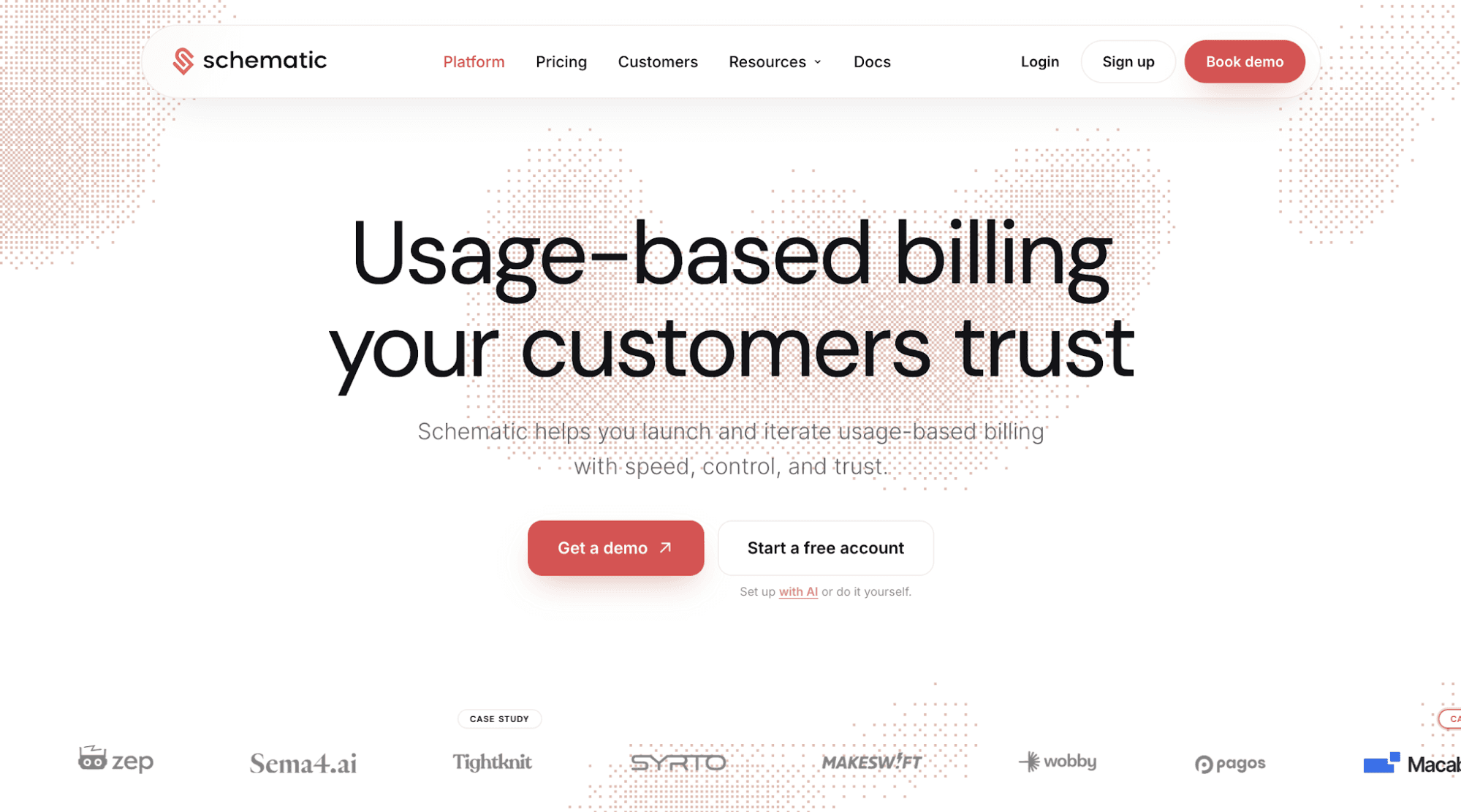
Schematic is the best usage-based billing platform for software and AI companies selling to enterprises. It provides full control, customization, and predictability over AI usage.
Teams use Schematic to sell usage-based plans, grant AI credits as part of a subscription tier, manage software entitlements, enforce access at runtime, and give customers consumption visibility.
Schematic stands out for its real-time entitlement engine and enterprise credit wallets. Buyers can see their current usage, credit balance, and limits in one place. They can also set usage caps, change credit top-up rules, and decide what happens when they reach a limit.
The billing engine enforces whichever policy they chose at runtime. If the buyer selects hard limits, Schematic automatically denies access at the cap. Meanwhile, soft limits allow usage to continue and bill it in arrears. Usage notifications are also sent to the right user before access stops.
Plus, Schematic supports credit rollovers, expiry windows, and priority consumption to implement credit burndown pricing successfully. Concurrency-safe holds prevent autonomous agents from drawing the same balance.
Buyers and sellers gain confidence that consumption will stay within budget. That leads to faster sales cycles, more predictable expansion, and higher long-term revenue.
Key Features
- Enterprise-ready wallet: Make usage-based billing transparent and trustworthy by giving customers full visibility and control over their consumption.
- Flexible pricing: Support any SaaS pricing model (e.g., per-seat, pay-as-you-go, tiers, overage fees, and hybrid models) without a billing rebuild.
- Usage metering: Track over a million usage events per second and turn them into billable totals.
- Credit ledger: Record every credit grant and deduction in an append-only ledger that teams can export.
- Self-service controls: Enable customers to set usage caps, control automatic top-up rules, and choose between hard and soft limits.
- Entitlement management: Control feature access and usage limits by plan, seat, or AI agent in real time.
- Customer profile: Show each customer’s plan, usage, credits, payment method, and billing details on one scrolling page.
- Plan versioning: Migrate current customers or keep them on older plan versions without filing an engineering ticket.
- Payment integration: Accept credit card and ACH payments through the built-in Stripe integration.
- Revenue recognition: Meet ASC 606 revenue recognition rules with export-ready ledger records.
2. Metronome
Source: Metronome.com
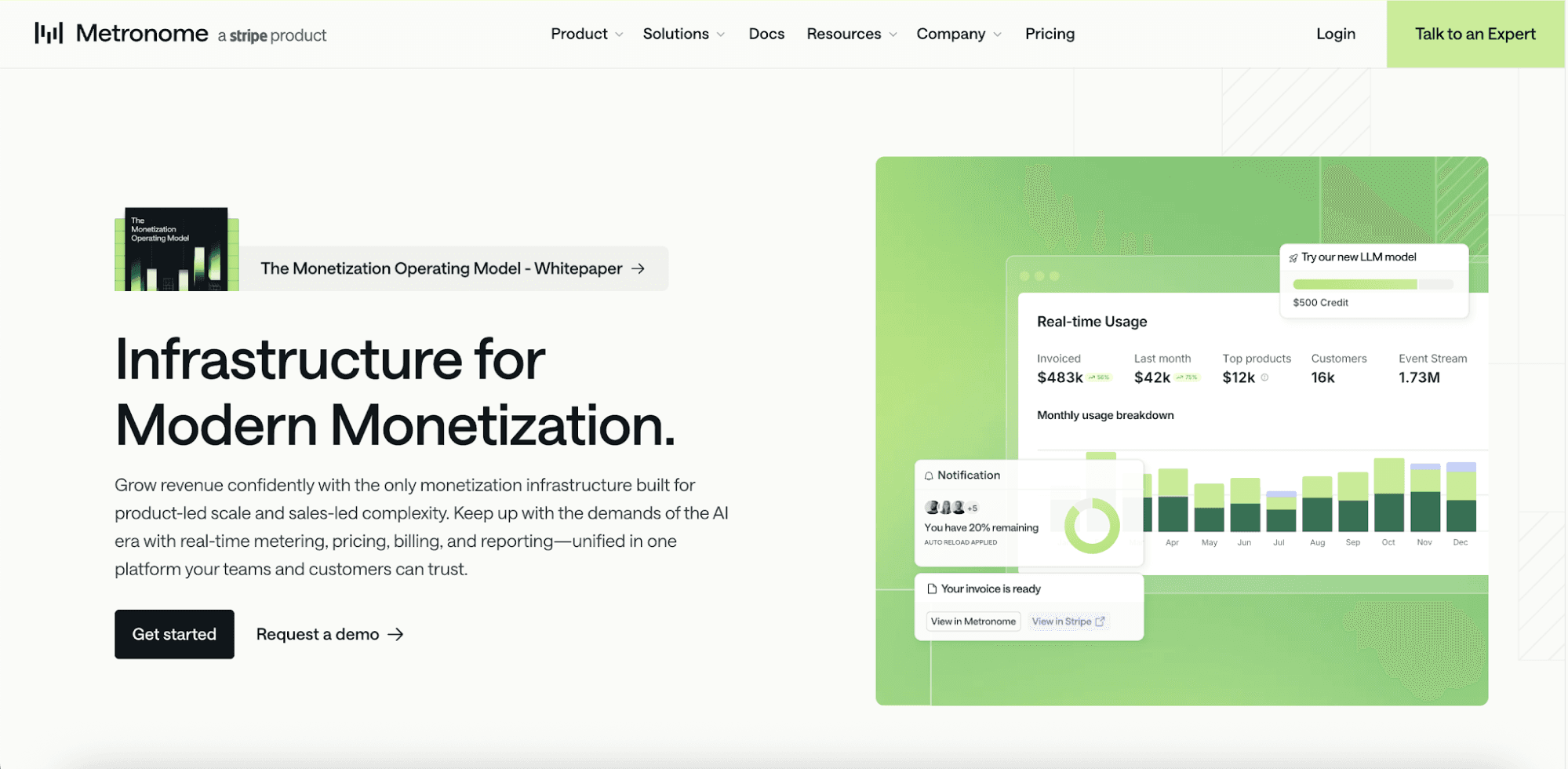
Metronome is modern billing infrastructure for companies dealing with product-led scale and sales-led complexity.
It provides pricing levers that support different go-to-market strategies. Implement freemium pricing and usage-based pricing for product-led growth. Multi-year contracts, bundled packages, and commit models work with sales-driven growth.
Metronome is also designed for pricing flexibility. Teams can use centralized rate cards, commitments, and credit systems to ship pricing changes without rebuilding their billing setup. They can also offer discounts, overrides, amendments, and custom enterprise contracts based on standard list pricing.
The platform even integrates usage billing into the product experience. APIs and webhooks give customers real-time visibility into spending and usage data. Buyers can also configure alerts and limits to prevent surprise bills.
Internal teams can use the same information for margin analysis, consumption tracking, and revenue forecasts.
Key Features
- Pricing levers: Support usage-based pricing, prepaid credits, commits, volume discounts, overrides, and other pricing models for any GTM strategy.
- Modular pricing engine: Use centralized rate cards, commits, and credit models to build pricing strategies.
- Usage metering with low-latency alerting: Track raw usage events and streaming billable metrics with low-latency alerts to prevent fraud.
- Customer configuration controls: Apply discounts, amendments, pricing overrides, and scheduled changes to individual customer contracts.
- Transparent billing dashboards: Bring real-time usage and spend data into customer-facing dashboards through APIs and webhooks.
3. Stigg
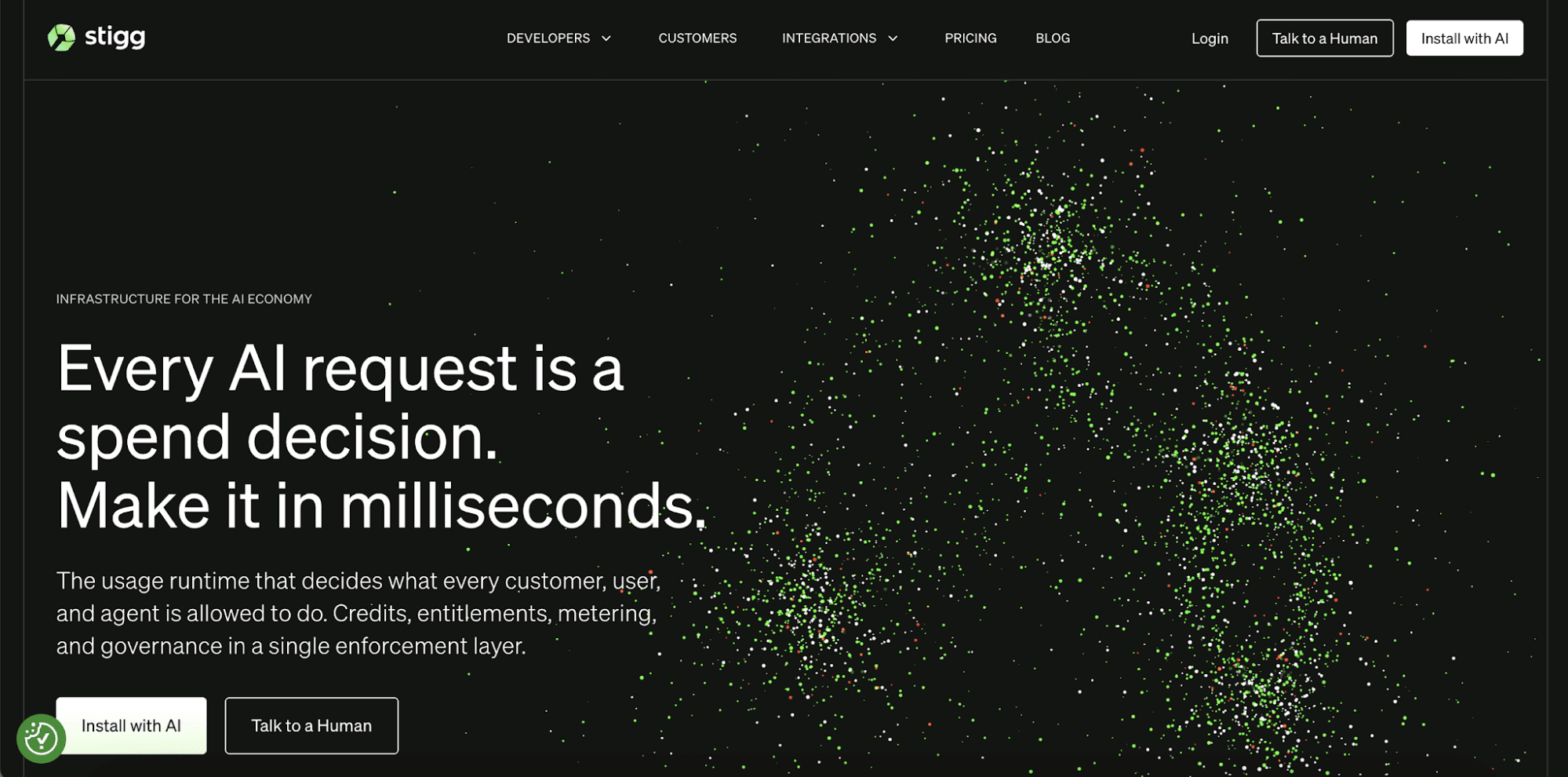
Source: Stigg.io
Stigg acts as a usage runtime layer that decides what each customer, user, team, and AI agent can do the moment they attempt to perform an action. It combines real-time enforcement, credits, entitlements, usage metering, and governance.
Before an AI request runs and depletes the customer's budget, Stigg can check entitlements, credit balances, and limits. If the account has enough balance, Stigg approves the request and enables the AI agent to work. Otherwise, the platform blocks further usage until the buyer tops up their account.
Stigg moves entitlement logic outside application code. Commercial teams can change pricing, bundle or unbundle features, or adjust usage limits without asking developers to deploy code.
For governance and spend control, Stigg allows customers to set budget caps per user, team, or agent. Then, it checks those limits at call time.
On top of these capabilities, Stigg supports real-time metering. It captures and aggregates tokens, inference calls, and agent actions to ensure billing accuracy.
Key Features
- Runtime access enforcement: Check credits, limits, and entitlements before each AI request proceeds.
- Financial-grade credit system: Built-in wallets, ledgers, expiry rules, priority consumption, and credit burndowns solve edge cases in credit-based billing.
- Entitlement management: Store entitlement logic outside the codebase so teams can change models, tiers, and features without a new deployment.
- Spend controls: Buyers configure per-user, per-team, and per-agent budget caps that apply at call time.
- Usage metering: Charge customers for actual usage by tracking raw event data.
4. Orb
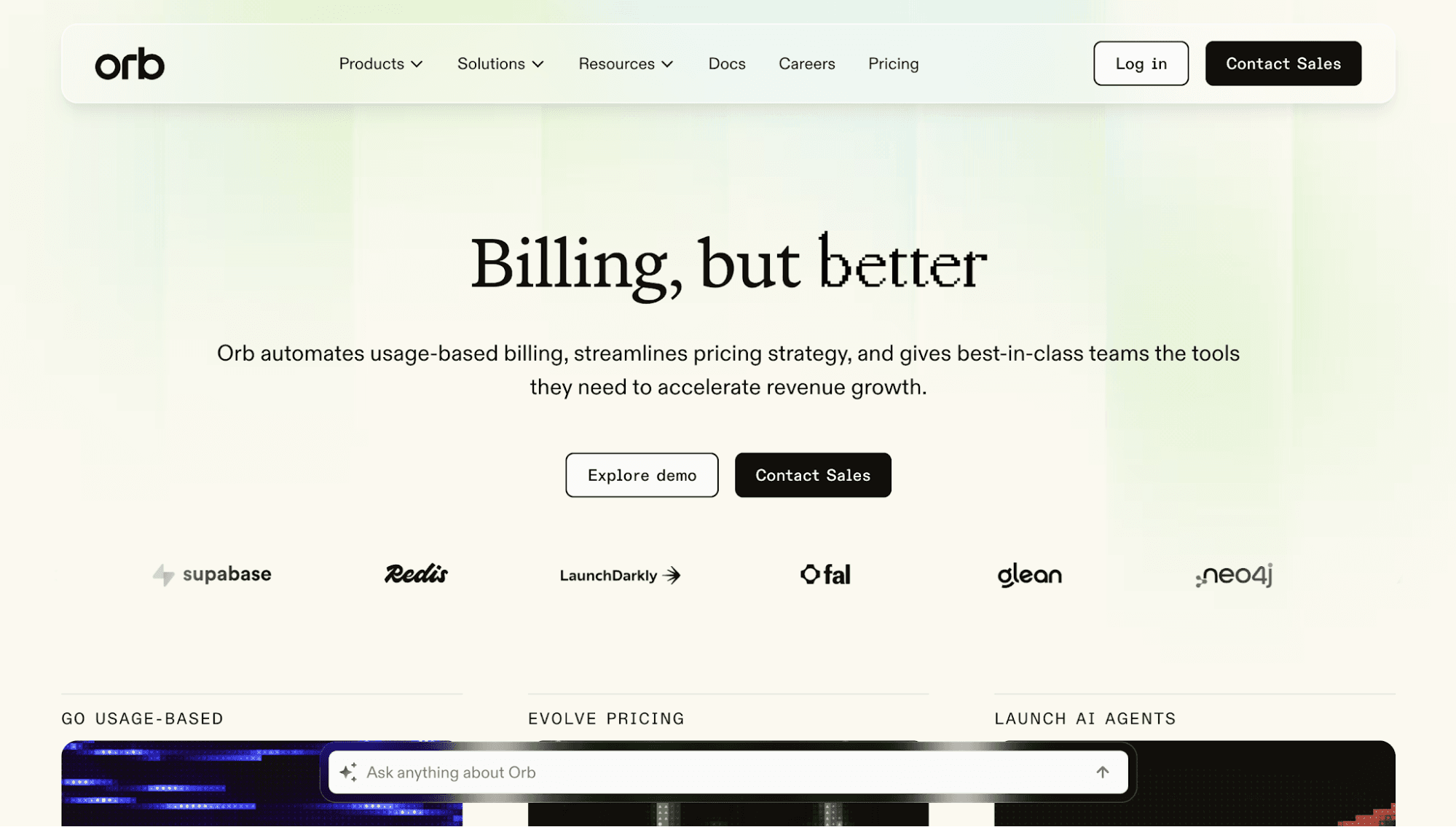
Source: withOrb.com
Orb is a usage-based billing solution that helps finance, engineering, and product teams monetize usage-based products.
The platform meters usage at scale without additional engineering resources. Commercial teams can manage complex contracts, customers, and prices from a single source of truth.
Orb also handles infrastructure outages, contract updates, backfilled usage, and invoice corrections. It ensures accurate metering and billing even when usage data or customer terms change.
Orb is a highly customizable pricing software that can tailor paid plans to individual users. Changes automatically reflect in pricing pages, calculators, and checkout flows.
Meanwhile, alerts and webhooks can notify customers about usage, helping them manage spend and future consumption.
Key Features
- Automated usage-based billing: Handle usage metering, pricing, and billing automatically as customer consumption changes.
- Invoice management: Generate and send invoices directly to customers based on their usage and contract terms.
- Price evolution and simulations: Model, test, and refine pricing strategies before rolling out changes.
- Spend controls: Allow customers to track and manage spending through alerts and automated workflows.
- Experience kit: Build pricing pages, usage dashboards, and checkout flows to gain customer trust.
5. Alguna
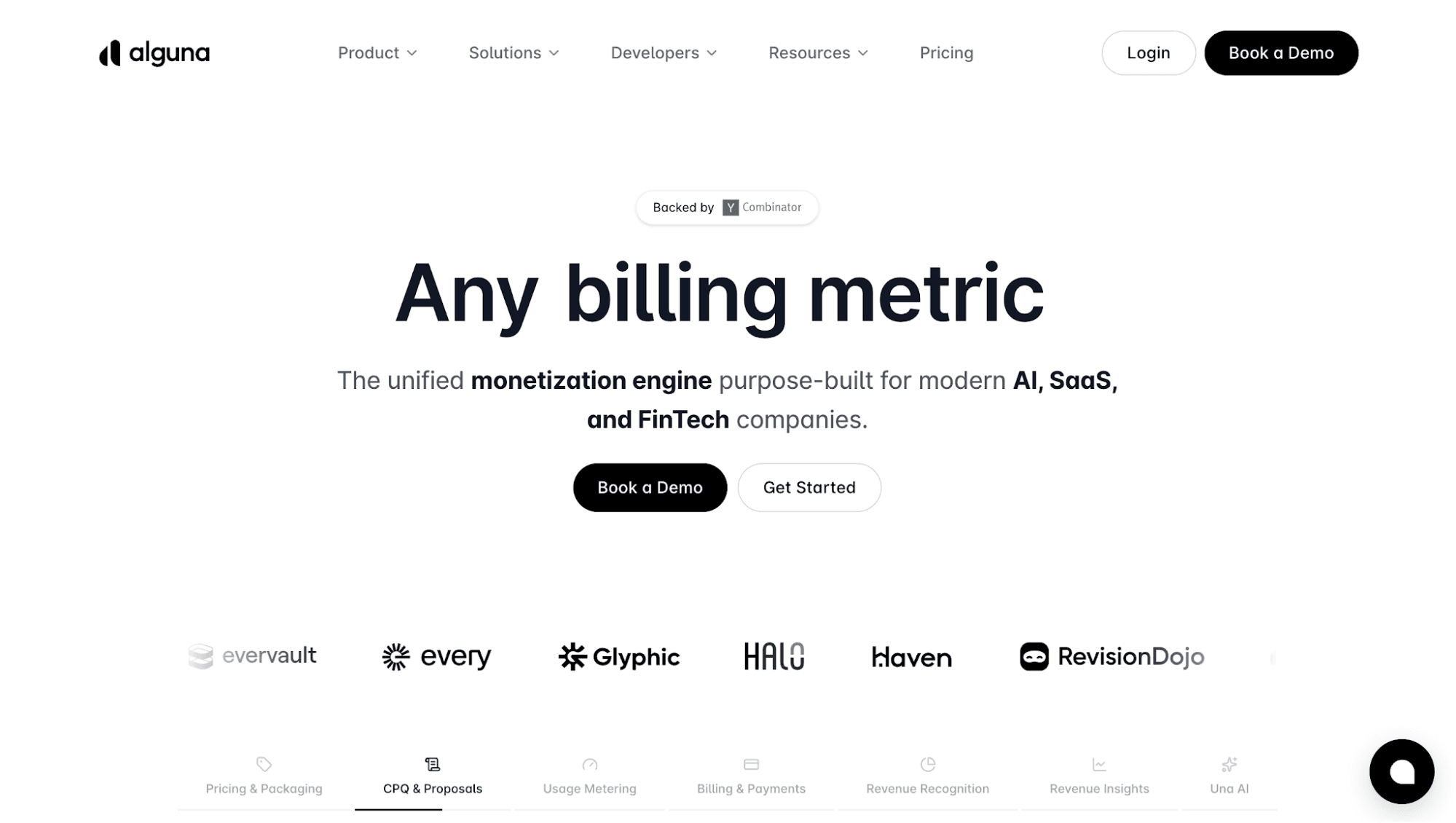
Source: Alguna.com
Alguna is an end-to-end monetization engine for software, AI, and FinTech companies. It unifies pricing, quoting, usage metering, billing, payments, and revenue recognition into one system.
RevOps teams can update pricing and packaging, create quotes, handle approvals, manage subscriptions and renewals, and sync revenue data with customer relationship management (CRM) software.
Developers send raw usage events into Alguna, enforce credits, build checkout pages and customer portals, gate features, and manage entitlements.
Meanwhile, finance teams benefit from billing and invoicing tools, payment orchestration, revenue recognition workflows, and tax management. They can close the books faster and stay audit-ready.
Plus, Alguna's built-in AI assistant helps different departments work efficiently, get quick answers about billing, and upgrade their current processes.
Key Features
- Automated billing and invoicing: Automate recurring and usage-based billing, invoice creation, and payment workflows.
- No-code configuration, pricing, and quotation (CPQ): Accelerate the sales cycle by using the intelligent pricing engine, prebuilt quote templates, and one-click integrations.
- Subscription management: Manage customer plans, approve subscription changes, and handle renewals in one flow.
- Credit systems: Provide real-time visibility into account balances, grants, limits, and prepaid commitments.
- Revenue and cost attribution: Break down product revenue and bring usage and financial data together for profitability analysis.
6. Zuora
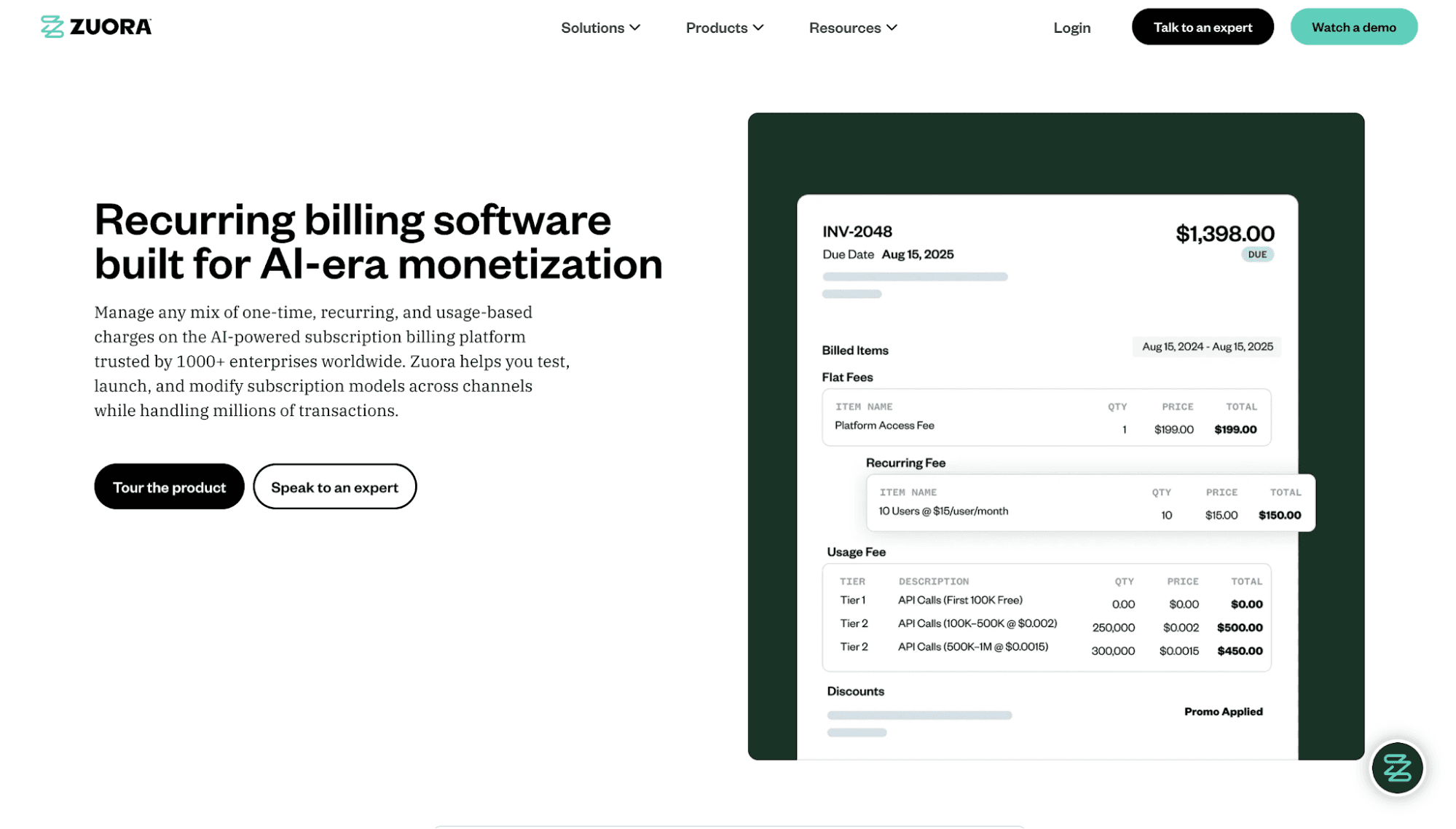
Source: Zuora.com
Zuora is an enterprise billing solution designed for subscription businesses that combine recurring, one-time, and usage-based charges.
Teams can test, launch, and update any monetization strategy while supporting high billing volume and complex revenue streams.
Zuora's built-in mediation and rating tools process usage events in real time and support different usage-based models. It can also surface consumption data directly to users, which prevents surprise charges and billing disputes.
Finance teams can use the same usage data to forecast future revenue, detect anomalies, and see emerging consumption trends that can maximize profitability.
Zuora is a powerful solution for fast-growing companies selling to enterprise customers. However, it introduces a steep learning curve for teams that only need a simple billing system.
Key Features
- Unified quote-to-cash workflow: Connect quoting, billing, invoicing, payments, revenue recognition, and accounts receivable workflows.
- Mediation and rating: Capture usage events at scale and rate them for any monetization model.
- Global payments orchestration: Integrate Zuora with multiple payment gateways to optimize payment success and prevent fraud.
- Subscriber lifecycle management: Handle upgrades, renewals, payments, and lifecycle changes in the middle of the billing cycle.
- Built-in extensibility: Build custom logic, integrations, and workflows that adapt to business needs.
7. Lago
Source: getLago.com
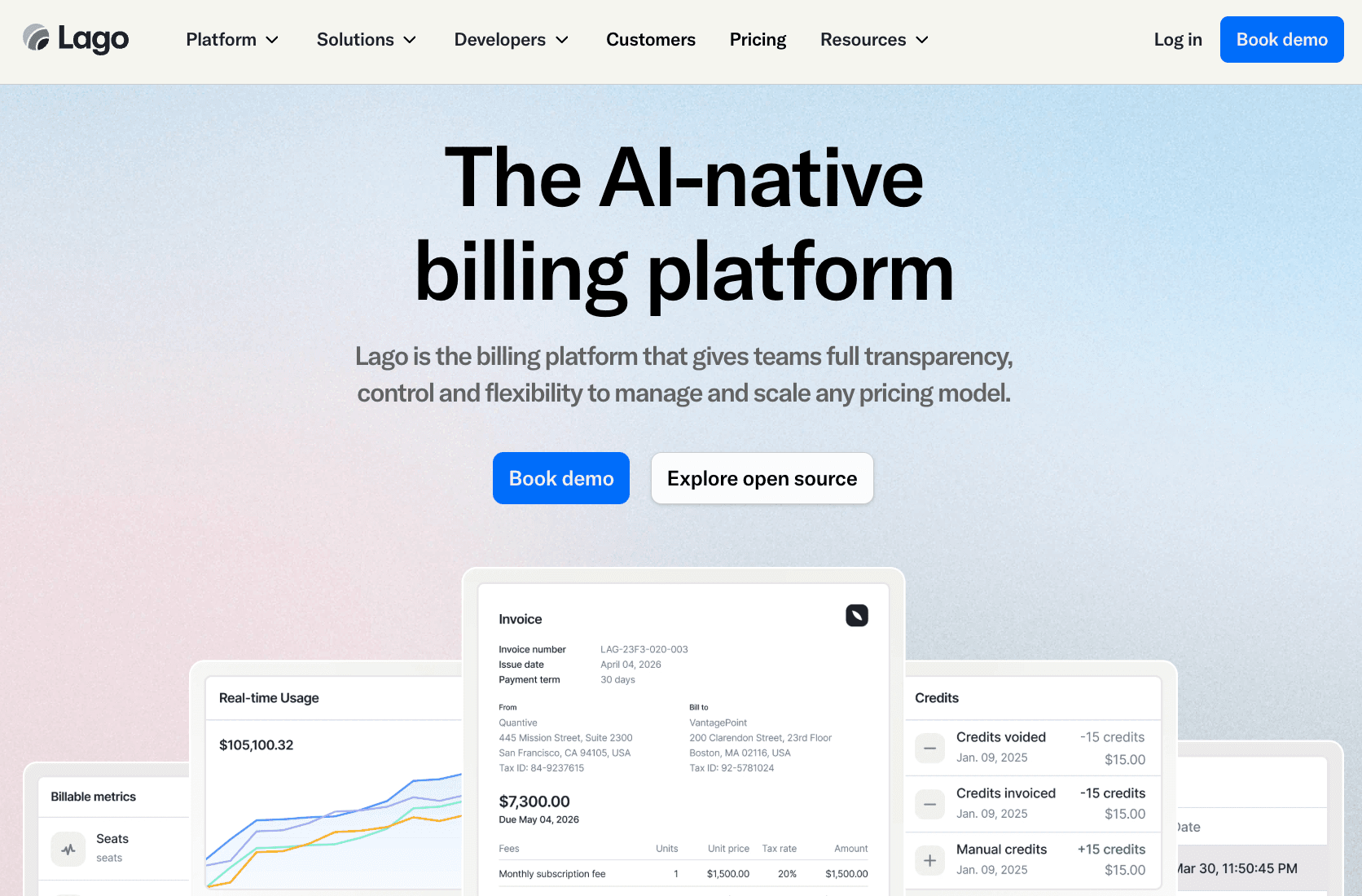
Lago is an open-source billing platform designed for AI monetization. It supports subscriptions, usage-based charges, prepaid credits, custom contracts, and hybrid pricing for self-serve and enterprise sales motions.
Lago's built-in metering solution can translate raw usage events to accurate invoices. It can bill usage across different products and implement any consumption-based pricing model.
The platform connects to accounting software, payment providers, CRMs, enterprise resource planning (ERP) tools, and other third-party systems. This eliminates manual data entry and ensures everyone works from the same billing data.
Lago also provides several deployment options. With self-hosting, teams can run the platform on their own infrastructure or inside a virtual private cloud (VPC) to gain full control over billing data and system changes.
Key Features
- Usage-based billing and invoicing: Turn usage events into billable totals and send invoices to customers.
- Flexible deployment: Lago offers cloud, on-premises, VPC, and self-hosted deployment options for teams that want more control over their billing infrastructure.
- Revenue analytics: Unify billing and usage data for reporting, forecasting, customer analysis, and invoice tracking.
- Entitlement management: Control feature access and apply overrides for enterprise customers.
- Out-of-the-box integrations: Connect Lago to payment gateways, accounting tools, data warehouses, CRM, online marketplaces, and more.
Tips for Choosing the Best Amberflo Alternative
Here's what you need to consider when evaluating different Amberflo alternatives.
Check Support for Your Pricing Model and Go-to-Market Strategy
Choose an Amberflo alternative that supports both existing and future pricing models you expect to add later.
Most AI companies combine two or more pricing models in one structure. A 2025 State of AI report shows that 38% of AI-native businesses use hybrid models.
Make sure the platform can charge recurring subscription fees alongside usage-based or outcome-based charges.
If you sell to enterprise buyers, you should test whether the platform can handle negotiated contracts, discounts, amendments, and custom pricing logic.
It's also important to evaluate how well the system supports your go-to-market motion. Product-led companies need self-serve onboarding, real-time usage visibility, and automated billing that scales without manual intervention.
On the other hand, sales-led teams require quote-to-cash workflows, approval chains, and contract flexibility for complex deals.
The best Amberflo alternative implements both models to help you expand from self-serve growth into enterprise sales without rebuilding your billing infrastructure.
Evaluate Usage Metering and Rating Capabilities
Review how the billing platform collects, processes, and prices usage data. Ask which events it can track and whether it supports a flexible event schema for tokens, API calls, compute, agents, or other units.
You should also check its event throughput limits against your current and future volume. Some usage billing platforms can only process thousands of events, while others handle millions of transactions without performance trade-offs.
Look for replays, backfills, and idempotent ingestion to prevent the billing engine from double-counting a retry.
Concurrency-safe holds are also important to avoid runaway costs. Two agents can draw from one balance without creating duplicate charges.
Look for Real-Time Usage Visibility and Cost Controls
AI costs can increase quickly when customers consume more tokens, compute, or API calls than expected. They may dispute their bill or fear surprise invoices if they cannot see actual consumption in real time.
Choose a billing solution that provides usage dashboards, spend forecasts, self-service controls, and configurable usage caps. Buyers must be able to view and control consumption without contacting your team.
Review Integrations With Your Existing Tech Stack
Look for an Amberflo alternative that connects to the tools your team already uses. Check native integrations with payment gateways, CRM software, ERP systems, product analytics, tax management tools, accounting software, and data warehouses.
Built-in connectors eliminate the need to write custom code or build integration glue from scratch. Teams can easily integrate the billing platform with just a few clicks.
For complex deployments, ask whether the vendor provides dedicated support for data migration, testing, and data validation before launch.
Consider Security, Compliance, and Reliability
Billing platforms handle sensitive customer, payment, contract, and usage information. It's important to review each tool's security controls before making a choice.
Check certifications, data encryption, access controls, audit logs, data retention options, and backup practices.
You should also ask the vendor about uptime commitments, incident response, and recovery procedures. Make sure the software offers flexible deployment options.
If the server goes offline, hosting the billing infrastructure in another environment adds another layer of resilience. The product continues to run on the last known good state.
Schematic Ships Usage-Based Billing That Enterprise Customers Can Trust
Schematic makes usage-based billing transparent and trustworthy through enterprise credit wallets. Buyers get real-time visibility into usage and credit balances. They can also set per-seat or per-agent limits, manage auto top-up rules, and choose what happens when usage reaches a cap.
The billing engine warns users and enforces whichever policy the customer chooses. Schematic can block access at the cap or allow continued usage and charge overage fees.
What sets Schematic apart is its all-in-one usage-billing platform and runtime entitlement system. It instantly answers who gets access to what based on the current plan and custom terms.
Entitlement checks work under any billing model and resolve access questions in milliseconds. Buyers and sellers gain confidence that usage will stay within budget and that in-product access lines up with subscription state.
FAQs About Amberflo Alternatives
Is Amberflo a good usage-based billing platform?
Yes. Amberflo is a popular billing solution for AI and software companies that need usage metering, usage-based billing, and visibility into AI costs. However, teams that need advanced subscription management, runtime access controls, or broader payment support may prefer other tools.
Who are Amberflo's competitors?
Amberflo competitors include Schematic, Metronome, Stigg, Orb, Alguna, Zuora, and Lago. These platforms specialize in different parts of usage-based monetization, such as metering, credit enforcement, subscription management, entitlement management, invoicing, and payment collection.
What is the best Amberflo alternative for monetizing AI products?
Schematic is the best Amberflo alternative for AI companies selling usage-based products to enterprise customers. It combines usage metering, enterprise credit wallets, real-time entitlement enforcement, spending controls, and customer-facing visibility tools in one platform.