All posts
What Is a Billing Engine? Benefits and Use Cases for SaaS
Blog· Ryan Echternacht·Jul 30, 2026
Ryan Echternacht·Jul 30, 2026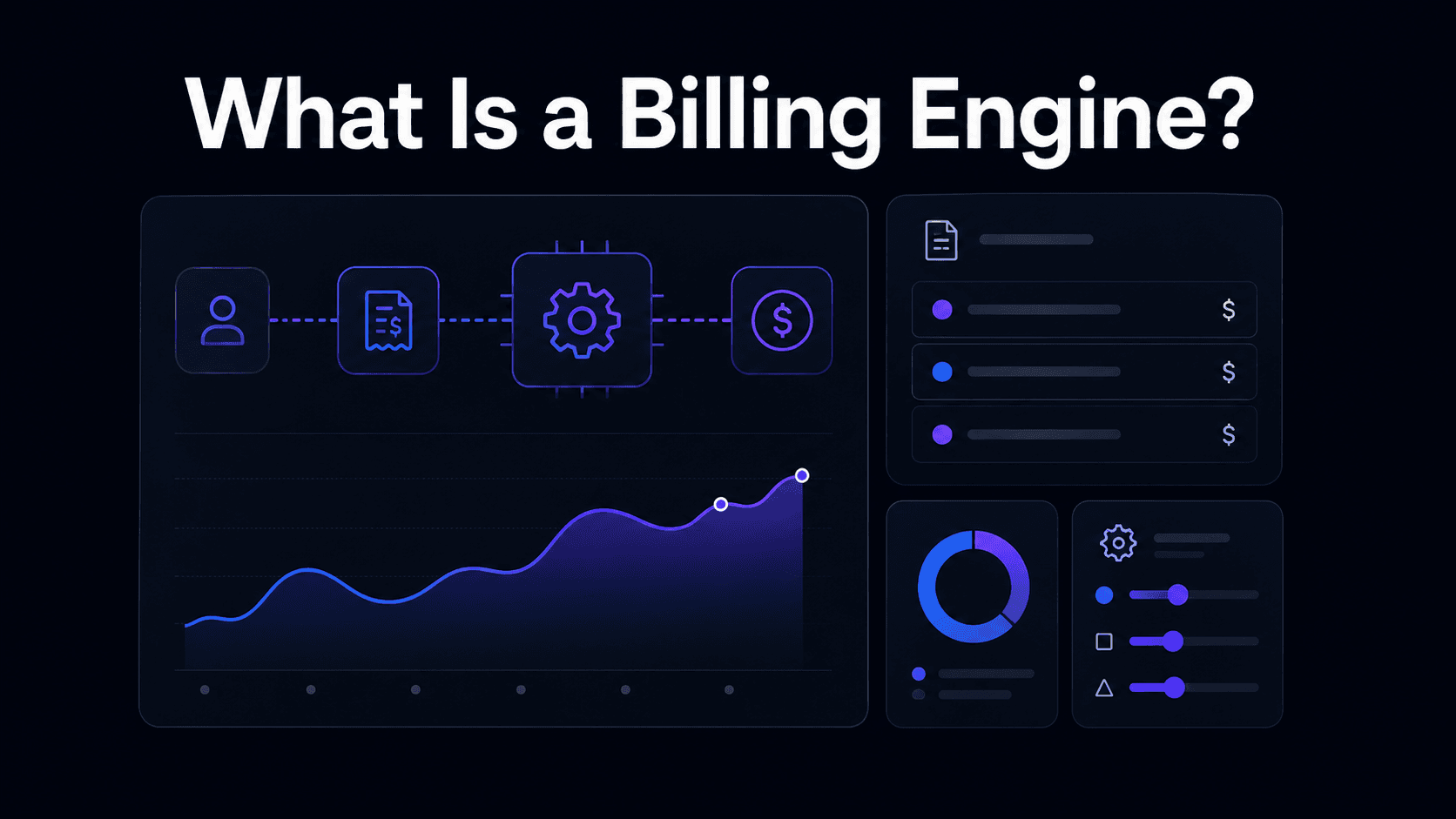
SaaS companies need billing systems that can keep up with how they sell. A basic payment processing tool may work at first. However, accepting online payments is no longer enough when pricing becomes more complex.
You might charge for seats, usage, AI credits, API calls, storage, monthly active users (MAUs), or custom contracts. You may also need to handle trials, discounts, plan changes, and subscription renewals.
A billing engine is the system that calculates what each customer owes based on pricing rules, actual usage, and contract terms. It automatically generates invoices and integrates with payment gateways to collect payments.
This guide explains what a billing engine is, how it benefits SaaS businesses, and how teams can use it in daily billing processes.
TL;DR
- A billing engine calculates what a customer owes by applying pricing rules to usage, plans, and account terms.
- It can reduce billing errors, support different pricing models, scale billing operations, simplify quote-to-cash processes, improve cash flow, reduce churn, and give teams financial insights.
- Common use cases include usage-based billing, hybrid pricing, subscription management, revenue recognition, discount management, enterprise contract handling, global billing, and failed payment recovery.
- Schematic helps modern SaaS and AI companies ship any pricing model without rebuilding their billing stack. It acts as the system of record for plans, limits, entitlements, add-ons, trials, and custom rules.
What Is a Billing Engine?
A billing engine is the key component of a SaaS billing system that calculates customer charges. It takes pricing rules, plan details, usage data, discounts, taxes, and contract terms, then turns them into billable amounts.
Let's say a customer used a discount coupon to upgrade to a Pro plan ($50/month), which includes 200 prepaid credits. When the customer consumes more than their plan's credit limit, the billing engine charges a recurring fee ($50 minus the discount) for the subscription plan plus credit overages.
In SaaS companies, the billing engine is an important part of the billing infrastructure. It sits between the product (which generates usage events) and the payment processor. It ensures that customers receive timely invoices for the correct amount based on what they actually consumed.
Key Benefits of Using a SaaS Billing Engine
Below are the advantages that SaaS companies can expect from billing engines.
1. Automate Recurring Billing and Reduce Human Errors
A SaaS billing engine replaces manual processes with rule-based billing logic. It can calculate recurring fees, usage charges, taxes, discounts, and plan changes without relying on spreadsheets.
Finance teams don't need to create invoices at the end of each billing period. The billing software engine automatically does the calculations and generates invoices.
This helps reduce manual data entry, which is one of the most common causes of invoicing errors. It also improves operational efficiency by lowering administrative overhead.
2. Support Different Pricing Models
Fast-growing SaaS companies often need to test new pricing and packaging strategies.
A billing engine makes that easier by letting you establish pricing rules once without rebuilding the entire billing infrastructure. It can support flat-rate subscriptions, usage-based billing, hybrid pricing, and other complex models.
You can confidently sell plans with multiple tiers, limits, overages, minimum spend, and enterprise contract terms. The billing engine reduces the need for custom billing work every time you launch a new SaaS pricing model.
3. Scale Billing Operations Efficiently
Billing gets harder as your SaaS company scales. More customers, plans, products, currencies, and contracts can create more work for your team.
A SaaS billing engine helps you handle increasing transaction volumes as your customer base and product catalog grow.
It uses horizontal scaling to process millions of billing events, manages multiple pricing models and currencies simultaneously, and flexibly adapts to new business models in minutes rather than days.
The platform also automates the entire billing process, which eliminates the operational bottlenecks and manual errors that would otherwise slow down growth.
4. Simplify Quote-to-Cash Processes
A SaaS billing engine connects sales, pricing, billing, invoicing, and payment workflows. Instead of handling each step separately, teams can manage the entire process through an automated billing system.
It integrates with quoting and CPQ (configure, price, quote) software to pull contract terms. Then, it automatically generates invoices based on those quotes, applies the correct pricing rules and discounts, and hands them off to payment processors for collection.
This helps with financial management because revenue data is cleaner and easier to track. Finance teams spend less time fixing billing gaps after closing a deal.
5. Improve Cash Flow
A SaaS billing engine helps companies send invoices and receive payments faster, which can improve cash flow.
With automated invoicing processes, teams do not have to wait for someone to create and check each invoice manually.
The billing platform can charge customers based on the right cycle, plan, and usage data. It can also send relevant reminders, making it easier for users to pay on time.
6. Boost Customer Satisfaction and Reduce Churn
Customers want billing to be clear and easy to understand. A SaaS billing engine creates transparent invoices that clearly break down plans, usage, credits, discounts, taxes, and other services rendered.
It can also support various payment methods, which gives customers more ways to pay. This can reduce payment friction and make the billing process easier.
Many billing engines also offer a self-service portal, where customers can quickly view invoices, update payment details, and manage billing information without contacting support.
When billing is clear, customers are less likely to dispute charges. Fewer billing issues can help reduce support tickets, payment delays, and churn risk.
7. Enhance Financial Visibility
Billing engine systems provide greater visibility into financial operations. It connects pricing, usage, invoicing, payments, and revenue data in one place.
This makes it easier to track recurring revenue, payment failures, unpaid invoices, plan upgrades or downgrades, payment trends, and account changes.
A billing engine helps turn all that information into cleaner reports. These give leaders data-driven insights into current financial health and future growth.
Common Use Cases for a SaaS Billing Engine
Here are the most popular use cases for a SaaS billing engine.
Usage-Based Billing
A billing engine helps you charge customers based on what they use instead of only charging a flat fee for software access. Common usage metrics include API calls, credits, storage, seats, MAUs, data processed, or compute time.
The billing engine meters usage and converts raw data into an accurate invoice that you can immediately send to customers.
This billing tool is useful when usage changes each month. It lets you bill customers more fairly and align pricing with the product's actual value.
Hybrid Pricing
Hybrid pricing combines two or more monetization models. For example, you may charge a base subscription fee plus overage pricing for usage beyond the plan's included limit.
A SaaS billing engine helps you manage hybrid and other complex billing scenarios by applying the right rules to each part of the customer account. It can rate base fees, usage, seats, add-ons, and contract terms in one billing flow.
This boosts efficiency because you can offer flexible pricing without building one-off billing logic for every plan.
Subscription Management
A SaaS billing engine can manage the entire subscription lifecycle. This includes new signups, plan changes, upgrades, downgrades, pauses, renewals, and cancellations.
It automatically generates recurring invoices based on the customer’s plan, billing cycle, and contract terms.
This is especially important for SaaS companies with monthly, annual, or custom billing cycles. It reduces the need to track each customer's account manually.
Revenue Recognition
Many SaaS teams find revenue recognition challenging because payment does not always equate to earned revenue.
For example, a customer may pay upfront for an annual contract or prepaid credits. You should only recognize revenue once the contract is finished or when credits are consumed.
A billing engine helps you meet revenue recognition rules by linking charges to the right billing period, contract terms, usage activity, and service dates. This makes it easier to separate billed amounts from earned revenue.
It also sends billing data to financial management tools or accounting software. Finance teams can report accurate figures without manual reconciliation.
Credit, Discount, and Promotion Management
SaaS companies often use credits, discounts, and promotions to close deals or retain customers. According to Churnkey, customers accepted discounts more than any voluntary retention method. Discounts represent 53% of all accepted offers.
A billing engine can apply these special rates to customer accounts and invoices. It can manage free trials, coupons, one-time credits, and volume discounts. It can also track when a discount starts, when it ends, and how it affects the final charge.
This gives sales and finance teams a clear record of what was promised and what was billed.
Enterprise Contract and Commitment Handling
Enterprise SaaS deals usually include custom plans and terms. A customer may have a minimum spend, annual commitment, ramp pricing, or special usage limits.
A SaaS billing engine helps apply those enterprise terms to each billing cycle. It can track committed spend, usage drawdown, overages, renewals, and add-ons.
This is useful when sales teams close deals that do not match standard plans. Instead of managing every custom contract in spreadsheets, teams can set rules inside the billing system software.
Multi-Currency and Global Billing
SaaS companies selling in many countries need billing and invoicing software that can support different currencies and tax requirements.
A billing engine can bill customers in their local currency, apply the right tax rules, and send invoices. It also accepts local payment methods through direct integrations with payment collection systems.
The right software gives teams complete control over how global billing is handled, so charges stay accurate and consistent across international markets.
Automated Dunning and Failed Payment Recovery
A SaaS billing engine can recover failed payments without manual intervention. When a payment fails, the system can instantly retry the charge and update the account status.
It can also send payment reminders before and after a due date. This reduces late payments and gives customers a chance to fix expired cards or failed payment methods.
Many billing tools also include dunning workflows to help SaaS companies protect recurring revenue and prevent involuntary churn.
Schematic Supports Modern SaaS Billing
Billing often starts with simple subscriptions for small businesses. Still, as your company grows and the product matures, you may deal with usage-based pricing, self-serve plans, and sales-led deals.
Schematic is the monetization operating system for modern SaaS and AI companies. It lets you ship any pricing model without rebuilding your billing stack.
With Schematic, you define and create plans, limits, software entitlements, credits, add-ons, trials, and exceptions in one place. You can connect billing data to product access, support hybrid selling, and give go-to-market teams more control over pricing.
Schematic is built on Stripe, so you can continue using Stripe for invoices, recurring payments, and taxes. Schematic extends Stripe Billing with real-time entitlement checks, usage limit enforcement, and customer lifecycle management.
Engineering only writes two calls instead of two hundred lines. Business teams can continuously iterate on monetization.
FAQs About What Is a Billing Engine
What are the three types of billing?
The three common types of billing are subscription billing, usage-based billing, and one-time billing. Subscription billing repeatedly charges customers on a fixed cycle. Usage-based billing charges for actual consumption. One-time billing charges for a single product, service, or setup fee.
What is the software used for billing?
SaaS companies use automated billing software to bill customers for software access or usage. This platform can automatically meter usage, calculate charges, create invoices, process payments, apply taxes, and keep billing data in one place.
How does the billing system work?
A billing system collects pricing, contract, and usage data. Then, it applies pricing rules to calculate the right charges. It can generate invoices, send them to customers, process payments, and update financial records with less manual work.
What are the key features of billing software?
The key features of billing software are invoice automation, payment processing, multi-currency handling, dunning management, a metering engine, and subscription management. Most billing platforms also offer native integrations with customer relationship management (CRM) systems, payment gateways, data warehouses, and analytics tools.