 Ryan Echternacht
Billing for AI products isn't the same as charging for software access. Instead of using subscription pricing, companies now bill customers for tokens, API calls, compute, or credits. A Growth Unhinged report reveals that flat-fee subscriptions saw a decline from 29% to 22% in 2025.
This shift in AI monetization requires modern billing infrastructure that can support flexible pricing and hybrid selling.
Schematic vs. Lago has become a popular comparison for AI companies moving beyond static and fixed pricing. Both platforms can meter usage, bill for credits, and manage software entitlements.
However, they differ in terms of billing focus and developer experience.
Schematic emphasizes speed and frequent iteration by allowing go-to-market teams to change pricing and packaging without code. Lago is highly flexible because it's open source, but it requires significant engineering investment.
This guide breaks down the key differences between Schematic and Lago to help you decide which one fits your billing needs.
TL;DR
- Both Schematic and Lago are usage billing platforms for companies selling AI products, but Schematic supports faster pricing changes and real-time access decisions.
- Schematic provides a complete usage billing solution hosted in the cloud. It unifies metering, billing, software entitlements, limit enforcement, and customer spend controls to address customer trust structurally.
- Lago is an open-source billing system that can be deployed on-premises or in a private cloud. It includes built-in tools for invoicing, metering, quote-to-cash, and revenue recognition.
- Schematic is the better choice for software and AI companies that want to close enterprise deals faster, iterate on pricing, and solve the trust problem in usage-based billing.
Schematic vs. Lago: What's the Main Difference?
Schematic provides the complete usage billing platform for software and AI companies that sell usage-based plans to enterprises.
It can track customer consumption, bill on credits, evaluate entitlements inside the product at runtime, enforce limits, and give customers self-service controls.
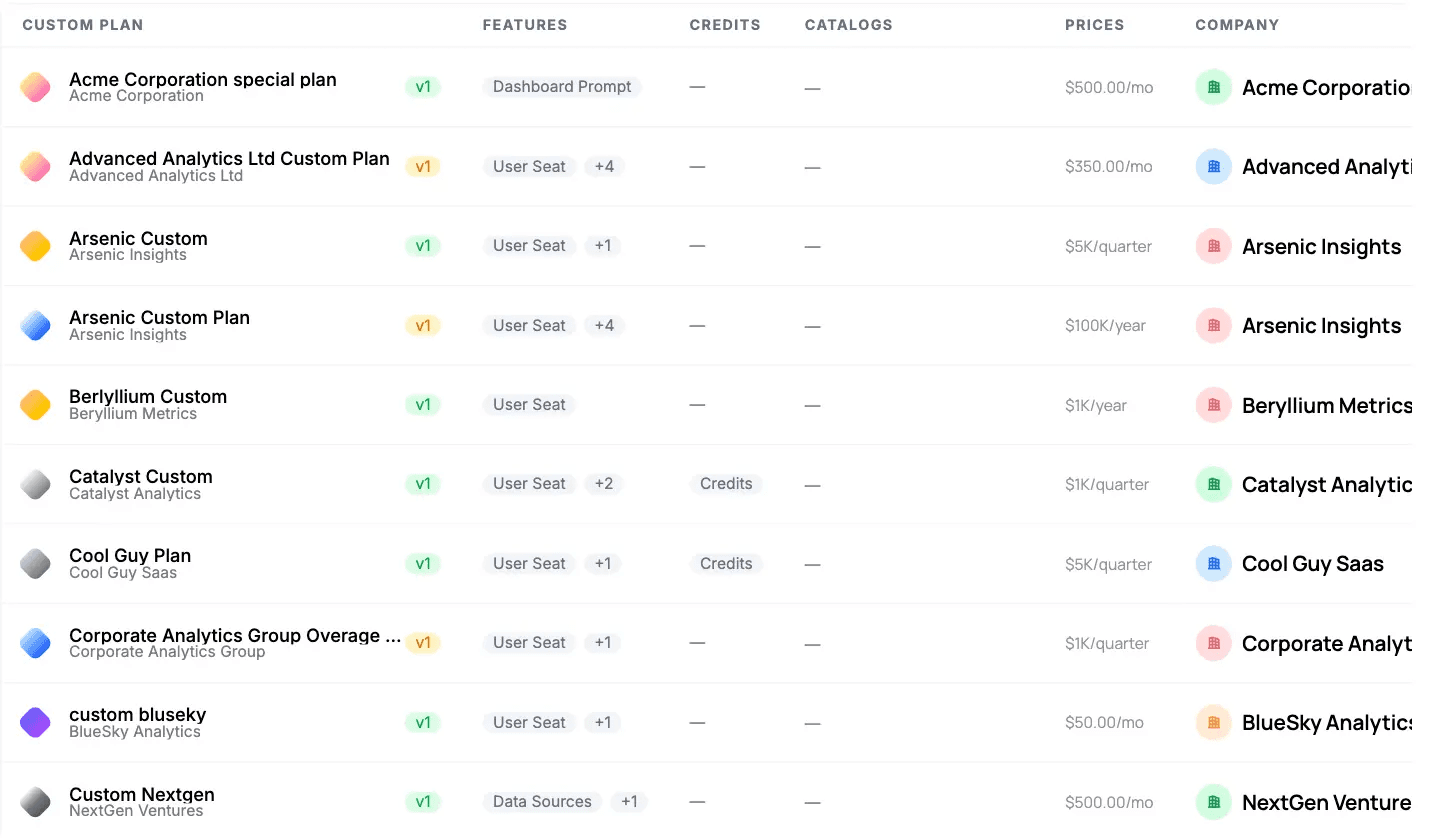
Schematic also supports sales-led, self-serve, and hybrid selling motions. Product managers and revenue operations (RevOps) teams can create custom plans, set contract terms, and grant credits. Meanwhile, customers get full visibility and control over their consumption.
Lago is another usage billing software for AI products. It can record usage events, support hybrid pricing models, and generate accurate invoices.
Finance teams gain clarity on how consumption affects revenue. Engineering can use usage data to power AI metering and billing.
The main difference between Schematic and Lago is how they balance speed and deployment.
Lago is an open-source platform that provides more control over where and how the billing system runs. The downside is the extensive engineering investment required.
Schematic runs as a cloud-hosted billing engine that communicates with your application via the API and monetization SDK. It's less flexible compared to Lago, but it offers a faster setup. Commercial teams, not engineering, own pricing decisions.
Schematic Core Features and Advantages
Schematic is the only usage billing system that addresses customer trust.
Enterprise credit wallets show buyers exactly what they use in real time so they can predict their bills and avoid surprises.
Runtime software entitlements make sure that limits are enforced the moment the customer reaches a cap. This prevents unexpected access throttling and protects the company's gross margins.
Schematic offers the following features:
- Robust credit wallets: Record every credit grant, auto top-up, rollover, and burn-down that your finance team can reconcile.
- Runtime entitlement engine: One call returns an allow or deny access decision before a paid feature runs. The same call works in React, Node, Python, and Go.
- Support for multiple pricing models: Implement pay-as-you-go, seat-based pricing, credit burndown, hybrid models, and other custom pricing models in one engine.
- Self-service cost controls: Customers can set usage caps or spending limits and forecast their bill.
- ASC 606-compliant revenue recognition: An append-only credit ledger meets ASC 606 compliance.
- Schematic MCP: Connect AI agents to read billing context in Schematic. Then, use a single prompt to check usage or find customers near limits.
Max Ade from Pickleheads shares, "The Schematic MCP is fantastic, and we now do most of our work in Claude, accessing plan and billing information directly without leaving our workflow."
Lago Core Features and Advantages
Lago is known for its open-source usage billing platform.
Engineering has complete control over where to host the company's billing infrastructure. They can deploy it on their own servers or use the cloud-based solution managed by Lago.
Lago also provides the necessary billing tools to help AI companies charge customers for usage.
Here is a breakdown of Lago's functions.
- Real-time metering: Lago collects usage events from the product. Teams define them as billable metrics and charge customers for AI credits, tokens, API requests, or compute hours.
- Billing automation: Automatically calculate charges and translate them into accurate invoices.
- AI-powered pricing assistant: Use the Lago AI to manage billing, create reports, and test pricing strategies before launching them.
- Flexible cash collection: Connect Lago to payment solutions to collect cash faster. Automated dunning workflows send payment reminders and retry failed payments.
- Open-source code: Teams have the ability to deploy Lago on their own infrastructure or use its cloud-based solution.
- Quote-to-cash management: Turn approved quotes into order forms and billing setup without re-entering deal terms.
Schematic vs. Lago: A Detailed Comparison Breakdown
Below are the key differences between Schematic and Lago.
Usage Metering
Both Schematic and Lago can meter product usage for software and AI billing.
Schematic records usage events, such as token consumption, API requests, agent runs, or other product actions. That same event stream can feed SaaS entitlements, invoices, and revenue reporting without double counting.
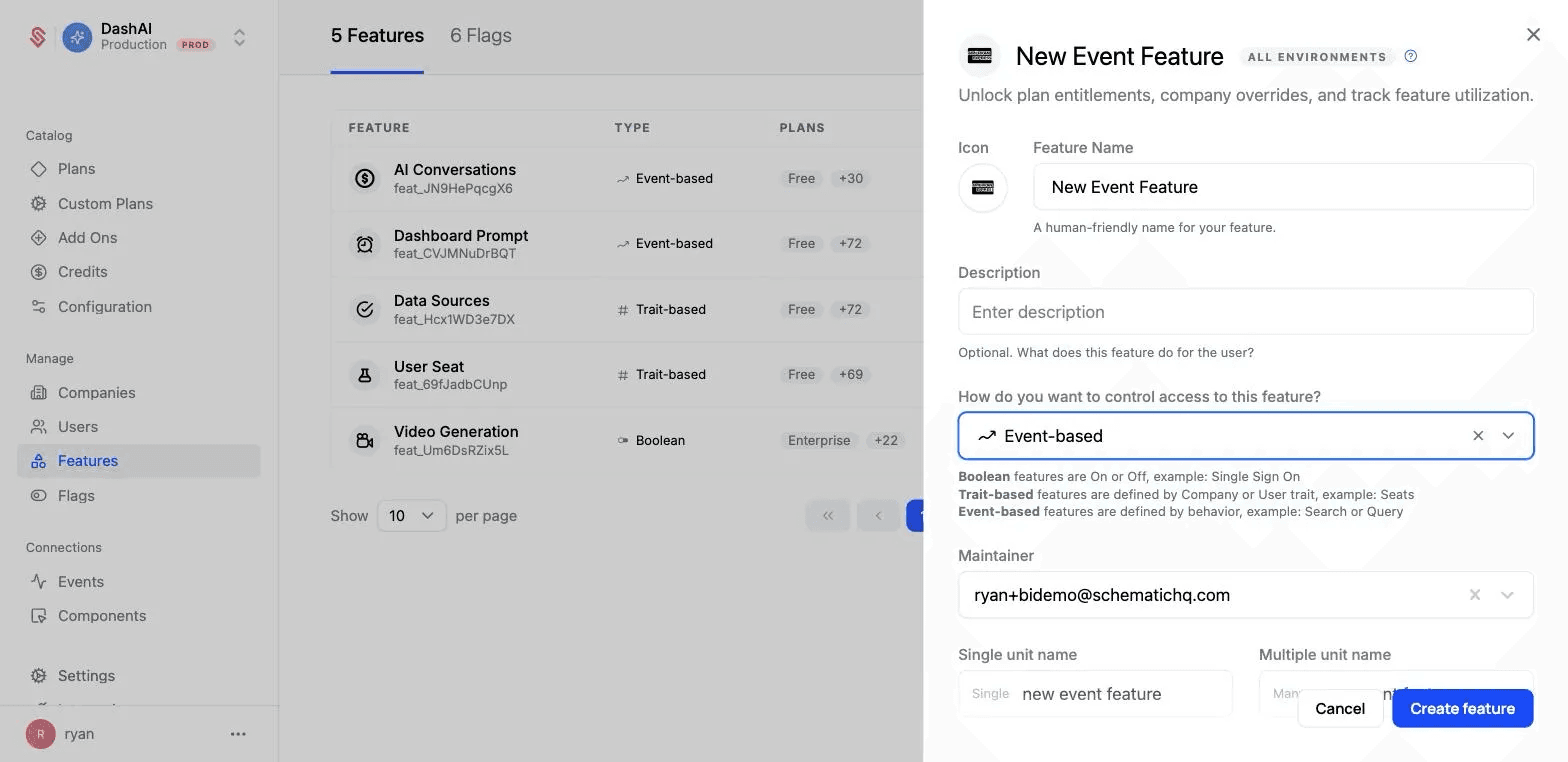
To meter usage inside Schematic, you first need to create an event-based feature. Then, you can decide how much usage a plan includes.
After that quick setup, the application will automatically report the event. Schematic will receive it, complete with a last seen timestamp for each company's record. This data becomes a useful health signal because a paying account that has gone quiet is worth looking into.
Lago also ingests raw usage events and turns them into billable charges. It can meter credits, tokens, compute hours, API calls, outcomes, or any consumption metric.
Teams can then tailor terms with overrides. Examples include usage budgets, subscription fees, plan currency, trial pricing duration, and the minimum spending amount, among others.
The key difference is what happens after usage is recorded. Schematic connects metering directly to entitlement checks and customer-facing tools. On the other hand, Lago provides strong metering and billing data, but access control is configured separately.
Billing and Invoicing
Schematic serves as the complete usage billing engine for companies selling to enterprises. It integrates bi-directionally with the Stripe app, which handles much of the invoicing workflow.
Schematic takes care of usage metering, customer-facing wallets, credit management, custom plan configuration, limit enforcement, and provisioning.
In other words, Schematic orchestrates billing logic and usage data, while Stripe generates and delivers the actual invoices to customers. The two-way sync between both systems means no manual reconciliation is needed.
Lago handles billing calculations and invoice generation inside its own platform. It can combine recurring subscription fees, usage charges, prepaid credits, and other line items on the same invoice.
Finance teams can also apply the correct taxes natively or by connecting Lago to tax management tools like Anrok and Avalara.
Spend Controls
Schematic gives customers complete control over their consumption and spending inside the product. Enterprise credit wallets, spend forecasts, and self-service controls prevent runaway bills or unexpected throttling.
Users can set spending caps, receive alerts before usage stops, purchase credit bundles, change top-up amounts, and define what happens at the limit.
Schematic enforces hard limits or soft caps depending on the policy saved by your customer or your team.
Buyers and sellers gain confidence that usage will stay within budget and that customers will only be charged for what they expect.
Rahul Gill from Macabacus shares, "Schematic's ability to offer usage caps, bundles, and top-ups gave our customers the cost predictability they need."
Lago offers prepaid wallets, proactive usage alerts, auto credit top-ups, and configurable budgets for each AI agent.
Customers can review how much usage or credits they have left without waiting for the invoice at the end of the billing period. Finance teams instantly know every balance before buyers even ask.
The only downside is that Lago doesn't enforce limits at runtime. Schematic is the better choice for companies that want to solve the challenges and trust problems in usage-based billing.
Software Entitlements
Schematic stands out for its real-time entitlement engine. This lets you control how product features are monetized and accessed by end users.
Your customers or your team can set usage caps per company or per user. Schematic enforces those policies as soon as they are saved without filing a support ticket.
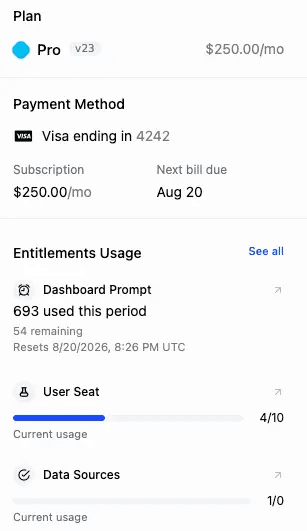
One flag check can gate features and return access decisions from the same ledger that bills customers.
Then, every check and metered event streams back in milliseconds. Credit balances, limits, and usage remain current everywhere your product reads them.
Lago also has a native entitlement management system. Teams can attach features and usage allowances to plans, restrict access based on payment status, grant overrides for enterprise customers, and retrieve current entitlements through the API.
By combining billing and feature flags in one place, Lago enables companies to iterate on pricing and packaging.
The main difference between the two platforms is runtime enforcement. Lago offers the entitlement model, but engineering still has to build the enforcement logic. Schematic has the advantage because it evaluates entitlements and access inside the app the moment a request is submitted.
Payment Processing
Schematic is mainly a usage billing platform instead of a payment solution. The platform itself does not process payments.
To collect cash and get paid, companies need to connect Schematic to Stripe. The Stripe App will handle payment processing and tax management.
Schematic extends Stripe’s capabilities by providing one engine for metering, price modeling, credit management, entitlements, and customer self-service controls.
Lago also does not process payments on its own. Instead, it integrates with any payment gateway or payment service provider (PSP).
Lago is provider-agnostic compared to Schematic. It connects to Stripe, Adyen, GoCardless, MoneyHash, and other tools via webhooks.
It works by calculating charges and creating invoices before sending the billing data to the connected provider. The PSP will collect global payments across different regions and countries.
Revenue Recognition
Schematic supports compliant revenue recognition through its append-only ledger.
It records every credit grant, burn-down, rollover, automatic top-up, and expiry complete with price and timestamp details. This helps finance teams apply ASC 606 or IFRS 15 treatment to credit-based pricing.
It's important to note that Schematic does not post journal entries, create deferred revenue schedules, or decide accounting policies. Those steps stay in your company’s accounting or revenue recognition system.
Schematic offers the precise, granular measurement data to help you recognize revenue under ASC 606 or IFRS 15 rules.
Lago takes a different approach. It can produce recognized and deferred revenue reports, revenue waterfalls, financial statements, and journal entries directly from billing data.
For finance teams that want revenue recognition inside the billing platform, Lago has built-in accounting support.
Schematic suits companies that want detailed usage and credit records while keeping accounting treatment in their existing finance stack.
System Integrations
Schematic integrates with Stripe for payment processing, customer relationship management (CRM) software for syncing usage and customer data, and identity providers for company profiles.
It also offers webhooks that notify the system when data changes or once a customer reaches a usage threshold. This is how engineers build most Slack alerts, CRM updates, and AI-assisted workflows.
Lago offers more out-of-the-box integration options. Examples include:
- AI gateways
- Payment solutions
- Accounting software
- Tax management tools
- Data warehouses
- Marketplaces
Stripe connection is just one of the choices for payment processing. Teams can collect global payments through Adyen, GoCardless, and MoneyHash without vendor lock-in.
Deployment Model and Developer Experience
Schematic offers a managed cloud billing engine that runs in the browser and your backend. Applications connect using the Schematic API and SDK. This reduces the infrastructure development work required from engineering teams.
Schematic also includes the Replicator. This container keeps flag, company, and user data in a Redis instance you host inside your infrastructure. It allows local flag evaluation even when the main Schematic API is unavailable to ensure long-term stability.
Lago provides more flexible deployment options. Teams can run the open-source billing software in a virtual private cloud (VPC) in their own infrastructure to maintain full control. Alternatively, they can use Lago's cloud-based version for faster setup.
Lago suits companies with deep engineering resources that need open-source flexibility and modular services. Schematic favors a managed setup that is optimized for speed and pricing iteration.
Pricing Plans
Schematic gives companies the freedom to choose from three different plans, each with unique features and limits.
- Starter (Free): Offers access to the whole platform plus 2 company overrides, 10 subscriptions, 500k monthly events, and unlimited flags, companies, components, and features.
- Growth ($400/month): Adds 20 overrides, unlimited subscriptions, 10m monthly events, data exports, and a 30-day audit log retention.
- Enterprise (Custom pricing): Includes all the features in Growth plus unlimited overrides, events, role-based access control, service level agreements, and premium support from a dedicated billing engineer.
Lago offers a free open-source version that companies can self-host under its AGPLv3 license. It also includes Lago Premium, which caters to those who want to run it as a managed cloud service.
However, the pricing of Lago Premium isn't publicly available. This prevents teams from comparing costs against other competitors, which can lead to lost deals.
How to Choose Between Schematic and Lago
Choosing between Schematic and Lago mainly comes down to what you prioritize.
Schematic is a better fit if you want to ship pricing and packaging changes while giving customers real-time visibility into their usage. Lago makes more sense if infrastructure ownership and broader finance integrations are higher priorities.
The choice also varies based on the systems already present in your revenue stack and how much technical depth your team wants to manage.
Use Schematic when you need to:
- Update pricing and packaging through configuration and without complex code deployments.
- Measure product usage and enforce limits at runtime.
- Give customers clear usage, credit, and spend visibility.
- Support credit-based and hybrid pricing for SaaS and AI products.
- Go to market using self-serve, sales-led, or a hybrid motion.
- Reduce engineering work when launching and testing new monetization models.
Consider Lago if you want to:
- Run billing infrastructure on your premises, in a VPC, or anywhere.
- Connect several payment providers instead of relying mainly on Stripe.
- Support deeper tax and finance integrations.
- Gain more control over invoicing and billing workflows.
- Recognize revenue correctly
- Use AI billing intelligence to automate repetitive tasks and minimize human errors.
Schematic Solves the Trust Problem in Usage-Based Pricing
Schematic is the best usage-based billing platform for AI and software companies selling to enterprises. Built-in credit wallets and the runtime entitlement engine solve the trust problem in usage-based billing.
Native wallets give customers real-time visibility into what they are using, forecasts of where they will land, and spending limits they set themselves. Buyers no longer fear surprise bills or unexpected access throttling, making it easier to trust usage-based pricing.
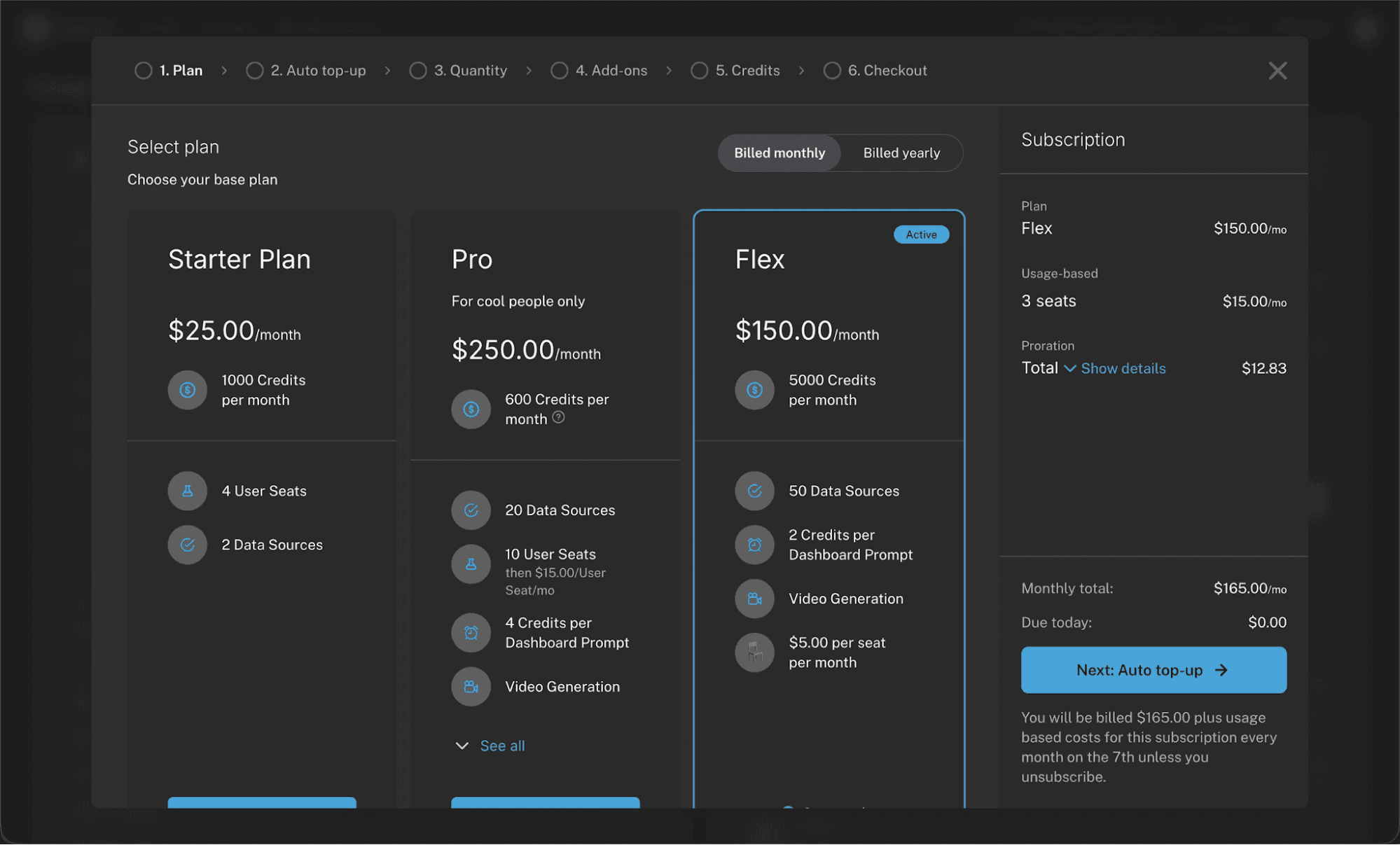
Customers can also use the self-serve checkout page to select plan variation, add seats, enable auto top-ups, purchase add-ons, and buy credit bundles.
Schematic's entitlement engine enforces limits inside your product at runtime.
Your app does not need to know each customer’s billing state. One entitlement check can return allow or deny, while the same ledger used for billing can keep usage, credits, and limits current everywhere the product reads them.
Engineering no longer builds the entitlement infrastructure. Commercial teams can frequently iterate on monetization since pricing lives as data on a real-time ledger. A plan change becomes a config change without code deployment.
Zach Hawtof from Titanet says, "Schematic lets us set customers up on our product, including enterprise customers, substantially faster than we ever would have without the system."
FAQs About Schematic vs. Lago
Which is the better usage billing software: Schematic or Lago?
Schematic is better for companies that want billing, metering, credit wallets, entitlements, and runtime enforcement in one system. Lago is also capable, but it only suits teams that value open-source code and flexible deployment. Schematic is a cloud-hosted solution, making it easier for engineering to set up and for commercial teams to iterate on monetization.
How do Schematic and Lago improve customer satisfaction?
Both platforms help customers understand usage-based fees before unexpected charges occur. Schematic adds live usage views, configurable spending limits, and spend prediction tools. Lago provides usage data, invoices, credits, and alerts at set intervals to help customers observe spending.
Why should you choose Schematic over Lago?
Choose Schematic if you want to launch pricing changes faster and connect billing directly to product access. Native credit wallets, entitlement checks, spend controls, customer-facing components, and robust integrations help SaaS and AI companies manage usage billing without hardcoding pricing logic.