 Ryan Echternacht
Running a subscription billing model means your SaaS company has to manage more than just recurring revenue streams. You also need to handle subscription plan changes, renewals, invoice generation, payment processing, customer records, and billing data.
Doing all of these tasks in spreadsheets can slow down your team and lead to billing errors. Many SaaS businesses have switched to modern subscription management platforms to streamline operations.
The best subscription software can automate billing processes, support different pricing models, improve revenue reporting, and prevent existing customers from churning before it's too late.
This guide lists the top eight SaaS subscription management software options and their key features.
TL;DR
These are the best subscription management software for SaaS businesses:
- Chargebee
- Recurly
- Maxio
- Zenskar
- Zuora
- Paddle
- Zoho Billing
8 Best SaaS Subscription Management Software to Use
Below, we'll review the best subscription management solutions that help SaaS companies handle subscription billing.
1. Schematic
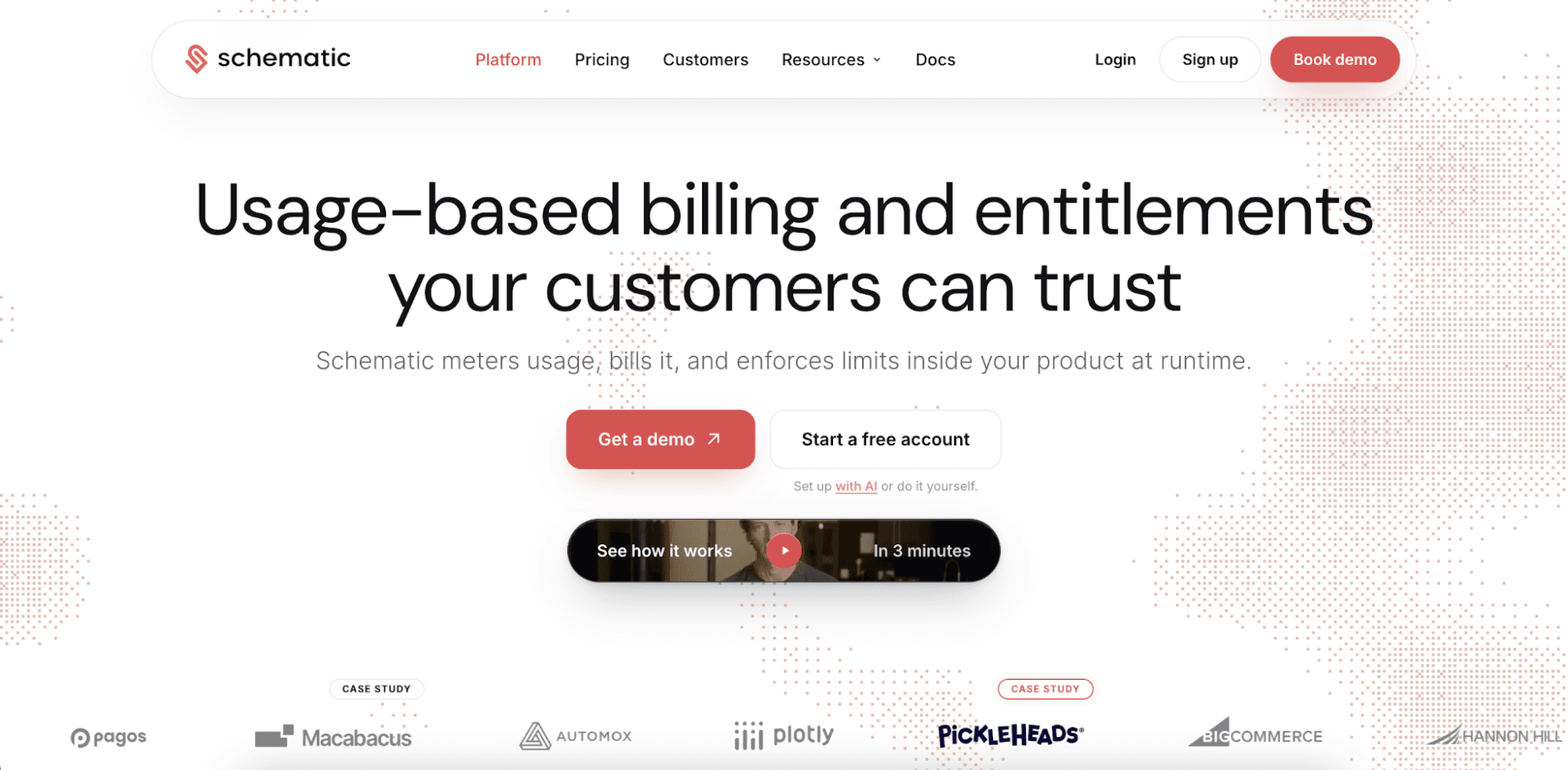
Schematic is the best subscription management platform for software companies selling to enterprise customers.
It's the only subscription billing software that combines runtime software entitlements, billing, and usage metering.
SaaS teams can model any pricing model, including seats, pay-as-you-go, credit burndown, and hybrid plans that combine subscription billing and usage-based billing.
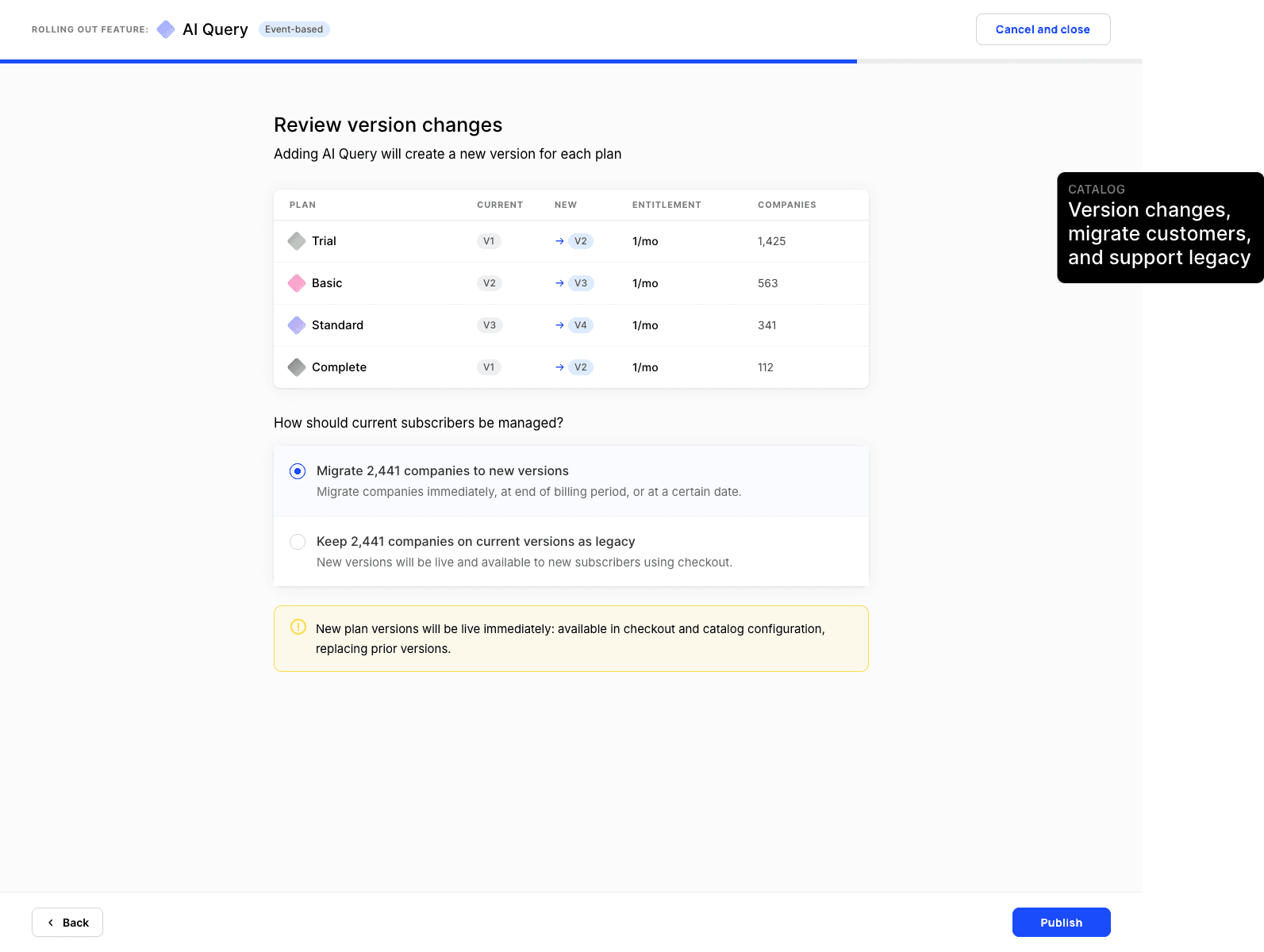
Version plans, preview models before shipping, migrate existing customers to another plan, and change pricing or packaging through configuration instead of code.
Max Ade, the co-founder and CEO of Pickleheads, shares, "Schematic lets us change plans in one place and cascade updates to everyone, migrate customers between plans, and run pricing experiments without any manual implementation."
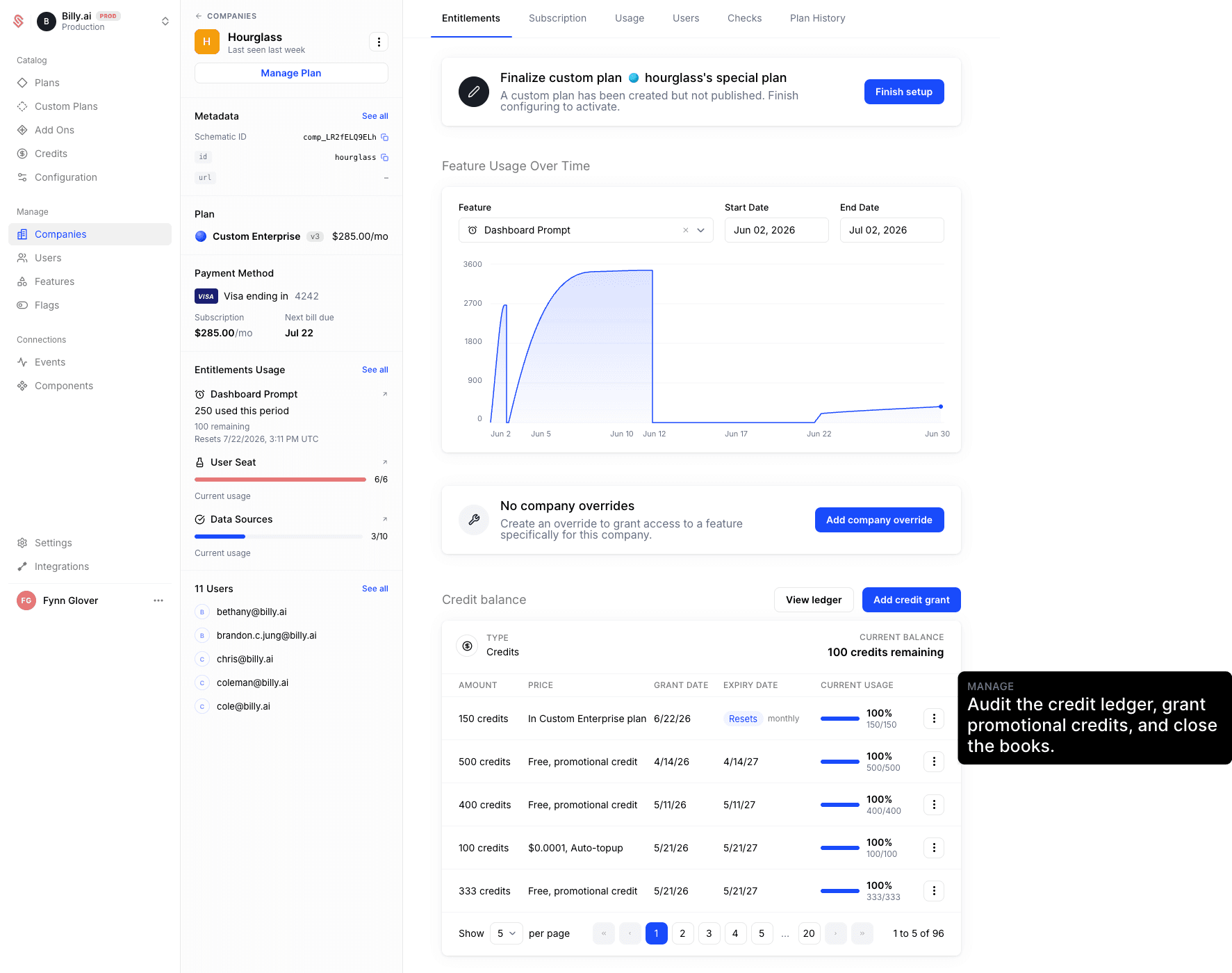
Schematic also stands out for its enterprise credit wallets. These give customers real-time visibility into usage, spend forecasts, self-service controls, and configurable spending limits to prevent runaway bills.
A real-time entitlement engine tracks usage against caps set by the customer or the company. Teams can quickly grant an exception with an expiration date for custom contracts.
Every override, credit grant, and entitlement check is stored in an auditable ledger. This ledger is export-ready and compliant with revenue recognition standards like ASC 606.
Key Features
- Customer lifecycle management: Run the entire subscriber lifecycle, from first checkout to plan renewal. and expansion, in one billing engine.
- Real-time ledger: Store pricing logic as data so that you can update plans through configuration instead of code.
- Subscription and usage billing: Support pure usage billing or hybrid pricing models that combine recurring software subscription fees and usage-based charges.
- Native credit wallets: Show customers exactly what they use and owe in real time to prevent billing disputes.
- Self-service controls: Give buyers the ability to set per-seat or per-agent usage caps, change automatic top-up rules, and define what happens when they reach limits.
- Runtime entitlements: Use a single flag check to gate features, answer access questions, and enforce limits inside the product.
- Plan versioning and customer migration: Version changes and move customers between plans without filing an engineering ticket.
- Credit configuration: Set credit grants, rollovers, expiry windows, self-serve top-ups, budgets, and priority consumption rules.
- AI and agent access: Connect any AI agent to read billing data from Schematic to identify churn risks, meter usage, and grant credits in one flow.
- ASC 606 revenue recognition: Track credit-based revenue recognition through an append-only ledger that is ready for export.
2. Chargebee
Source: Chargebee.com
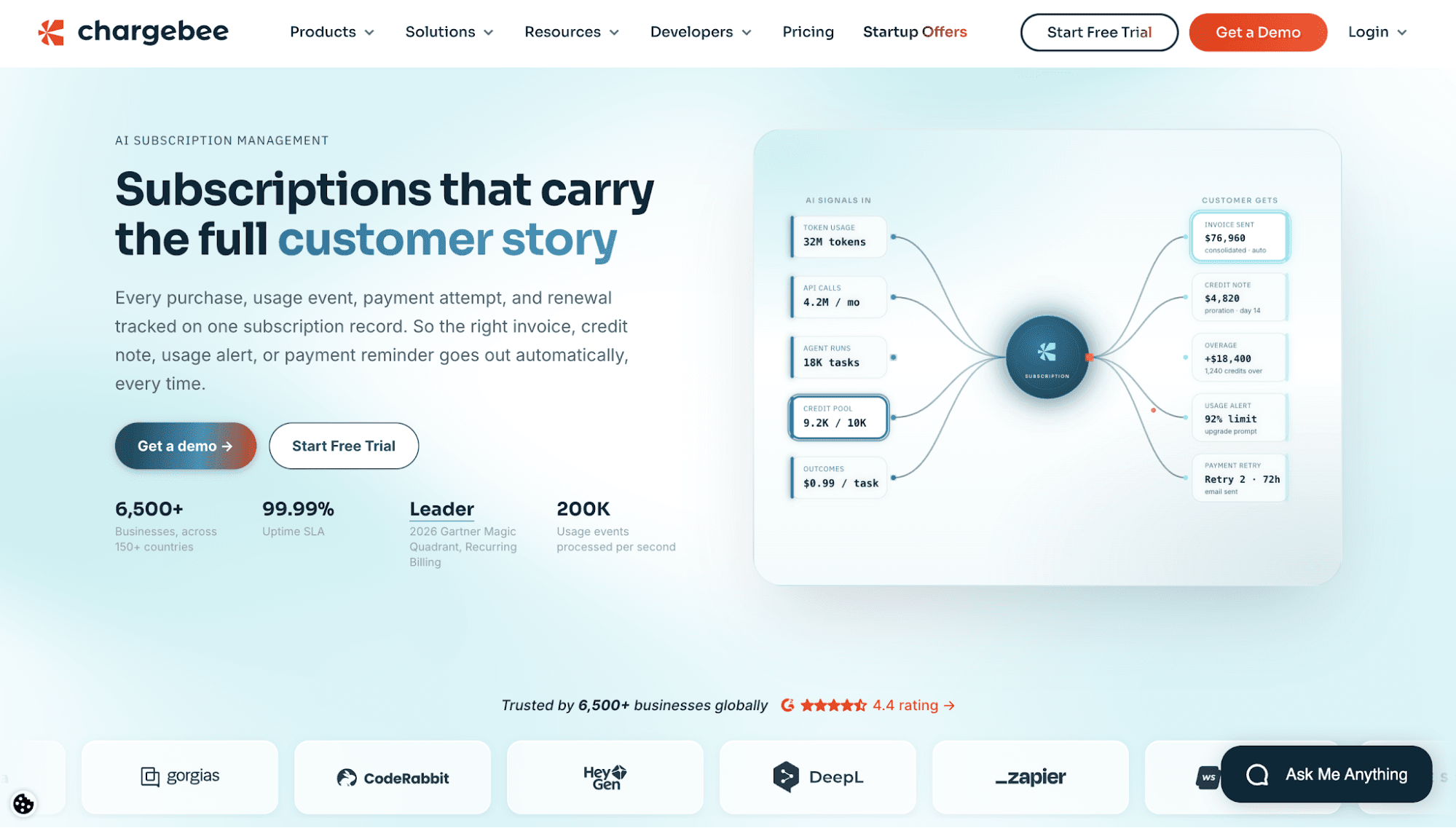
Chargebee provides a subscription management system for SaaS companies that sell flat-rate, seat-based, usage-based, tiered, or custom pricing models.
Teams can launch subscription plans, test packaging, change price points, and publish new offers from one dashboard without changing application code.
The platform automates subscription changes, such as upgrades, downgrades, proration, and renewals. It generates accurate invoices without manual intervention.
Chargebee also supports multiple payment methods and currencies by connecting to more than 40 payment gateways.
If a recurring payment fails, the subscription management software provides configurable dunning sequences and smart retry logic to recover lost revenue.
Chargebee even includes a self-service portal where customers can manage subscriptions, update payment details, and pause software subscriptions.
Key Features
- Built-in plan builder: Create and publish flat-rate subscriptions, usage-based, tiered, and hybrid pricing models without code.
- Automated subscriber lifecycle: Automate plan upgrades, downgrades, prorations, renewals, and other mid-cycle changes.
- Payment gateway integration: Customers pay using their preferred payment method and currency.
- Dunning and payment recovery: Use smart retries and configurable dunning to recover subscription revenue from failed payments.
- Self-service portal: Let buyers update payments, change plans, and pause subscriptions without contacting support teams.
3. Recurly
Source: Recurly.com
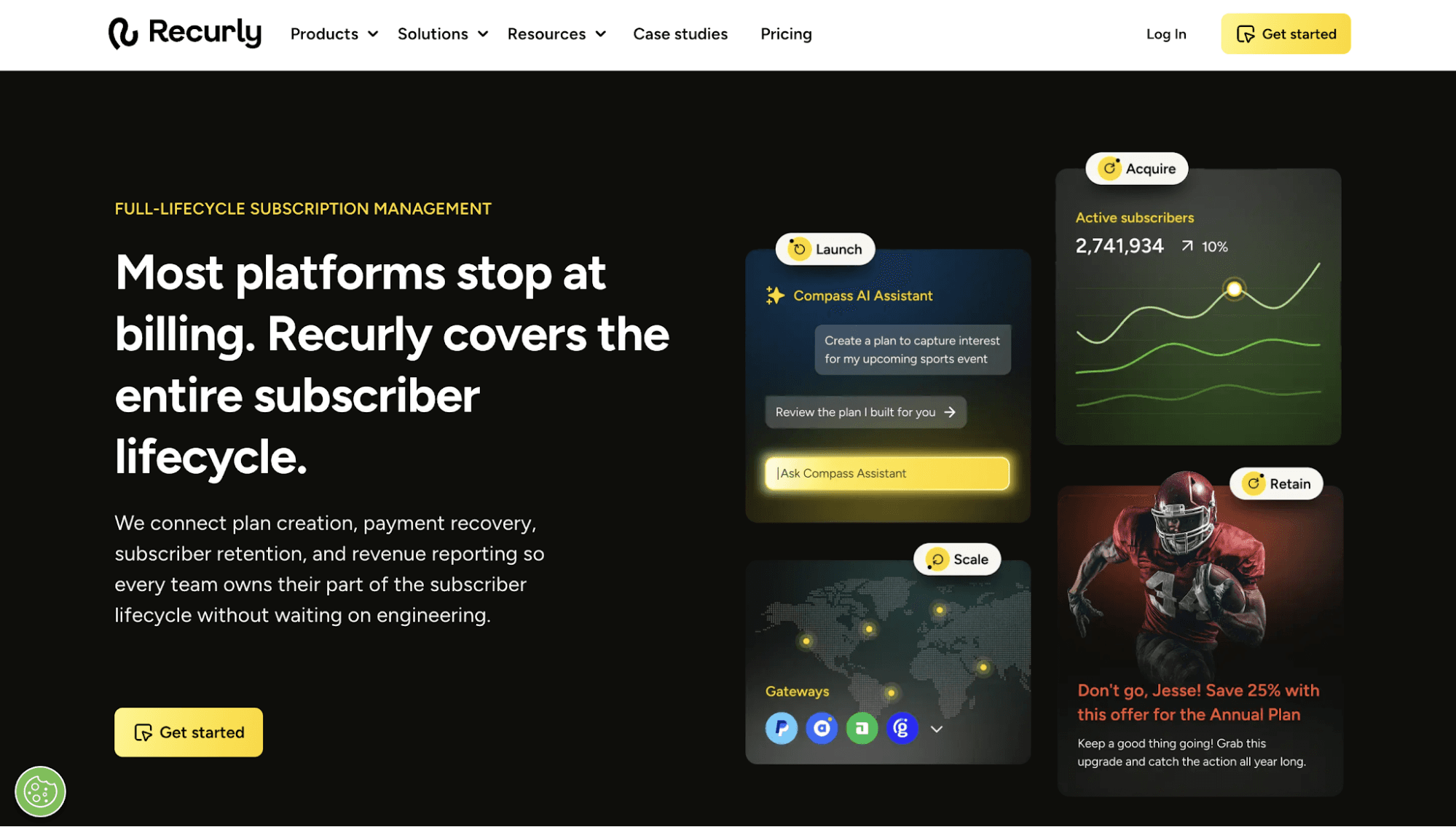
Recurly is an end-to-end subscription management platform. It covers subscriber management, recurring billing, payment tracking, churn management, financial reporting, and revenue recognition automation.
SaaS companies can launch any subscription plan, pricing model, trials, or promotional offers. Automated billing workflows streamline operations and support global tax compliance rules.
Recurly also gives teams a complete view into key financial metrics and customer subscriptions. Handle subscription changes, engage existing customers at every subscriber lifecycle stage, and make smarter pricing strategies.
Global payments orchestration is another key strength of the SaaS subscription management platform. It supports a multi-gateway setup with fraud management and localized payment processing.
Plus, Recurly uses AI agents to surface revenue insights, configure platform settings, and run workflows using live subscription data.
Key Features
- Recurring billing system: Automate recurring payments, change pricing, adjust credits, and manage global tax compliance in one platform.
- Subscriber management: Gain a complete view of all subscriptions and modify pricing plans by subscriber.
- Global payments orchestration: Choose from different payment solutions that accept multiple currencies and payment methods.
- Churn management: Use configurable dunning and machine learning retry logic to recover failed payments.
- Revenue reporting and recognition: Track important financial metrics and export audit-ready reports while meeting ASC 606 and IFRS 15 rules.
4. Maxio
Source: Maxio.com
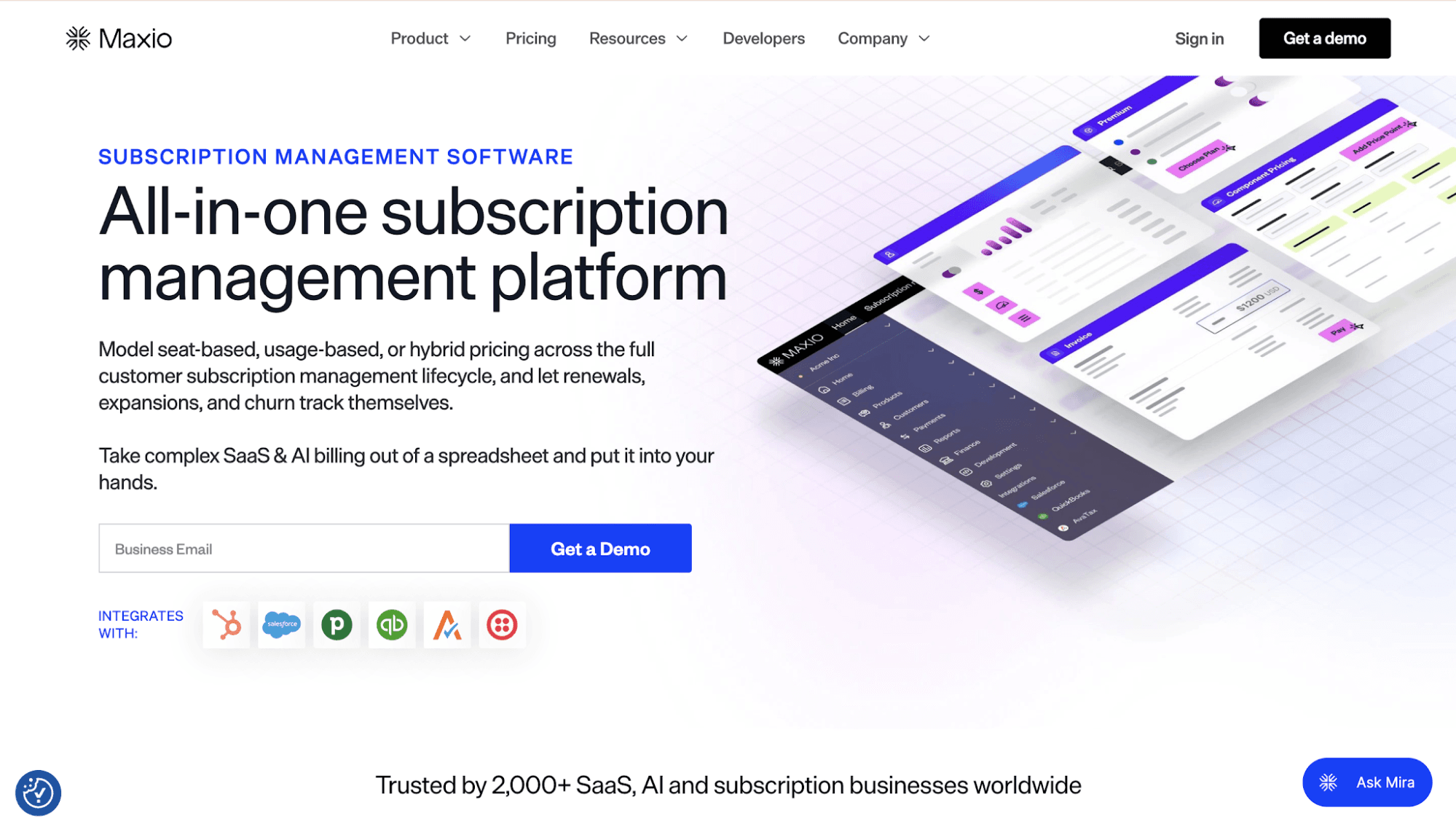
Maxio gives B2B SaaS and AI companies an all-in-one subscription management platform for recurring billing, payments, renewals, and financial reporting.
The built-in product catalog supports complex pricing models. Teams create individual contracts, custom plans, and unique pricing rates for each subscriber without developer work.
SaaS companies can also charge based on consumption, such as API calls, tokens, or AI credits. Maxio automates usage tracking and rating to implement usage-based pricing alongside seat-based or hybrid pricing.
The subscription software can also generate accurate invoices and collect payments by credit card, ACH, or direct debit in more than 150 currencies.
Renewal workflows alert teams before contracts expire, while customizable dunning and reminder emails help reduce involuntary churn.
Key Features
- Support for complex pricing models: Build custom contracts and plans using seat-based, usage-based, hybrid, or other pricing models.
- Automated recurring billing and invoicing: Generate recurring invoices and manage subscription billing with less manual work.
- Payment processing: Accept credit cards, ACH, and direct debit payments in more than 150 currencies.
- Real-time dashboards and analytics: Track revenue, subscriptions, and customer behavior through live dashboards.
- Self-service portal: Let customers manage subscriptions, upgrade, downgrade, cancel, and choose from different payment methods.
5. Zenskar
Source: Zenskar.com
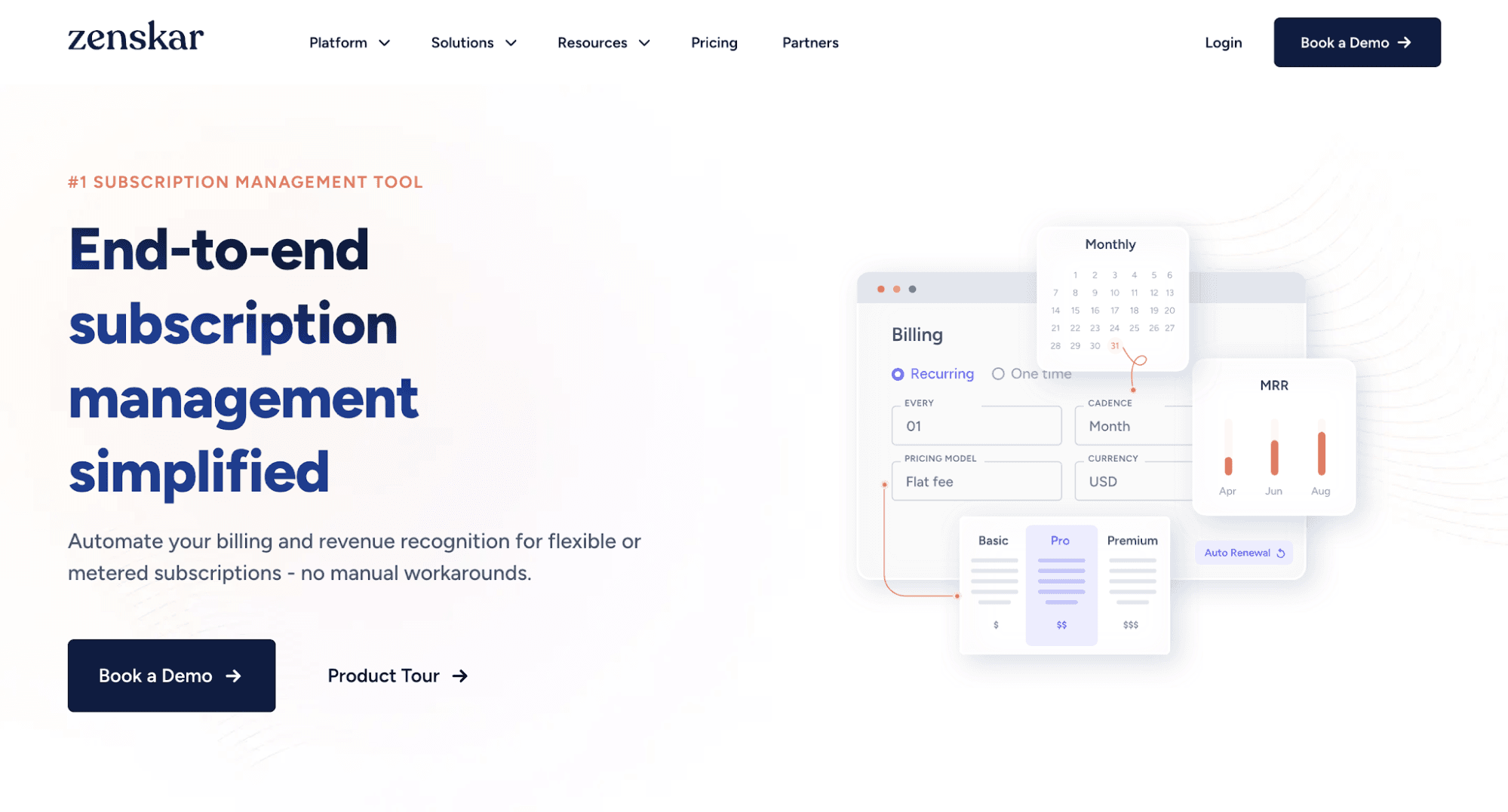
Zenskar simplifies subscription management by automating recurring billing and revenue recognition.
SaaS businesses can configure subscription pricing with overages, add-ons, and variable usage charges. Teams can also offer freemium pricing, free trials, discounts, upgrades, and cross-sell opportunities.
Zenskar is more than just a subscription billing platform. It handles payment collection, churn management, revenue recognition, and financial reporting.
Retention management workflows analyze usage patterns, segment high-risk subscribers, and automate dunning to help teams retain customers.
With Zenskar, finance teams can create tailored revenue recognition rules and balanced journal entries for accrued revenue, deferred revenue, payment gateway expenses, and accounts receivable.
Plus, this subscription management tool includes subscription analytics that can help identify growth levers and customer needs.
Key Features
- Product catalog: Create flexible subscription plans with different billing frequencies, usage add-ons, credits, and SaaS entitlements.
- Payment processing: Support prepaid and postpaid payments through cards, wire transfers, and other payment methods.
- Intelligent retention management: Segment high-risk users based on subscription status, receive alerts when a payment fails, and automate dunning workflows.
- Revenue recognition automation: Set custom recognition rules and create journal entries for different types of subscription revenue.
- Subscription analytics: Track recurring revenue, customer lifetime value, and churn rate in real-time reports.
6. Zuora
Source: Zuora.com
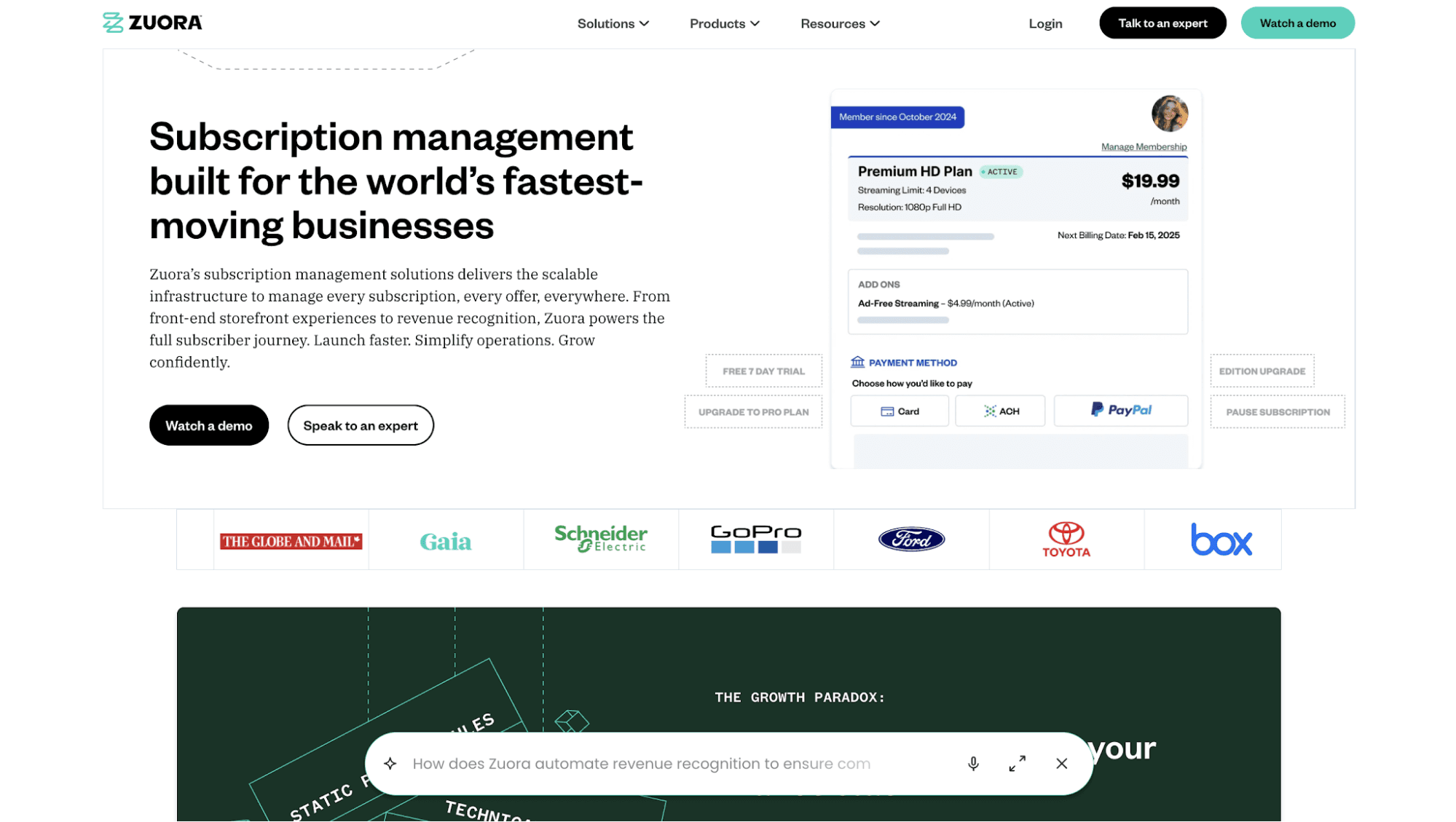
Zuora is a subscription management solution for fast-growing SaaS companies. Teams can create personalized offers and launch new bundles or promotions through business-friendly tools, not engineering sprints.
Built for high subscription volumes, Zuora can handle millions of subscribers on recurring, usage-based, hybrid, and one-time pricing models.
It connects billing, payments, and revenue in one auditable flow. This gives internal teams a single source of truth for subscription data.
Zuora can also simplify international selling by providing built-in localization options. It supports taxes, currencies, and local payment methods in more than 30 markets.
Intelligent payment retries and dunning workflows even help businesses recover more subscription revenue.
Plus, subscription management events and revenue recognition rules are connected. Finance teams can automate compliance and report accurate earnings in real time.
Key Features
- Offer builder: Create personalized offers, bundles, and promotions with business-friendly tools instead of code.
- Monetization catalog: Manage recurring, usage-based, hybrid, and one-time pricing through a centralized platform.
- Built-in localization: Support tax, currency, and payment options in more than 30 markets.
- Automated subscription billing: Handle invoices, adjustments, and renewals at scale without manual intervention.
- Revenue recognition: Connect revenue recognition to subscription events and report earned revenue.
7. Paddle
Source: Paddle.com
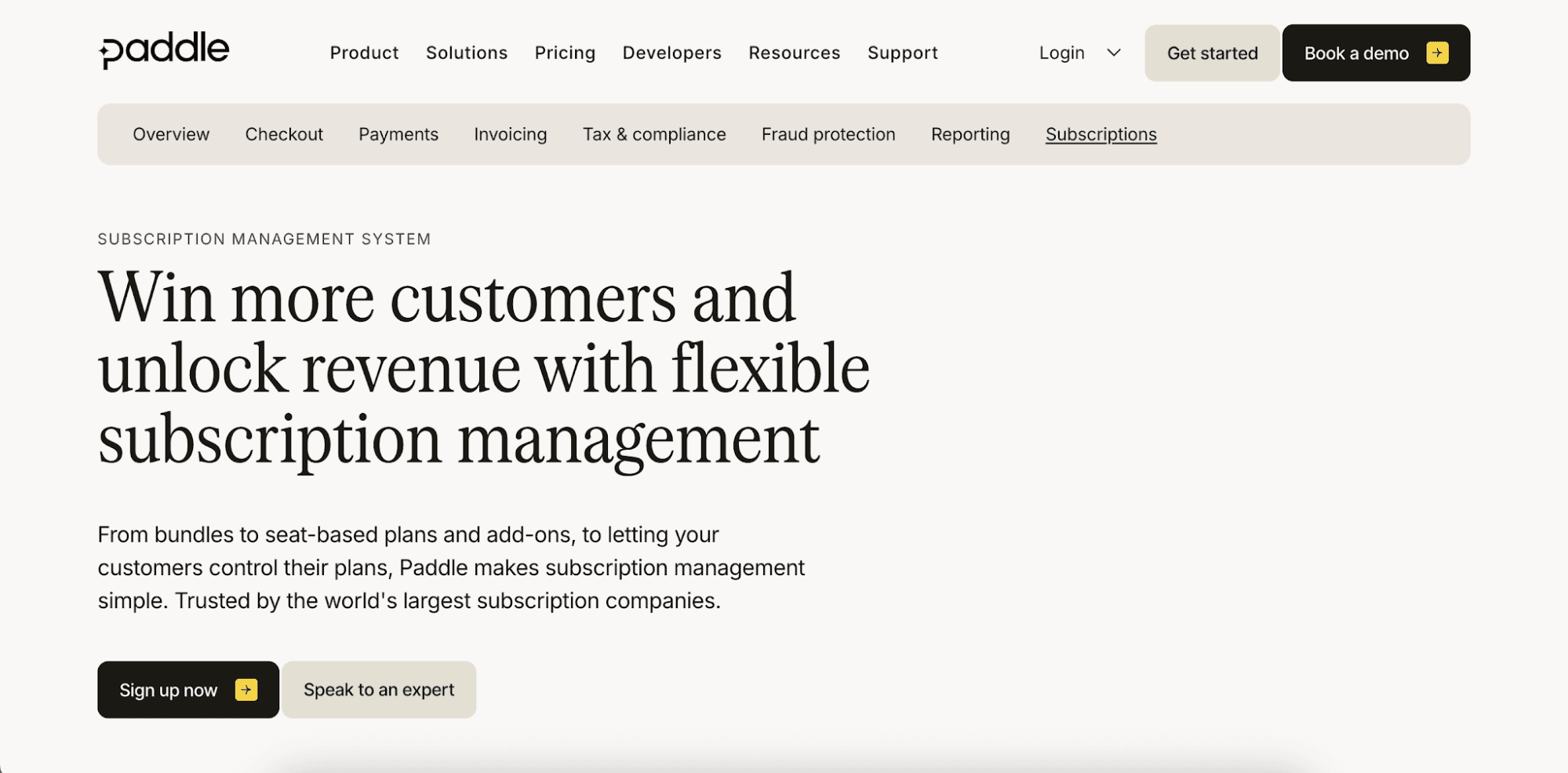
Paddle acts as a merchant of record and simplifies subscription management for SaaS companies. It manages customer subscriptions, payments, taxes, and other related billing tasks.
Paddle automatically calculates prorated payments when customers change subscriptions to ensure accurate billing.
SaaS teams can pause accounts instead of canceling them, then reactivate subscribers when they return. They can also use retention reporting tools to prevent churn.
Paddle also provides access to subscription data from over 40,000 businesses. Compare performance and review segments, cohorts, and pricing plans to identify recurring revenue trends.
Plus, a built-in customer portal allows buyers to cancel subscriptions, update payment methods, add or remove products, and change quantities without contacting support.
Key Features
- Automatic proration: Calculate prorated charges automatically when customers change their subscriptions.
- Subscription pauses: Pause customer subscriptions and reactivate them later instead of canceling the entire plan.
- Benchmarking data: Compare performance with data from 40,000 subscription companies.
- Customer portal: Give buyers full control over their subscriptions, payment methods, and products.
- Support for flexible subscription billing: Sell product bundles, seat-based plans, add-ons, and multiple products within one subscription.
8. Zoho Billing
Source: Zoho.com
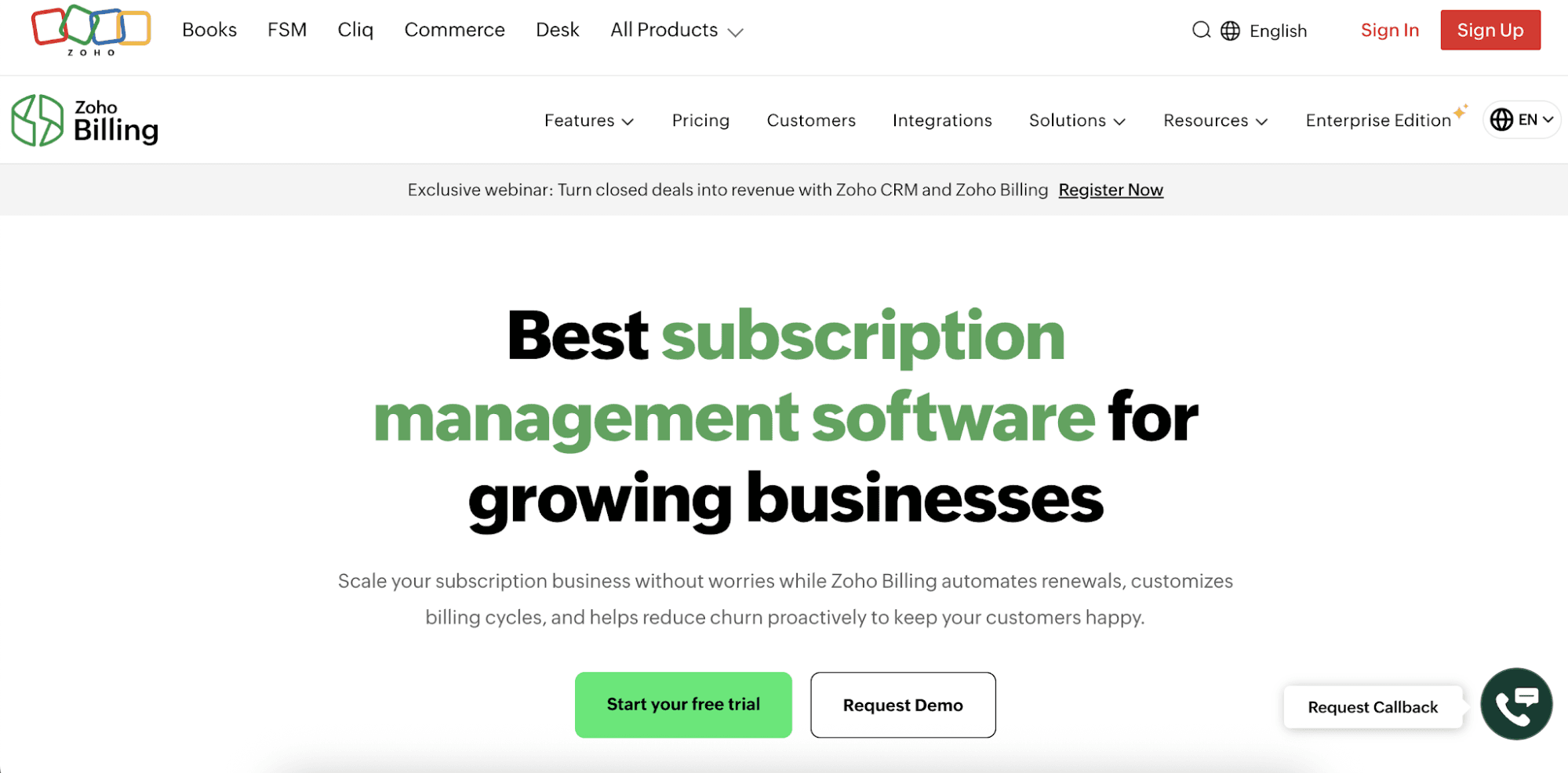
Zoho Billing helps SaaS companies scale operations with its subscription management solution.
Teams can customize plans with different pricing tiers, billing frequencies, add-ons, freemium options, and free trials to match changing customer needs. They can also create, upgrade, downgrade, renew, or cancel subscriptions from the same platform.
For payment collection, Zoho Billing offers a secure hosted payment page with multi-currency and multi-language capabilities. It also sends automated reminders and enables auto-charges for customers with overdue payments.
Subscription reports show customer behavior and pricing trends, which can help teams plan retention efforts and adjust their pricing strategy.
Zoho Billing even provides a self-service portal where customers can view and manage their subscriptions.
Plus, native integrations with accounting software, customer relationship management (CRM) tools, and other third-party applications can maintain data consistency.
Key Features
- Customizable subscription billing: Design plans with pricing tiers, add-ons, freemium, and custom billing frequencies.
- Hosted payment page: Accept payments through a secure page without building a checkout flow from scratch.
- Subscription analytics: Review subscriber behavior and forecast trends through subscription reports.
- Self-service portal: Keep your customers in the loop about their subscription plan.
- Automated workflows: Automate billing workflows and payment follow-ups to reduce manual errors.
The Importance of Subscription Management Software for SaaS Companies
SaaS subscription management software is important for several reasons.
- Automate billing processes and other routine tasks: Subscription management software automates the entire subscription billing process, from creating plans and generating invoices to payment processing and revenue recognition.
- Prevent revenue leakage: The platform automatically computes prorated payments when customers upgrade, downgrade, or change plans mid-cycle. This means each invoice reflects the correct amount and no billable revenue is missed.
- Minimize churn: Use smart payment retry logic, dunning workflows, and timely notifications to prevent involuntary churn and retain customers.
- Improve revenue forecasting and financial planning: Track annual/monthly recurring revenue, renewals, churn, and subscription changes in one place to build more reliable forecasts and make smarter decisions.
- Scale with business growth: A subscription management system can scale with business growth. It can handle more customers, subscription plans, billing data, and payment activity without adding more work for internal teams.
What to Look for in Subscription Management Tools
Below are the subscription management capabilities you should look for when evaluating different platforms.
Subscription Lifecycle Management
Look for software that manages the entire subscription lifecycle from signup through renewal, upgrade, downgrade, pause, and cancellation.
Teams should be able to configure plans, billing frequencies, item quantities, and contract terms without rebuilding billing logic.
Strong lifecycle controls also help customer success and finance teams keep account records current when subscribers change plans or return after canceling.
Support for Multiple Pricing Models
Check whether the subscription management system supports different pricing models.
Look beyond flat-rate subscriptions. Modern SaaS businesses are moving towards hybrid billing, usage-based pricing, and tiered plans. The 2026 State of B2B Monetization report reveals that 37% of B2B software companies have hybrid pricing.
Flexible subscription billing tools help you launch new offers and change packaging without rebuilding the billing system every time pricing changes.
Automated Recurring Billing and Invoicing
Choose subscription management software that can calculate recurring charges, generate invoices, apply discounts, handle prorations, and collect payments.
It should also account for mid-cycle plan changes and usage charges before sending invoices to customers.
Automation reduces repetitive work and keeps invoice amounts consistent with custom contracts, pricing rules, and subscription activity.
Dunning Workflows and Failed Payment Recovery
Failed payments can lead to involuntary churn when teams do not respond quickly.
Look for configurable dunning workflows that retry payments and send automated notifications to remind customers about their outstanding balances. These capabilities help you recover revenue and minimize churn.
Self-Service Portals
Invest in a SaaS subscription management solution that includes a self-service portal.
Buyers should be able to update payment details, view invoices, change subscription plans, pause service, or cancel when allowed. This reduces support requests and gives customers faster answers about their accounts.
The portal should also reflect current subscription status and billing information to prevent back-and-forth with support teams.
Subscription Analytics
Choose a platform that provides real-time visibility into key subscription metrics, such as annual/monthly recurring revenue, churn rates, and customer lifetime value.
These metrics help finance and revenue teams understand how customer activity affects future income. They can also reveal recurring revenue trends, high-risk subscribers, pricing performance, and areas for improvement.
Native Integrations
Subscription management software should connect to your existing systems. Look for native integrations with your billing tools, accounting systems, CRM software, data warehouses, and payment gateways.
These integrations reduce duplicate data entry and help subscription changes flow between teams without manual reconciliation.
Native connections also make it easier for sales, finance, support, and product teams to work from the same subscriber and billing data.
Schematic Combines Subscription Management and Usage-Based Billing
Schematic helps SaaS companies manage subscriptions and implement usage-based billing that enterprise accounts trust.
One engine can manage the full customer lifecycle from checkout through plan renewal. The same engine supports modeling, usage metering, and credits. This makes it easier to ship any pricing model, adjust packaging, version plans, and preview changes before full implementation.
Schematic also includes enterprise credit wallets that let your team configure credit grants, rollover policies, credit amount, and top-up thresholds.
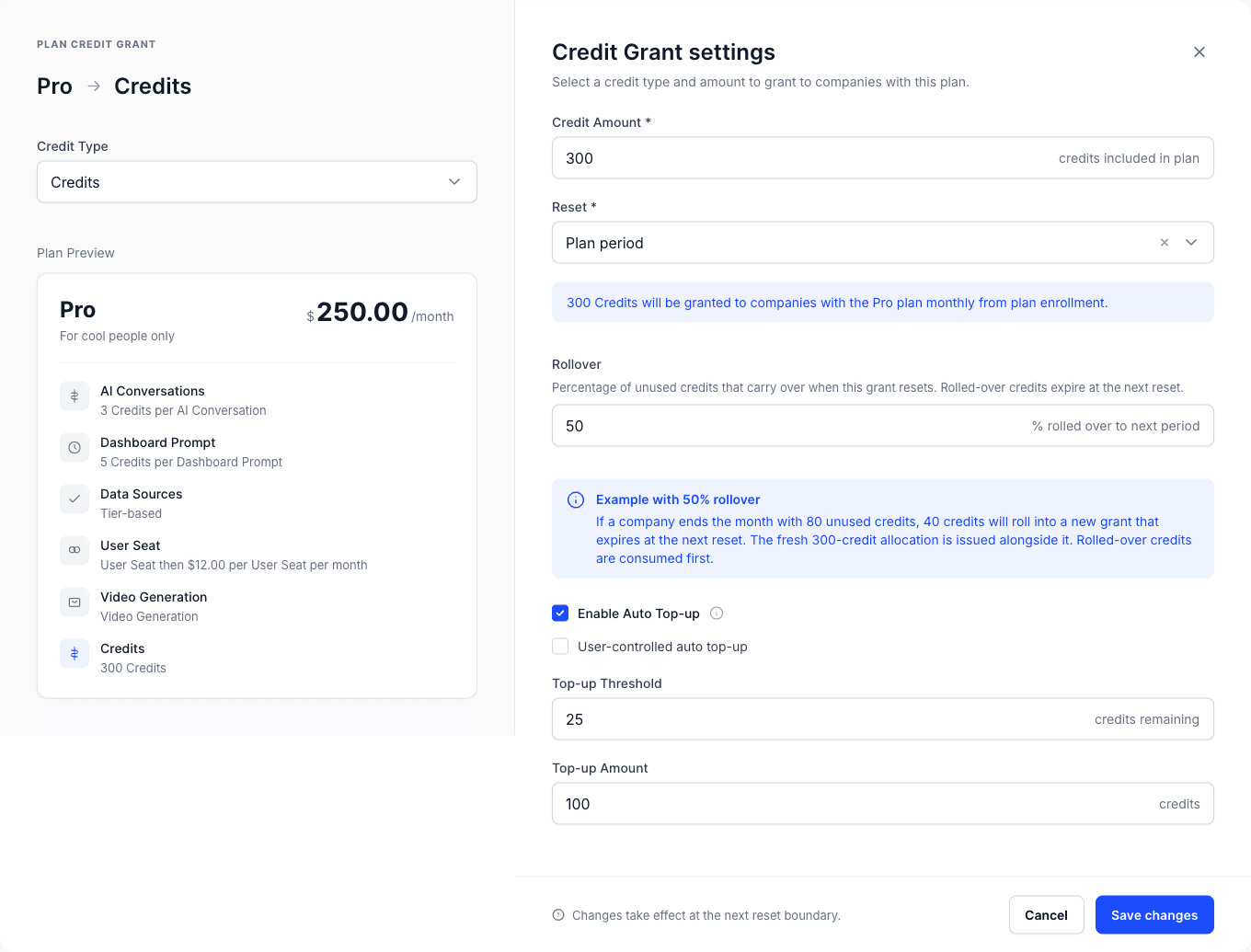
Native wallets also give enterprise customers real-time visibility and control over their consumption. When combined with spend forecasts, self-service controls, and configurable spending limits, these tools prevent runaway bills or unexpected access throttling.
Rahul Gill from Macabacus shares that, "Schematic's ability to offer usage caps, bundles, and top-ups gave our customers the cost predictability they need."
Schematic enforces policies using the same ledger that bills customers. A single flag check works in React, Node, Python, and Go so that the user interface and the API always agree.
Entitlement checks and meter events update in milliseconds to ensure consistent balances, limits, and usage wherever the product reads them.
FAQs About SaaS Subscription Management Software
How to manage SaaS subscriptions?
Use a subscription management platform to handle subscribers, plans, invoices, payments, upgrades, downgrades, renewals, and cancellations. Managing these tasks in one system helps teams reduce manual work.
What is SaaS subscription management?
SaaS subscription management refers to the process of handling recurring billing, plan changes, payment status, and in-product access throughout the entire subscriber lifecycle.
What are some examples of SaaS software?
Examples of SaaS software include CRM platforms, project management tools, accounting software, email marketing platforms, and collaboration apps. These products are usually accessed online and sold through recurring subscription plans.