 Ryan Echternacht
Selling AI products creates new billing challenges for SaaS and AI companies. Unlike traditional software, AI products often have variable costs based on actual usage.
Power users might consume thousands of tokens, AI credits, or API calls throughout the day. Unpredictable usage patterns can quickly eat into profit margins.
According to the 2026 State of B2B Monetization report, the median target gross margin for AI products is only 50%, far below the average SaaS margins of 70–80%.
This makes a dedicated billing infrastructure an important part of AI monetization. Companies need this platform to meter usage, support different pricing models, generate accurate invoices, and enforce limits.
In this article, we'll review the best AI billing infrastructure platforms and their key features.
TL;DR
These are the best AI billing infrastructure platforms worth considering in 2026:
- Metronome
- Lago
- Orb
- Maxio
- Chargebee
6 Best AI Billing Infrastructure Platforms to Consider in 2026
Let's look closely at the best AI billing systems, their core capabilities, and their pricing plans below.
1. Schematic
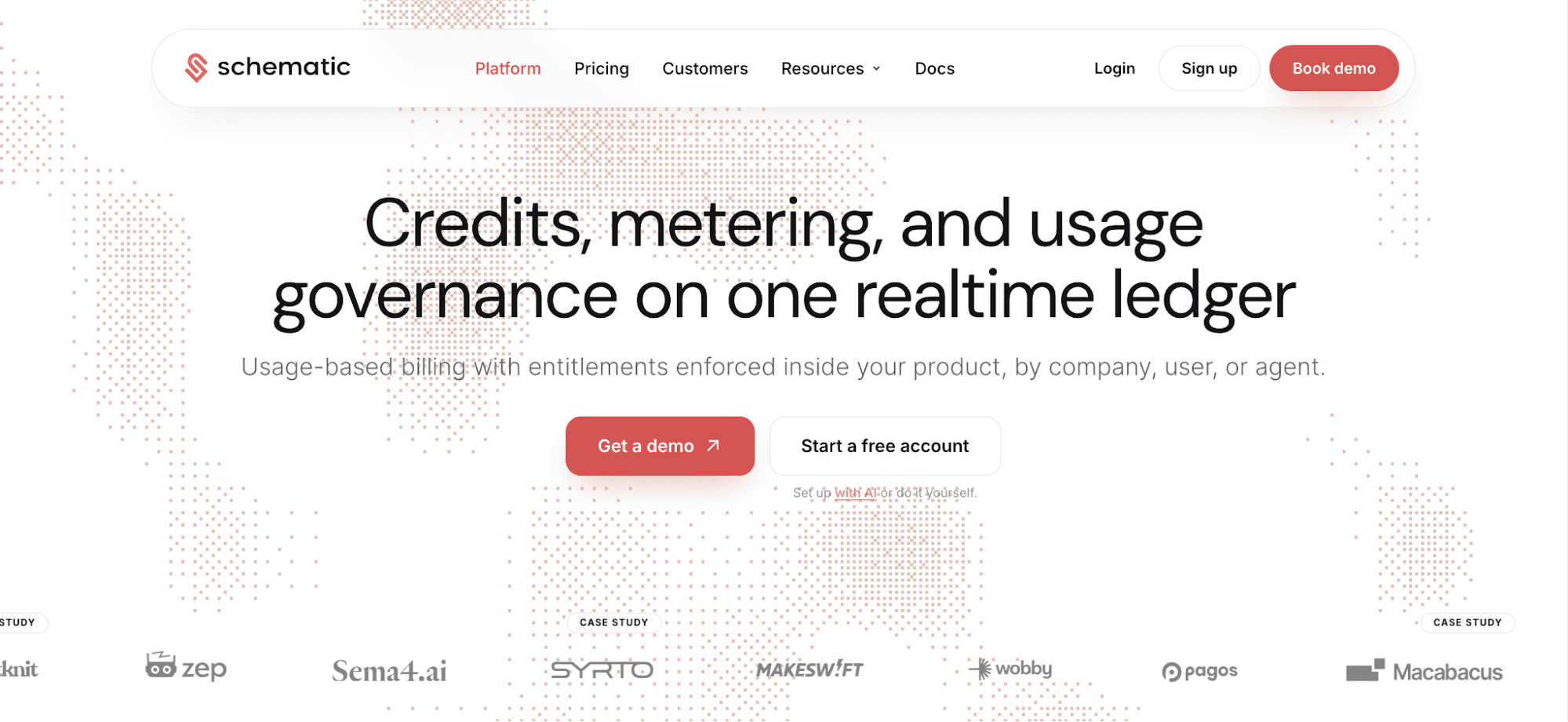
Schematic is the best AI billing infrastructure platform for software and AI companies selling to enterprise accounts. It combines metering, credits, software entitlements, and usage governance controls on a real-time ledger.
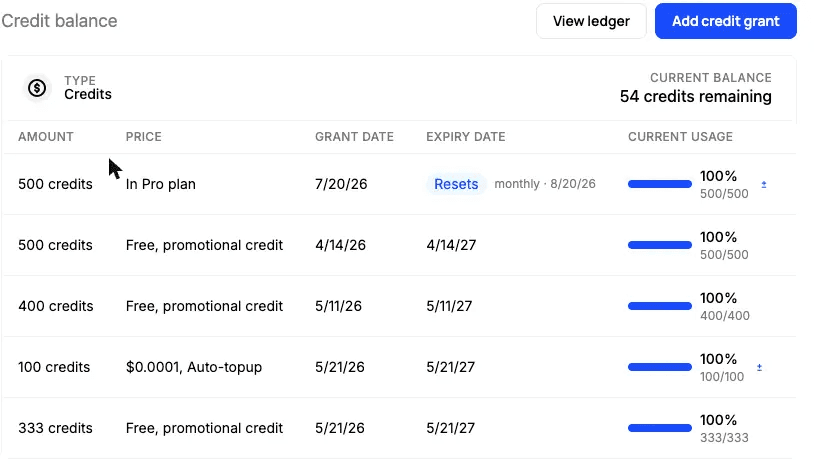
Native credit wallets give enterprise customers full visibility and control over their AI consumption. By showing users exactly what they use and owe, companies can close deals faster, drive expansion, and earn more revenue.
Wallets also record every grant, auto top-up, rollover, expiry date, and burn-down that finance teams can reconcile.
Schematic also stands out for its runtime entitlement engine. It uses one flag check to gate features and answer access questions from the same ledger that supports usage-based billing.
Usage limits and spending policies take effect as soon as your customer or your team saves them. Engineering no longer deploys code or writes pricing logic into the application.
Max Ade from Pickleheads says, "Without Schematic, we couldn't have implemented usage limits like capping round robins per month, a capability that was essential to our pricing strategy."
Plus, Schematic provides AI billing tools out of the box. Credit expiry windows, priority consumption rules, concurrency-safe holds, plan versioning, and credit-based revenue recognition workflows help teams monetize AI products using any pricing model.
Key Features
- Enterprise credit wallets show customers real-time usage and update balances as activity happens
- Runtime entitlements track against the cap and enforce limits
- One metered event stream powers entitlements, invoices, and analytics
- Configurable spending limits per company, individual user, or agent
- Spend forecasts and proactive alerts that warn customers before usage stops
- Support for usage-based pricing, credit burndown, seat-based pricing, and hybrid pricing models
- Credit management capabilities, such as rollovers, expiry windows, and priority consumption rules to ensure oldest credits burn down first
- Version plans and migrate customers without filing an engineering ticket
- Track credit-based revenue on an append-only ledger for ASC 606 compliance
- Connect AI assistants to Schematic's model context protocol (MCP) server to automate billing tasks
Pricing
Schematic offers three plans that can be billed monthly or yearly.
- Starter (Free): Gives startups and small teams free access to the entire usage billing platform. Companies can use unlimited flags, companies, components, and features, but there's a limit to the number of subscriptions, overrides, and billable events processed every month.
- Growth ($400/month or $3,840/year): Adds unlimited subscriptions, 20 company overrides, 10m usage events per month, a higher monthly billing volume limit, and a 30-day audit log retention.
- Enterprise (Custom pricing): Designed for large companies that need unlimited events, overrides, webhooks, advanced integration options, service level agreements, and premium support.
2. Metronome
Source: Metronome.com
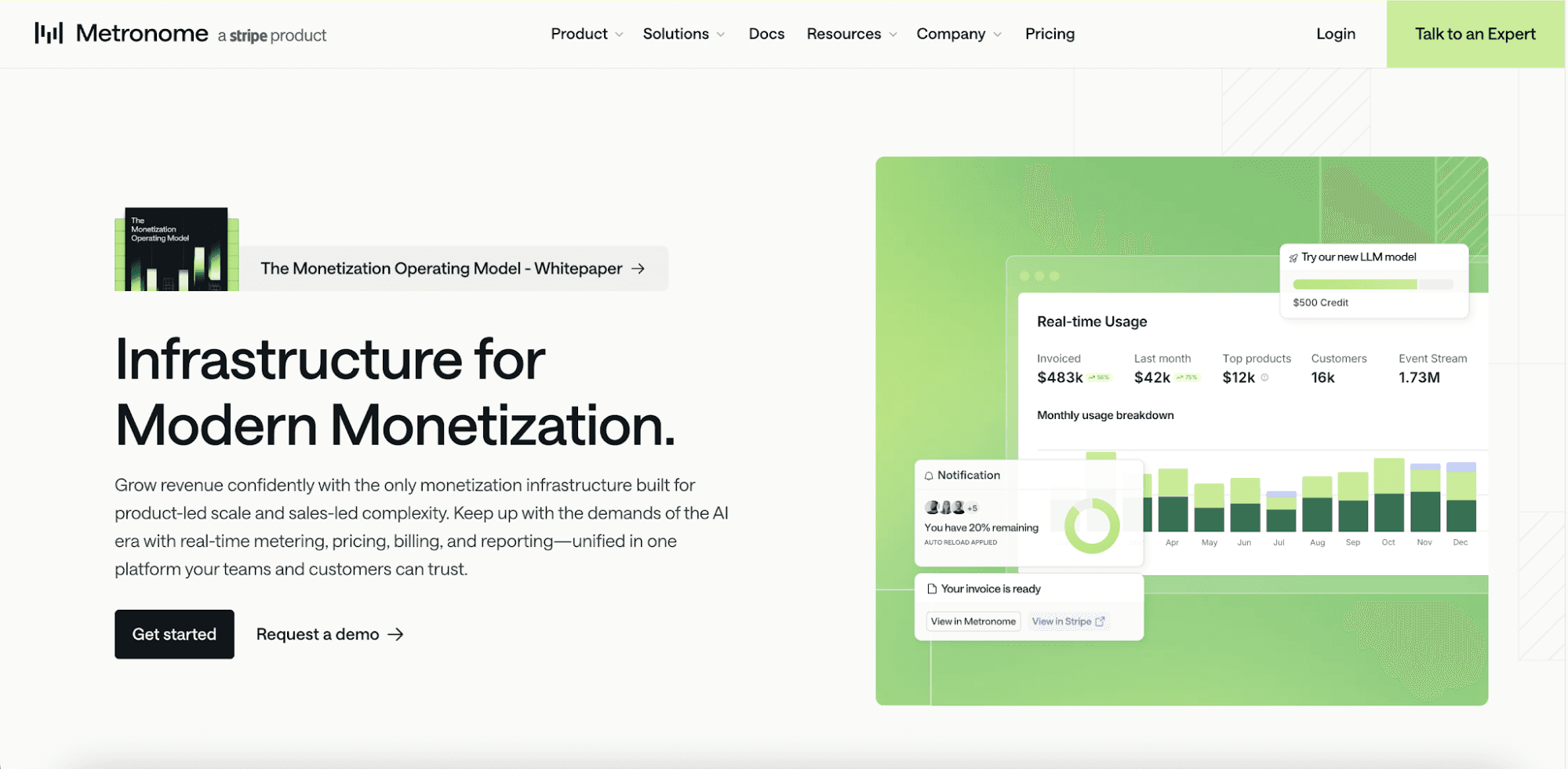
Metronome provides a flexible AI billing infrastructure for companies that need real-time metering, price modeling, billing, and financial reporting in one platform.
It can measure usage event data at high volumes and turn raw activity into billable metrics for product-led and sales-led businesses.
Teams can manage pricing centrally, run experiments, and make pricing changes for selected customer groups without manually updating contracts.
Metronome also supports different pricing models, such as pay-as-you-go, prepaid credits with volume discounts, tiered rates, outcome-based models, and freemium pricing.
In-product dashboards show actual consumption and AI model costs in real time. Configurable alerts and spending limits give enterprise buyers more control over their usage.
With Metronome, finance teams can filter and export billing records to review AI usage, track daily revenue, and analyze profit margins.
Key Features
- Pricing levers for any go-to-market strategy and monetization model, such as subscription pricing, usage-based, and hybrid billing
- Real-time metering for credit, API call, or token usage
- Modular billing engine to configure pricing elements and enterprise contract terms
- Transparent customer experiences with in-product dashboards, usage alerts, and configurable limits
- Built-in reports and insights that break down key performance metrics to help teams make smarter pricing decisions
Pricing
Metronome’s pricing details are not publicly available.
3. Lago
Source: getLago.com
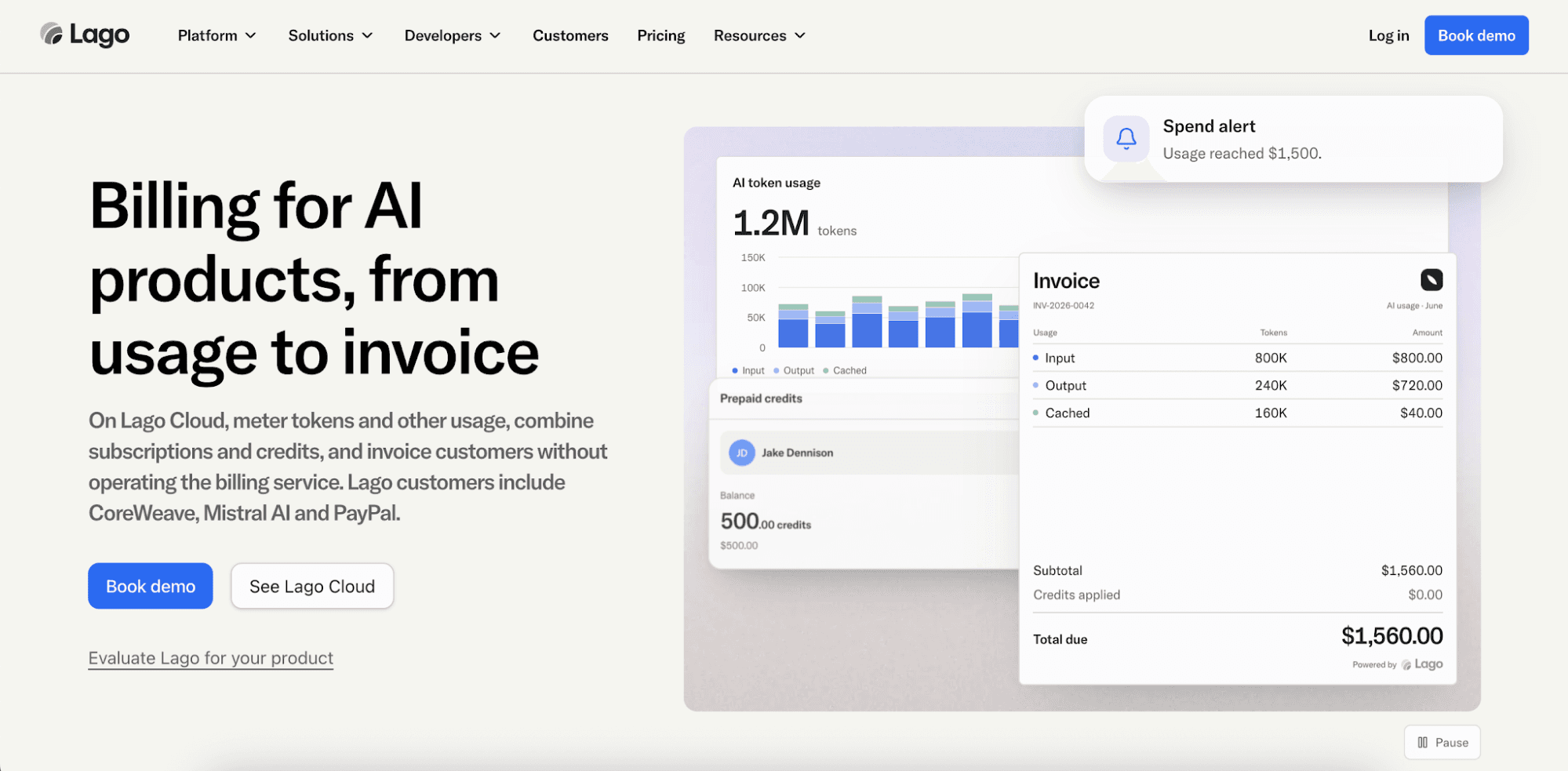
Lago is an open-source billing infrastructure that can meter usage, ship hybrid pricing models, and send invoices to customers.
AI and SaaS companies can use Lago's cloud-hosted service or deploy the open-source software on their own servers.
Lago Cloud includes a metering layer that captures raw usage events from APIs, AI gateways, and large language models (LLMs). It aggregates events to support token pricing, prepaid credits, and other usage-based billing models.
For invoicing and payment collection, Lago calculates customer charges based on recorded usage and pricing rules. It generates itemized invoices, applies taxes, and connects with external payment solutions to simplify billing operations.
Meanwhile, the built-in analytics dashboard provides insights into usage-based revenue, retention revenue, credit systems, and unit economics. Each number breaks down by month, plan, or customer. Finance teams can use this data without a separate business intelligence (BI) tool.
Key Features
- Open-source code to deploy Lago on your own infrastructure
- Real-time metering and metered billing capabilities that allow engineering and finance teams to model usage-based plans
- Flexible AI pricing and packaging changes without rebuilding billing systems
- Invoicing tools compute costs and taxes while payment gateway integrations process payments
- Revenue analytics can break down profit by month, plan, or customer
Pricing
Lago offers a self-hosted deployment option that is free to use. This is a popular choice among AI and SaaS companies with dedicated engineering resources that can run their billing infrastructure in-house.
Lago provides the Lago Cloud product for businesses that prefer a fully-managed service.
Premium features are available for both self-hosted and cloud-deployed billing platforms. However, pricing details are hidden, which can prevent teams from comparing cost structures.
4. Orb
Source: withOrb.com
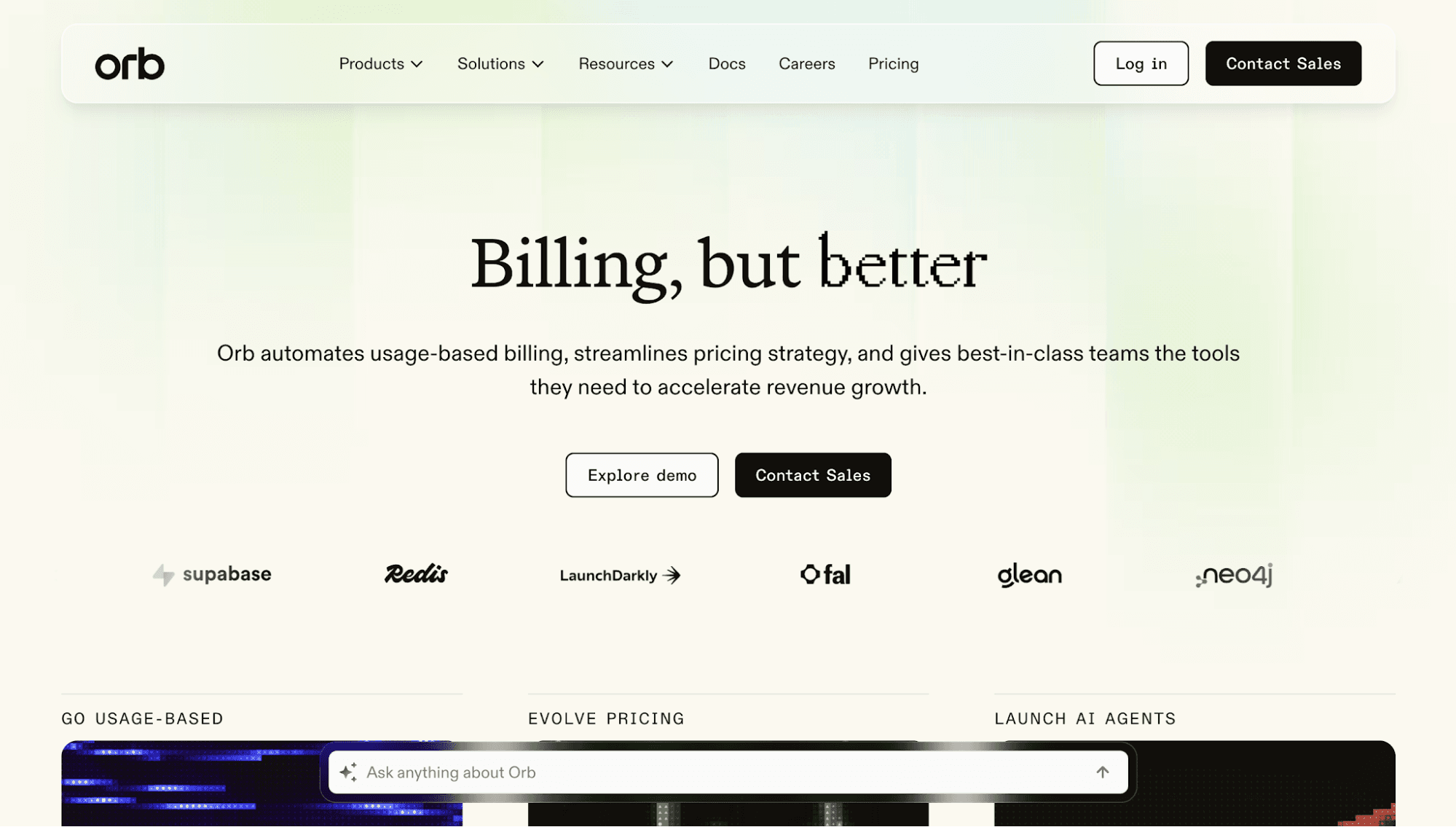
Orb provides a flexible billing infrastructure that automates usage-based billing. It gives SaaS and AI companies all the tools they need to monetize AI products.
Engineering, product, and finance teams can meter API calls, credits, and token consumption. They can also manage customers, contracts, and prices from one place.
Orb supports global pricing by SKU, customer-specific plans, and updates to the entire billing stack. It also triggers alerts and webhooks in near real time to help customers manage usage.
Built-in pricing simulations provide a canvas where teams can model version and pricing changes. These even show projected impacts to avoid pricing blindly and make smarter decisions.
Plus, Orb's experience kit can provide transparent pricing pages, calculators, and checkout flows. Customers always have up-to-date information so they can track current usage, token costs, and invoices.
Key Features
- Flexible usage billing engine for revenue decisioning and execution
- Support for global pricing, individual price changes, usage alerts, and webhooks
- Pricing simulations that test pricing tiers and models before shipping
- Trust and transparency tools give customers real-time visibility into their usage
- Invoicing and payment collection tools for friction-free cash acceptance
Pricing
Orb offers two pricing plans for companies that need usage-based billing.
- Business: This plan costs $6 per credit and includes everything you need to launch and scale usage billing. It has event ingestion, alerting, invoicing, Adyen and Stripe payment processing, automated price changes, and finance workflow integrations.
- Custom: Pricing is hidden. It offers all features in Business plus automated payment collection, advanced integration options, customer hierarchies, data exports, role-based access controls, and audit logs.
5. Maxio
Source: Maxio.com
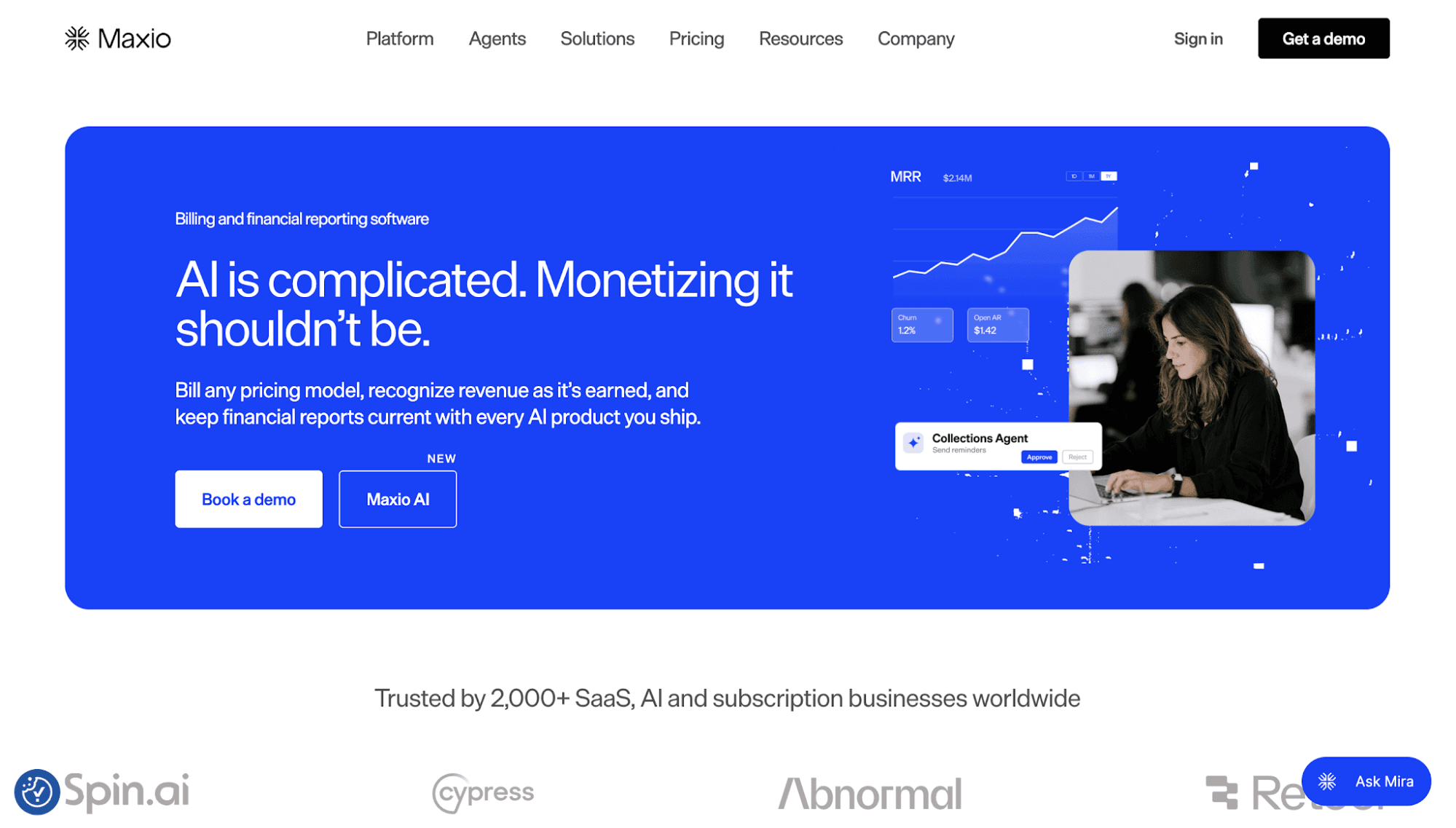
Maxio combines AI billing, financial reporting, invoicing, subscription management, and revenue recognition in one billing infrastructure. It solves complex billing challenges by providing purpose-built solutions.
Dynamic pricing capabilities let B2B SaaS and AI companies charge based on customer value using tokens, API calls, support tickets, or custom usage metrics.
Product teams can test different pricing strategies and launch updates in real time. Keep up with customer needs and market trends without touching application code.
Maxio can also automate routine AI billing tasks, such as invoicing, payment collection, and subscription renewals. The goal is to eliminate errors and reduce manual work for teams.
Plus, Maxio can visualize metrics using custom dashboards and reporting tools. These support revenue recognition under ASC 606 and IFRS 15 rules.
Key Features
- Dynamic usage-based billing based on token counts, tool calls, tickets, or custom attributes
- Faster pricing experiments to meet customer demands and market trends
- Automated invoicing, collection, and subscription management
- Adjustable revenue recognition schedules and rules that align with ASC 606 and IFRS 15
- One-click reporting to identify growth opportunities and optimize billing performance
Pricing
Maxio's pricing page shows two options for software and AI companies.
- Grow: Pricing starts at $599/month for up to $100k in monthly billings. This plan offers automated invoicing and billing, payment processing, subscription management, standard reports, standard revenue recognition, and standard A/R management.
- Scale: It provides custom pricing and handles more than $100k in monthly billings. It features advanced capabilities (reports, revenue recognition, and A/R management), usage metering, expense amortization, and multi-entity support.
6. Chargebee
Source: Chargebee.com
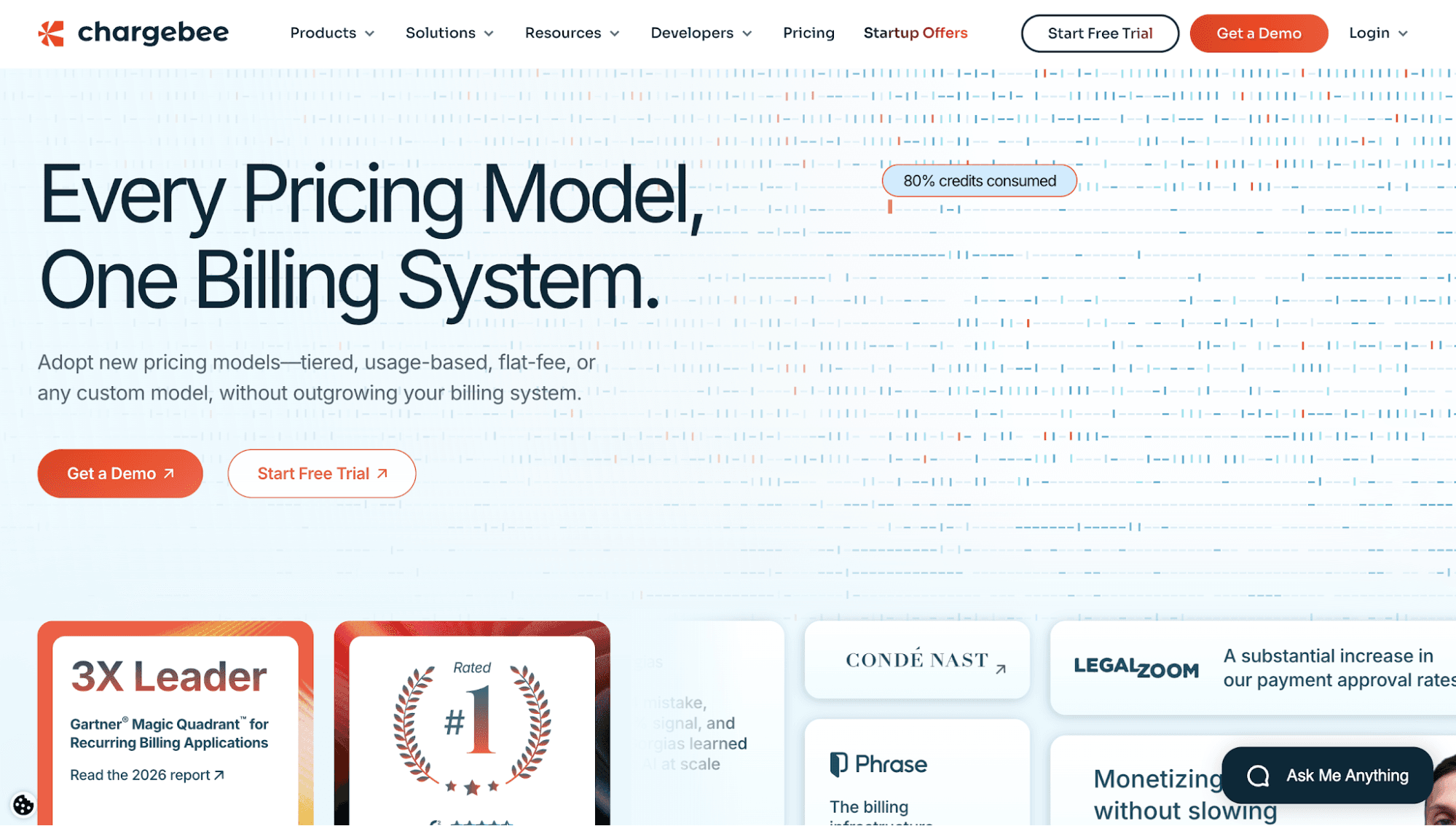
Chargebee is known for its subscription billing tool, but it also provides a monetization infrastructure for AI companies.
It supports token-based billing, usage-based pricing, outcome-based pricing, and hybrid subscription models.
Teams can charge customers based on API calls, completed tasks, seats, or raw consumption events. Chargebee handles usage metering, invoicing, revenue recognition, and financial reconciliation in one system.
A built-in product catalog allows companies to configure monetization models. They can change pricing and packaging inside Chargebee's dashboard without touching the application code. They can even experiment with pricing in different currencies, markets, and customer segments.
Chargebee even helps teams scale globally by integrating with payment gateways. It can offer multiple payment methods and accept currencies from 150+ countries. Meanwhile, automated dunning workflows can retry failed payments to recover revenue.
Key Features
- Configurable usage-based and hybrid pricing models
- No-code pricing and packaging changes through Chargebee's product catalog
- Extensive payment gateway integrations
- Automated follow-up reminders and smart payment retries
- Full traceability and compliance with audit trails, role-based access controls, and enterprise-level safeguards
Pricing
Chargebee offers two pricing options for its billing software.
- Flow: This plan charges 0.80% of billing volume for up to $68K monthly invoicing volume. Beyond that amount, companies pay a fixed monthly cost of $99 plus 0.65% of billing volume. Flow includes invoicing, usage ingestion, billing, real-time limits, usage alerts, and analytics.
- Enterprise: Designed for scaling companies, this plan has custom pricing and offers multi-entity management, account hierarchy, contract terms, and on-demand discounting. Paid add-ons are also available, such as the ability to ingest up to 500M usage events per month.
Schematic Provides a Complete AI Billing Infrastructure
Schematic is the all-in-one billing infrastructure platform for software and AI companies selling to enterprises.
The robust credit wallet brings three core monetization functions in one place:
- Metering: Track every usage event and count it once for accurate billing.
- Enforcement: Apply spending limits and enforce in-product access at runtime.
- Credits: Sell AI usage as prepaid credits and track consumption.
Enterprise customers can view and manage all three directly inside your product. They can predict future spending, set per-agent, per-user, or per-company limits, configure credit top-ups, and decide what happens at the cap.
Hard limits block further activity once the account hits the threshold. Soft limits enable continued access and bill extra usage as overage fees.
Sales teams can grant an override when a custom deal needs one. They can set clear expiry dates to prevent abuse.

Meanwhile, product managers and RevOps teams can change plans through configuration since pricing lives as data on Schematic's real-time ledger. They can easily create custom deals, set payment terms, meter usage, and renew subscriptions with receipts.
Rahul Gill from Macabacus shares, "Schematic's responsive advisory services and flexibility let us change our pricing overnight for custom customer deals."
FAQs About AI Billing Infrastructure
How can AI agents be used in billing?
AI agents can review usage records, flag unusual charges, answer billing questions, and help teams find unpaid invoices. They can also suggest credit top-ups or payment follow-ups, while human staff can review and approve changes that affect customer accounts.
Is AI taking over billing?
AI can automate routine tasks, trigger smart payment retries, and help finance teams organize data. However, it doesn't fully replace human oversight and intervention when it comes to billing, metering, or revenue recognition.
Should AI companies build or buy an AI billing infrastructure?
Building gives SaaS and AI companies full control over monetization. But this approach requires extensive engineering resources to handle metering, credits, invoicing, and usage limits.
Buying dedicated billing systems can reduce setup and maintenance time. For many teams, effective AI billing starts with a platform that supports their pricing model.
How do businesses monetize AI products?
Businesses charge for AI products through usage-based pricing, token-based pricing, prepaid credits, outcome-based pricing, or hybrid models. The right monetization model connects pricing to customer costs and product value.