 Ryan Echternacht
The right billing software can shape how efficiently SaaS and AI companies price products, meter usage, and bill customers.
Many teams compare Schematic and Maxio when implementing recurring subscription fees with usage-based billing. However, these platforms have different priorities and functionalities.
Schematic is a complete usage billing solution that combines modeling, metering, software entitlements, and self-service controls. It solves the trust problem in usage-based pricing by giving enterprise buyers control over their spending.
Maxio, on the other hand, is a billing and reporting platform in one. It connects to the general ledger or accounting systems to handle the complex financials of subscription-based businesses.
Below, we'll discuss ten key differences between Schematic and Maxio to determine which billing software fits your needs.
TL;DR
- Both Schematic and Maxio are popular billing platforms that can support usage-based billing, metering, subscription management, and revenue recognition.
- Schematic features metering, credit wallets, entitlement enforcement, and usage governance to solve the trust problem in usage-based billing.
- Maxio is known for its billing and financial reporting tools, which help teams recognize revenue and analyze patterns.
- Schematic suits software and AI companies selling usage-based plans to enterprise customers and want to iterate on monetization frequently.
Schematic vs. Maxio: What's the Difference?
Schematic provides an all-in-one usage billing platform for software and AI companies selling to enterprises.
One engine takes care of price modeling, usage metering, and credits. That same engine also carries a customer from first checkout to plan renewal.
Plus, Schematic specializes in enterprise credit wallets and runtime entitlements. Wallets give customers a live view of their usage and spending. Meanwhile, entitlements control what buyers can access based on their plan, credit balances, or custom overrides.

Maxio offers out-of-the-box tools for metering, invoicing, revenue recognition, financial reporting, and subscription management. Its billing platform supports different pricing models and handles large billing volumes.
It primarily focuses on the financial side of monetization instead of access control and trust signals. Finance teams use it to visualize metrics, report on revenue, and sync product data to invoices.
The main difference between Schematic and Maxio is their priority. Schematic suits companies that sell usage-based plans and want to give customers predictability over their consumption. Maxio is often considered when billing needs to feed invoices and reports, but it lacks real-time limit enforcement.
Schematic Key Features and Advantages
Schematic is the only billing software that combines credits, metering, and usage governance on a real-time ledger. This ledger can gate features and answer access questions before allowing a paid action to run.
Schematic stands out because it shows live consumption, gives customers self-service controls, and enforces limits per user, company, or agent.
Below are the core features of Schematic.
- Enterprise credit wallets: Track grants, rollovers, auto top-ups, and burn-down that finance leaders can easily reconcile. Customers can see exactly what they use and how much money they owe.
- Runtime software entitlements: Monitor product usage against caps and enforce limits inside the product in real time.
- Usage metering and billing: Meter usage once to feed billing invoices and power revenue analytics.
- Self-service controls: Customers can view credit balances, set spend caps, manage top-ups, and receive warnings before usage stops.
- Plan versioning: Create new plan versions, move customers to new versions, or keep existing customers on legacy plans.
- Out-of-the-box billing tools: Support a fast setup using built-in event logs, concurrency-safe holds, and priority consumption.
- Append-only ledger: Record every grant and deduction for compliant revenue recognition.
Rahul Gill from Macabacus says, "Schematic enabled us to track token costs and billing ledgers without having to build that infrastructure manually."
Maxio Key Features and Advantages
Maxio helps AI and SaaS companies connect billing to financial books and reports. It can implement any pricing model, recognize revenue for each sale, and report on every product SaaS teams sell.
Maxio can also create custom contracts and make pricing changes depending on the target audience. Data instantly syncs to invoices without manual reconciliation.
Here are the features to expect when you use Maxio:
- Metered billing and invoicing: Turn raw usage data into accurate invoices that you can bill customers for.
- Automated revenue recognition: Apply tailored recognition rules and schedules to comply with ASC 606, IFRS 15, and internal policies.
- Financial reporting: Finance leaders can track key metrics and generate investor-ready reports in one workflow.
- Native wallets: Track prepaid credits, tokens, or dollar balances as customers use them.
- Subscriber lifecycle management: Support subscription billing, offer self-serve subscription changes, and automate plan renewals.
- Standardized quoting and approval workflows: Simplify quote-to-cash processes by using standardized SKUs, price lists, and pre-approved terms.
Schematic vs. Maxio: Main Differences Explained
Below, we'll break down the key differences between Schematic and Maxio.
Subscription and Usage Billing
Schematic supports subscription billing alongside consumption-based models. It can implement pay-as-you-go, pay-in-advance, fixed fees with overage fees, volume pricing, credit burndown, and hybrid billing.
SaaS teams can version plans, preview the impact on revenue share before shipping, and make pricing changes without a billing rebuild.
Pricing lives as data on a real-time ledger. That means companies can model any pricing and apply changes through configuration, not code.
Zach Hawtof from Titanet says, "Schematic gives us the ability to reconfigure plans without having to reconfigure the product itself, which is huge when we need to iterate quickly."
Meanwhile, Maxio is a subscription and usage-based billing system in one. Teams can quickly set up subscription plans and usage-based pricing models without writing code.
It can also manage enterprise-scale billing in global markets. It supports multiple currencies, local taxes, mid-contract changes, and compliance controls for international transactions to minimize risk.
SaaS Metering
Both Schematic and Maxio handle usage-based billing, but they differ when it comes to metering consumption events.
Schematic tracks usage for AI monetization or limit enforcement. Every event is counted only once to avoid billing disputes.
That single event stream can power SaaS entitlements, invoices, and revenue analytics.
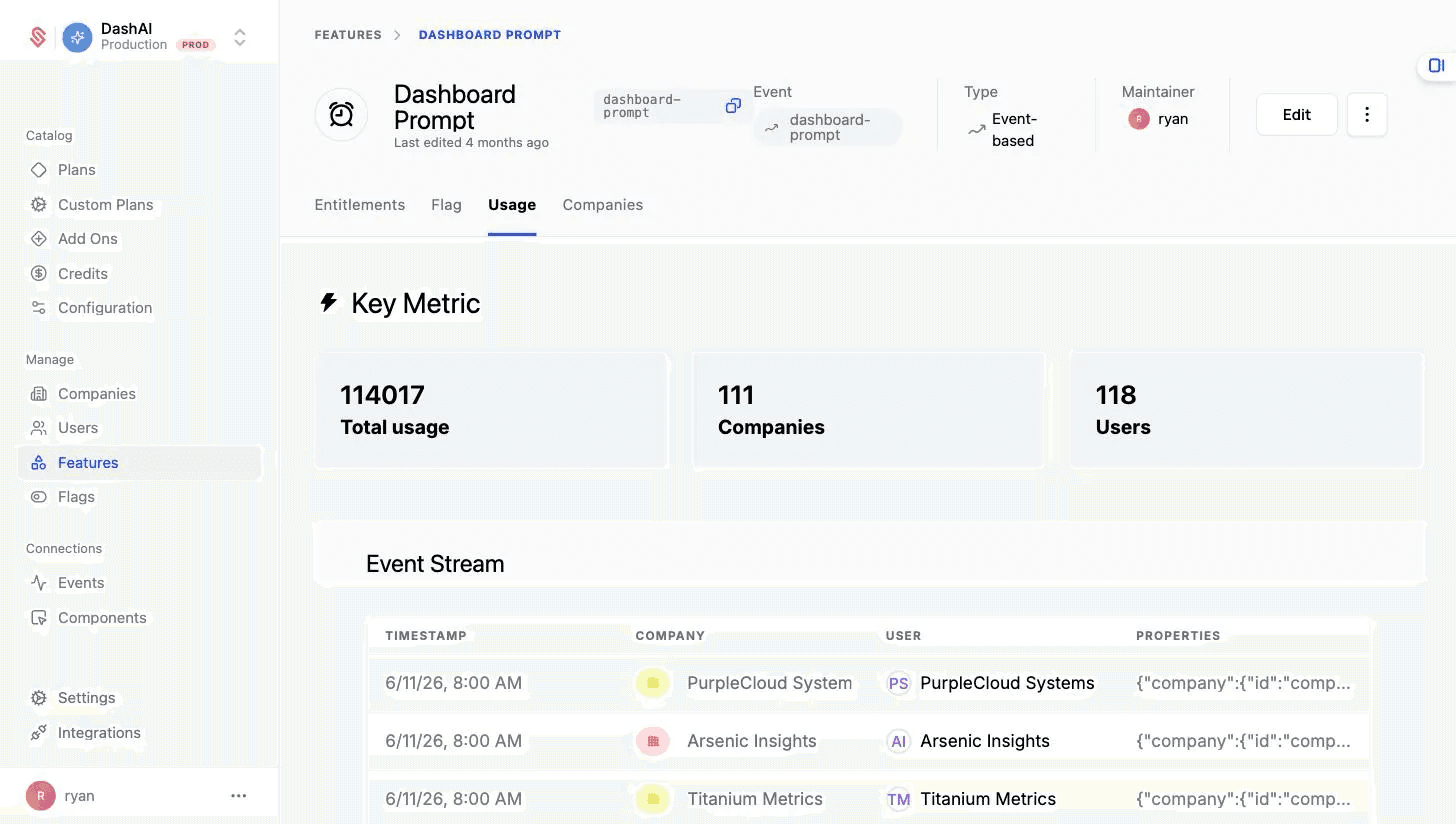
Teams can add a usage event corresponding to when customers use a feature inside the product. Schematic attributes it to paid features, companies, or users. The platform will also reflect total usage in the dashboard.
Maxio captures all customer interactions within the product and handles usage events at enterprise scale.
Teams can aggregate usage by attributes such as customer segment, geography, AI model, or event type before applying pricing rules. Maxio then turns aggregated usage data into accurate invoices without extensive engineering resources.
Credit Wallets
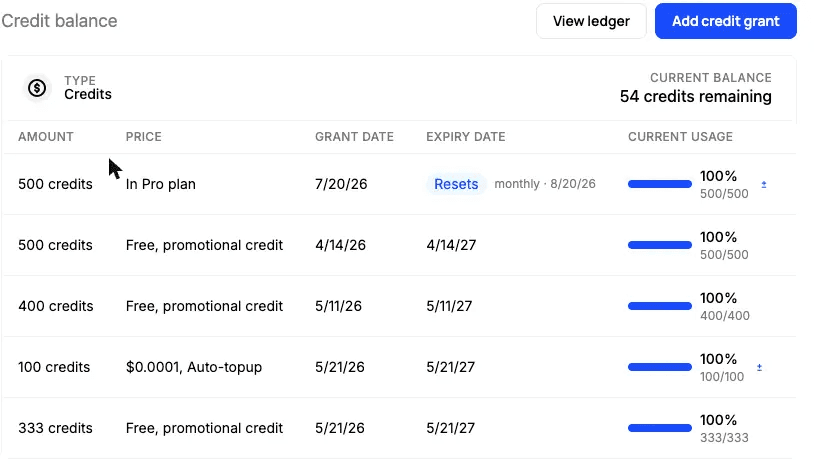
Schematic stands out for its robust enterprise credit wallets. Native grants, auto top-ups, rollovers, and burn-down make it easier for finance teams to reconcile data.
The same credit wallet gives enterprise customers real-time visibility into usage, spend forecasts, self-service controls, and configurable spending limits.
Users are no longer surprised by runaway bills or unexpected access throttling. Instead, they gain confidence that usage will stay within budget and that they are only charged for what they expect.
Rahul Gill from Macabacus says, "Schematic's ability to offer usage caps, bundles, and top-ups gave our customers the cost predictability they need."
Maxio also offers native wallet support as part of its monetization engine. Wallets track stored value in credits, tokens, or dollars. They are instantly updated as soon as usage happens.
SaaS teams have full access to the product catalog so they can easily set rollover, expiration, and threshold policies.
Maxio's wallets are mostly for usage metering, while Schematic focuses on giving customers self-service controls and enforcing limits at runtime.
Subscription Management
Schematic helps software and AI companies run the whole subscriber lifecycle in one place. A robust billing engine carries a customer from first checkout to renewal.
Schematic provides full visibility into account data, usage patterns, and billing status. Sales reps, support teams, and account managers gain complete customer context to inform decision-making.
Teams can also connect AI assistants to Schematic's model context protocol (MCP) server. Use one prompt to query subscriber information, manage overrides, check entitlements, update plans, and analyze usage patterns.
Max Ade from Pickleheads says, "The Schematic MCP is fantastic, and we now do most of our work in Claude, accessing plan and billing information directly without leaving our workflow."
Maxio provides advanced subscription management tools. It can automatically generate recurring invoices, renew subscriptions, and send dunning emails to prevent involuntary churn.
According to Churnkey, the average recovery rate for dunning emails and SMS campaigns sits at 42%. This proves the impact of smart retry tools.
Maxio even includes a self-service portal, allowing customers to manage their subscriptions without relying on customer support. Users can upgrade, downgrade, or cancel their plans and update payment methods.
The platform instantly calculates prorated charges so teams can focus on tracking business growth and identifying sudden rate drops.
Software Entitlements
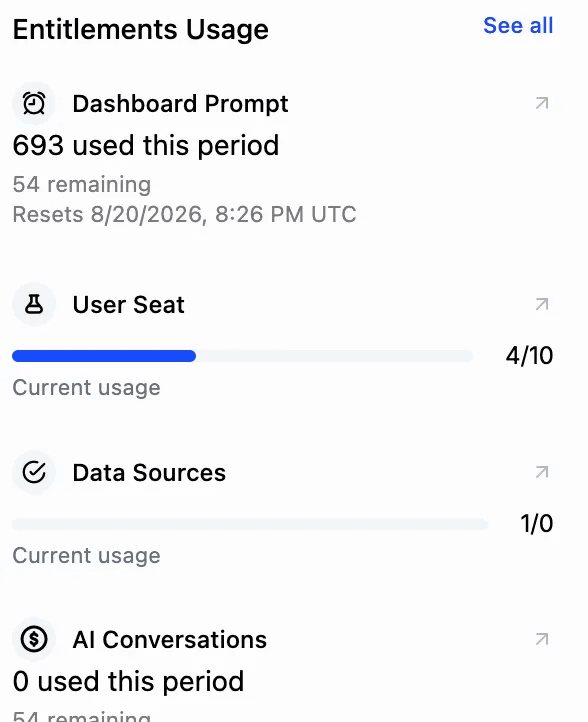
Schematic features a real-time entitlement engine. It controls customer access to paid features based on their plan, current usage, or custom rules, without touching application code.
Policies, such as spending caps and the credit top-up amount, set by your team or your customers take effect as soon as they are saved.
Every entitlement check and metered event streams back to the ledger used for billing. The same call works in React, Node, Python, and Go to guarantee that the user interface and the API are always in sync.
Maxio also includes a native access and governance system. SaaS teams can set usage limits, access policies, and service rights in one catalog.
Software entitlements update automatically when subscription statuses or price points change.
However, Maxio's entitlement engine still needs to be fed into existing access control or provisioning platforms through an API connection. Schematic tracks entitlements against their cap without engineering overhead.
Revenue Recognition
Schematic supports credit-based revenue recognition through its append-only, export-ready ledger.
This ledger records grants, draws, reservations, transfers, and expirations with pricing and timestamps. Finance teams can use that data to apply ASC 606 rules to prepaid credits and usage-based plans.
However, Schematic does not create journal entries or deferred revenue schedules. Those steps stay in the company’s accounting software or revenue recognition system.
Maxio has built-in revenue recognition software. It can automatically adjust recognition schedules by customer, contract, or transaction. It can also apply tailored recognition rules that meet ASC 606 and IFRS 15 compliance requirements.
Maxio even syncs invoices with the company's general ledger. Meanwhile, a unified view of all deferred revenue and journal entries can simplify reconciliation and prevent reporting errors.
Payment Processing
Schematic is not a payment solution. Instead, it acts as a complete usage billing platform that offers a two-way sync with Stripe Billing.
This native integration allows Stripe to process payments, update payment methods, handle retries, and manage taxes. Payment status changes in Stripe instantly reflect in Schematic without maintaining webhooks or reconciling billing state.
Schematic makes Stripe better by adding usage metering, software entitlements, credit wallets, and concurrency-safe holds.
On the other hand, Maxio offers a payment processing platform. It can accept online payments, support multiple currencies, automate disputes, use built-in surcharging to recover credit card processing fees, and calculate taxes.
Maxio can also prevent revenue leakage through automated reconciliation, chargeback handling, and native fraud detection technology.
Integration Capabilities
Schematic offers native integrations with existing identity providers, customer relationship management (CRM) software, and data warehouses.
It connects directly to Stripe Billing, Clerk, WorkOS, HubSpot, Salesforce, and Segment.
Schematic's webhooks send changes to other systems when billing or usage state changes. These allow developers to build most Slack alerts, CRM updates, and AI-assisted workflows.
Maxio also has pre-built connectors that reduce manual handoffs. It integrates with CRM, billing, enterprise resource planning (ERP), payment processors, and financial systems.
Maxio even supports different payment gateways, such as Adyen, GoCardless, and PayPal. Choose one that suits your target audience, growth strategy, and business model.
Developer Experience
Building with Schematic is straightforward for developers. The platform includes monetization SDKs and the REST API, making it easier to integrate it into the company's billing infrastructure.
Developers simply instrument the app, install the SDKs, tell Schematic which company is active, meter usage, and enforce entitlements.
Commercial teams (sales reps, product managers, and RevOps) own pricing decisions and plan changes. They can create custom plans, set contract terms, and grant overrides for customers on advanced and enterprise tiers.
Every update happens through configuration, not an engineering sprint.
Maxio provides APIs for both its core billing platform and its advanced billing developer portal.
Developers can create offers, activate subscriptions, list invoices, add a billing portal, record usage, and automate webhooks.
Maxio also features hosted pages for sign-up, billing, and product catalog. These eliminate the need to code or design the frontend.
Pricing Plans
Schematic's public pricing page shows three options tailored for companies at different growth stages.
- Starter: This free tier allows small businesses and startups to use 10 subscriptions, 2 company overrides, 500k monthly events, and unlimited flags, companies, components, and features.
- Growth: At $400/month, this plan targets mid-market companies that need unlimited subscriptions on top of 20 company overrides, 10m monthly events, a 30-day audit log retention, and the ability to remove the Schematic branding.
- Enterprise: Custom pricing is available for enterprise companies. This tier includes unlimited overrides, events, webhooks, service level agreements, role-based access control, and premium support.
Maxio only offers two pricing plans.
- Grow: It starts at $599/month for up to $100k in monthly billings. The plan includes automated invoicing and billing, standard reports, standard revenue recognition, and standard A/R management.
- Scale: This tier has custom pricing and supports over $100k in monthly billings. It comes with advanced features (revenue recognition, reports, and A/R management), multi-entity support, expense amortization, and metering.
How to Choose Between Schematic and Maxio
The choice between Schematic and Maxio comes down to what your company needs from its billing system.
Schematic is a better fit when you want to meter usage, grant credits, enforce limits, control product access, and give customers predictability over their bill.
Maxio suits SaaS teams that want to connect billing to financial reporting and revenue recognition workflows.
Choose Schematic if you need:
- Complete usage-based billing in one platform
- Robust enterprise credit wallets
- Per-user, per-agent, or per-company limit enforcement at runtime
- Usage metering that powers entitlements, invoices, and analytics
- Self-service controls, forecasts, and spending limits configured by customers
- One engine for customer lifecycle management
- Sales-led overrides and custom enterprise terms
- Append-only ledger for revenue recognition
Consider Maxio if you want:
- Subscription and usage billing tied closely to finance operations
- Automated revenue recognition workflows
- Detailed financial and SaaS reporting
- Built-in payment collection and dunning tools
- Self-serve subscription billing portals
- Standardize quote and deal construction
Schematic Ships Usage-Based Billing Your Customers Trust and Enforces Runtime Entitlements
Schematic is the best usage-based billing platform for software and AI companies that want to close enterprise accounts faster.
It addresses customer trust structurally by combining credits, metering, and usage governance on a real-time ledger.
Customers can see exactly what they use and owe in real time through enterprise credit wallets. They can also set spending limits per company, user, or agent and decide what happens when thresholds are reached.
The entitlement engine enforces limits at runtime and sends alerts before users hit a metered paywall. Customers no longer fear surprise bills or unexpected access throttling. Instead, they only pay for what they expect, and usage will never exceed their set budget.
Schematic is also known for its out-of-the-box billing tools designed for the AI era. It lets you version plans, migrate customers, implement credit-based pricing, record every grant or deduction, and recognize revenue in compliance with ASC 606.
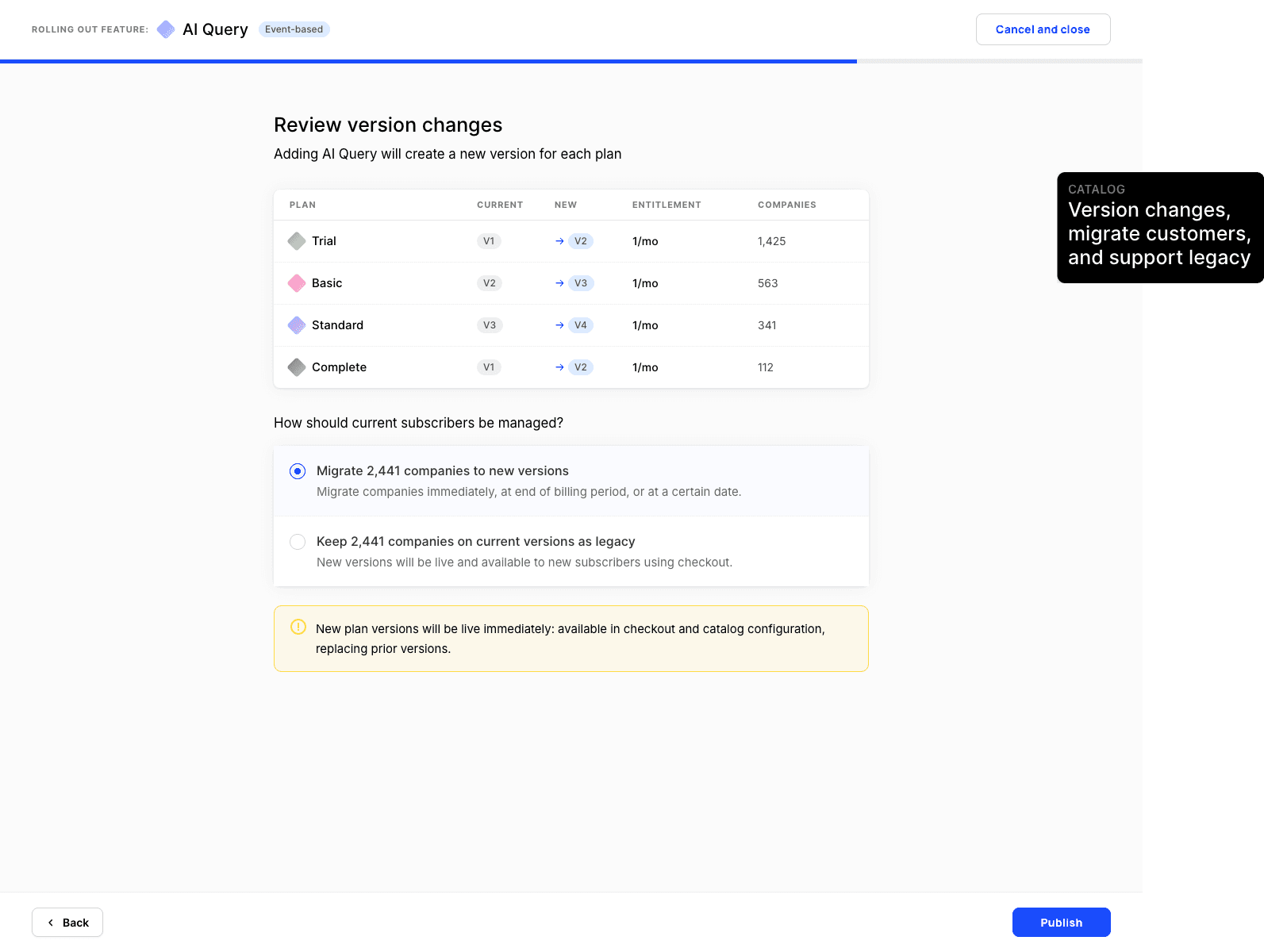
Max Ade from Pickleheads says, "Schematic lets us change plans in one place and cascade updates to everyone, migrate customers between plans, and run pricing experiments without any manual implementation."
FAQs About Schematic vs. Maxio
Which is the better usage billing platform: Schematic or Maxio?
Schematic is the better fit for software and AI companies that need metering, credit wallets, runtime entitlements, and usage governance in one system. Maxio makes sense for billing teams that place more emphasis on finance operations and revenue reporting.
Can Schematic and Maxio support recurring billing?
Yes. Both platforms support recurring billing. Schematic combines fixed subscription fees with usage-based charges and credit-based pricing. Maxio supports recurring subscriptions and self-service renewals, upgrades, or downgrades as part of its broader subscription billing platform.
What is the main limitation of Maxio?
Maxio’s main limitation is its inability to enforce entitlements at runtime. Engineering still needs to build entitlement logic and feed data to existing provisioning platforms.