 Ryan Echternacht
Usage-based billing involves more than tracking consumption events and generating invoices based on metered usage. When customers pay for API requests, tokens, or AI credits, the product also needs runtime controls that decide what happens when the account is near its usage cap.
Without entitlement checks, billing can become disconnected from what customers can access inside the product.
That's why Schematic vs. Stigg is a key comparison for software and AI companies that need SaaS access control.
Both platforms help teams manage software entitlements, usage metering, limits, and credit enforcement. However, they differ in execution.
Stigg focuses on what happens during live product usage before a single token exceeds the set budget. Meanwhile, Schematic treats runtime entitlements as just one feature within its broader usage billing platform.
This comparison guide will discuss the 10 key differences between Schematic and Stigg to help you make an informed choice.
TL;DR
- Both Schematic and Stigg are AI monetization platforms that can meter usage, manage entitlements, and enforce limits inside the product.
- Schematic combines billing, metering, price modeling, entitlements, credit wallets, and self-service controls in one powerful platform.
- Stigg layers on top of existing billing systems to check entitlements and usage limits before allowing a request to run.
- Schematic is the better choice for companies selling to enterprises that need a complete usage billing platform to solve the trust problem in usage-based pricing.
Schematic vs. Stigg: What's the Difference?
Schematic is the complete usage-based billing system for software and AI companies that want to close enterprise contracts.
Teams use Schematic to model pricing, meter usage, bill customers per unit, enforce in-product limits at runtime, recognize revenue in compliance with ASC 606, and give enterprise buyers real-time usage visibility.
Robust enterprise credit wallets help customers see exactly what they consume and control spending inside the product.
Meanwhile, the runtime entitlement engine can track usage against its caps, answer access questions from the same ledger that bills, and apply policies set by customers or commercial teams. Sales can grant overrides with a clear expiry date for custom deals.

Stigg acts as a usage runtime layer that works with billing systems, such as Stripe Billing, Maxio, and Zuora.
A single enforcement system unifies credits, entitlements, metering, and governance. This helps teams decide what each customer, user, or agent can do.
Stigg does not replace every billing function, such as payment optimization or tax handling. Its main role is to control access while working with the billing systems that modern software businesses already use.
Both platforms are similar because they support entitlements, access control, and credit-based pricing.
The key difference is scope. Schematic also provides usage billing, real-time event ingestion, plan configuration, full subscription lifecycle management, and customer-facing tools on top of entitlements.
Schematic Key Features and Pros
Schematic is the only billing software that solves the trust problem in usage-based pricing. It combines billing, entitlements, credits, and self-service controls.
Teams use Schematic as a full-stack billing platform instead of building usage metering and entitlement infrastructure from scratch.
Schematic separates pricing logic from application code and stores it as data on a real-time ledger. A plan change is a config change for commercial teams. Customers can also see their usage, set plan limits, purchase add-ons, and manage payment methods.
Here is a full breakdown of Schematic's features:
- Enterprise credit wallets: Record credit grants, rollovers, auto top-ups, and burn-down while showing customers exactly what they use.
- Runtime entitlement engine: Check a customer's current usage and entitlements before a feature runs. Then, enforce limits per company, seat, or agent.
- Support for usage-based pricing and credit-based pricing: Implement pay-as-you-go, fixed subscription fees with usage overages, and prepaid credit models common in API and SaaS products.
- Configurable spending controls: Customers set limits, receive usage warnings, and define what happens at the cap.
- Out-of-the-box billing tools: Use credit rollovers, expiry rules, concurrency-safe holds, and plan versioning.
- Revenue recognition: Sync credit activity in an append-only ledger for ASC 606-compliant revenue recognition.
Stigg Key Features and Pros
Stigg’s main strength is real-time control over product usage. It sits in the request path and checks remaining credits, limits, and SaaS entitlements before an action runs.
This makes it useful for AI, SaaS, and subscription businesses that need fast access decisions by keeping entitlement logic outside the codebase.
Stigg works with upstream billing systems instead of acting as a complete usage-based billing product that owns the entire billing flow.
It does not replace a company's existing tech stack. It merely adds an entitlement management system on top of it.
Below are the core capabilities of Stigg:
- Entitlement checks: Check remaining credit balance, current usage, and entitlements before allowing a request to run.
- Financial-grade credit system: Native wallets, ledgers, expiry rules, and priority consumption solve edge cases in credit burndown pricing.
- Software entitlements: Store entitlement rules outside the codebase and support boolean, configured, and metered features.
- Self-serve spend controls: Customers can set budget caps per team, user, or agent.
- Usage-based metering: Stigg's metering pipeline is built for high-volume usage events, with support for local buffering and deduplication.
Schematic vs. Stigg: 10 Key Differences Explained
Here's a detailed breakdown of the differences between Schematic and Stigg.
1. Software Entitlements
Entitlements sit at the center of how both platforms work. They determine what features and resources a customer can access based on what they've purchased.
Schematic ties entitlements directly to plans, usage, credits, billing rules, and customer overrides.
Your app never needs to know the billing state of a customer. It simply calls on Schematic, which acts as the entitlement management platform, to learn whether to allow or deny a request.
Engineers no longer need to build entitlement infrastructure from scratch. Commercial teams can set access policies, gate features, and enforce limits from the same ledger used for billing.
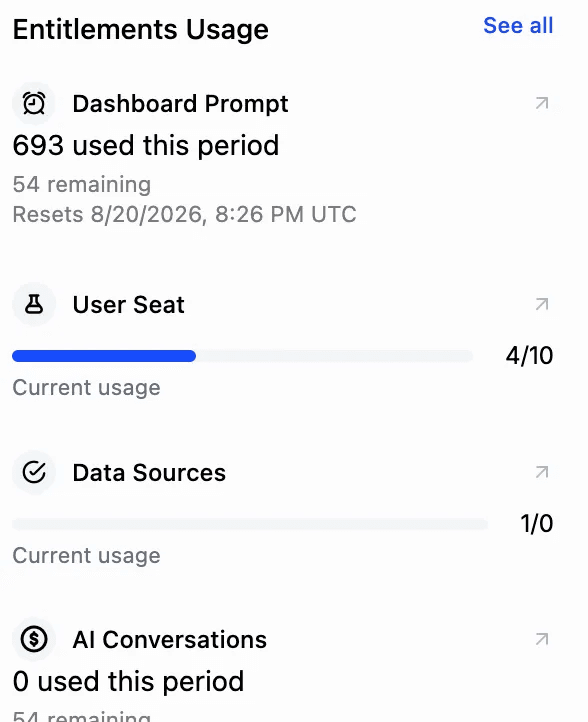
Both vendors and customers can see entitlement usage and predict spend without filing an engineering ticket.
Similar to Schematic, Stigg moves entitlement logic outside the application. Teams can launch new pricing models, usage tiers, or features without code deployment.
The main difference is that Schematic ties entitlements closely to its broader usage billing system, while Stigg treats them as a core part of its usage runtime application.
Stigg also supports credit entitlements to give customers a set amount of credits every month or year as part of their subscription plan. It is useful for API and infrastructure companies that want to sell extra credits.
2. Runtime Enforcement
Both platforms can return product-access decisions and enforce limits while customers are using the software.
Schematic can check whether an account has the correct entitlements, sufficient credit balance, or exceptions before an action runs.
Teams or customers themselves can set usage limits, warning thresholds, and top-up rules. Schematic's entitlement engine applies those policies the moment they are saved.
One flag check works in React, Node, Python, and Go so that the user interface and the API are always in sync.
Every entitlement check and metered event streams back in milliseconds. Credit balances, limits, and usage stay current everywhere the product reads them.
Stigg focuses on the request path. It can check balance, token usage, plan allocation limits, and large language model (LLM) entitlements for AI monetization.
After entitlement checks, it returns an access decision before a single token runs over the budget.
Once a customer has reached their cap, Stigg automatically enforces limits and denies further access. It also supports soft caps, where access is granted after exceeding the limit.
3. Usage Metering and Billing
With Schematic, AI and software companies can meter usage events once. That event stream can feed entitlements, invoices, credit wallets, and revenue analytics without double counting.
Schematic's usage billing engine also supports different consumption-based pricing models. Ship pay-as-you-go, pay-in-advance, fixed fees with usage overages, volume pricing, prepaid credits, and hybrid pricing models.
You can even replay usage against a draft plan to learn how it impacts recurring revenue. Test changes safely before rolling out the new plan to the entire customer base.
Stigg, on the other hand, offers real-time and high-throughput event ingestion. Metering engines run in the Kubernetes cluster and are a key component of the bring-your-own-cloud (BYOC) environment.
Stigg can track and aggregate every token, inference call, and agent action for billing. It also generates invoices based on metered usage.
However, Stigg largely remains a usage runtime platform instead of a billing system.
4. Credit Infrastructure
Both Schematic and Stigg are neck and neck when it comes to credit billing infrastructure. This becomes useful, considering that credit models grew 126% year-on-year in 2025 based on a Growth Unhinged report.
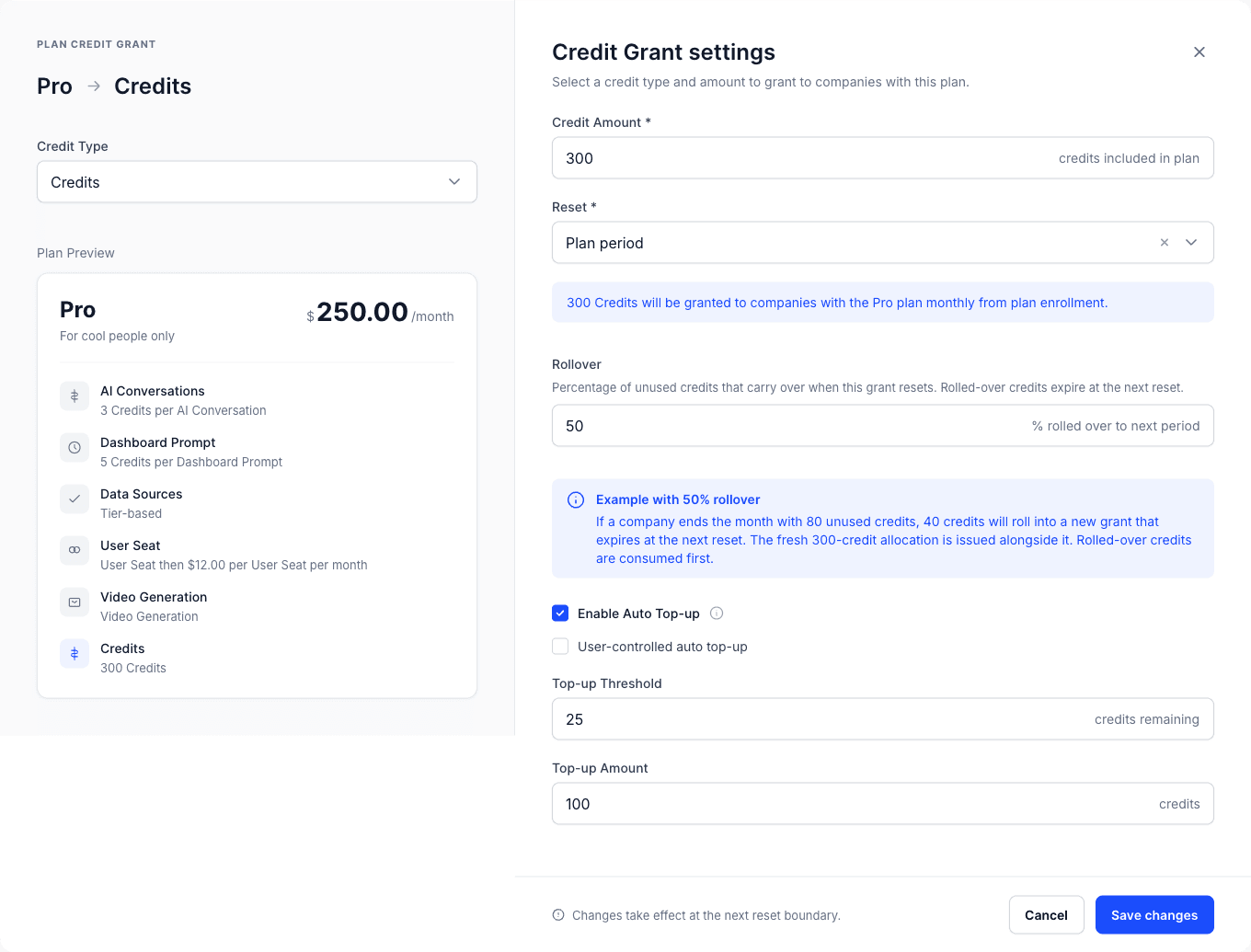
Schematic stands out for its robust credit wallets. These give enterprise customers real-time visibility into usage, spend forecasts, self-service controls, and configurable spending limits. They no longer fear surprise bills or unexpected access throttling.
Plus, the ability to set usage caps, enable auto top-ups, enter top-up amounts, set thresholds, and receive warnings gives buyers the confidence that bills align with their expectations.
Rahul Gill from Macabacus shares, "Schematic's ability to offer usage caps, bundles, and top-ups gave our customers the cost predictability they need."
Stigg is known for its financial-grade credit infrastructure. It combines wallets, ledgers, burn-down rules, expiry rules, and priority consumption logic.
Engineers no longer build credit systems from scratch and write code to solve every edge case in contract billing.
Commercial teams can grant credits to customers regardless of whether they have an active subscription plan. They can specify exact start and end dates for expiring credits. Plus, they can enable auto-recharge to prevent an account’s prepaid credit balance from running low.
5. Usage Visibility and Self-Service Controls
Schematic gives enterprise customers real-time visibility and control over their consumption. They can see exactly what they use and owe as they use the product.
Buyers can also set spending limits and define what happens at the cap to prevent runaway bills. Hard limits block access once the usage threshold is reached. Soft limits enable continued usage and bill additional activity as overages.
Schematic's self-service portal even lets customers select plans at checkout, add more seats, buy add-ons, manage top-ups, and purchase credit bundles.
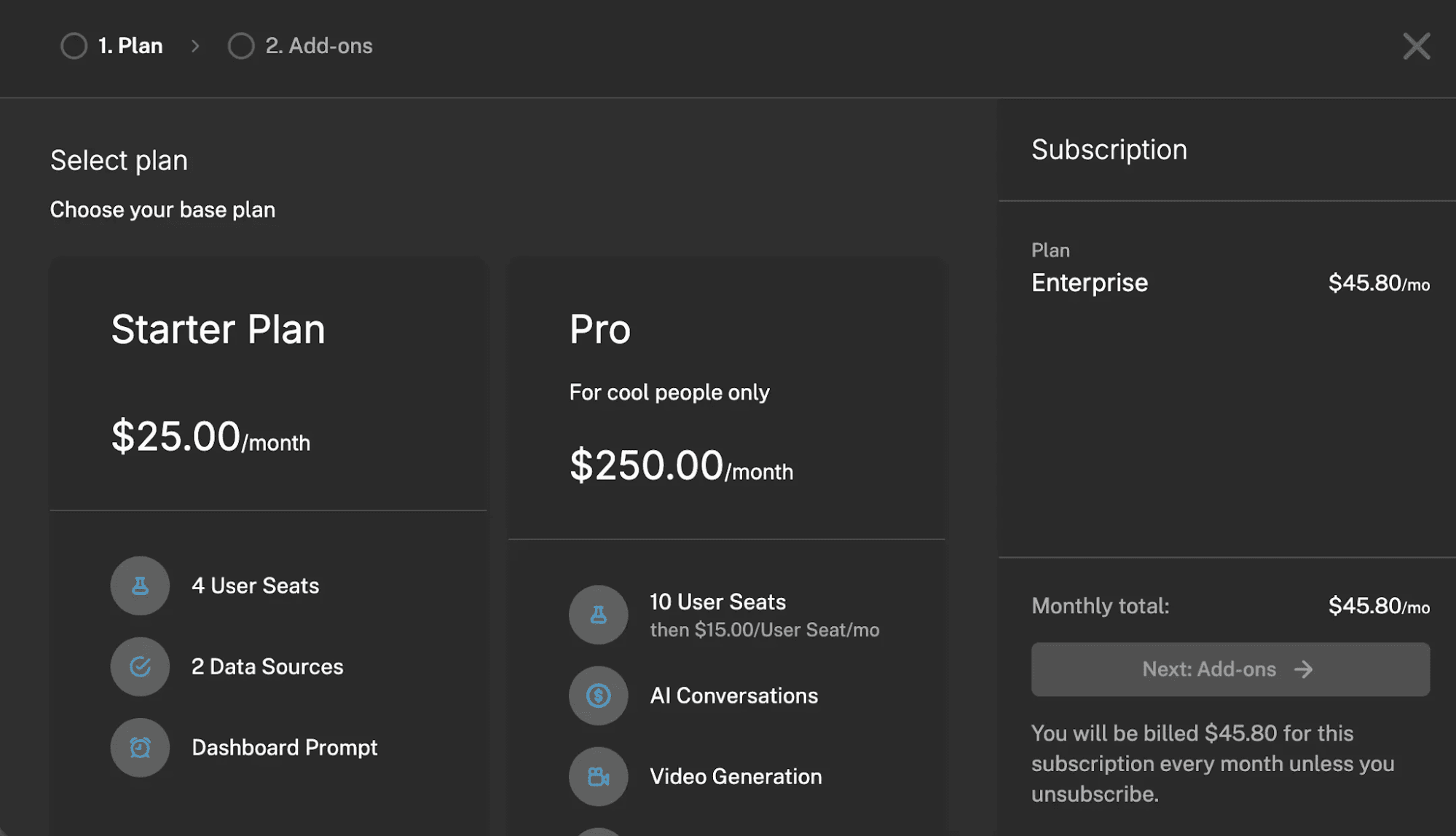
Stigg offers self-serve spend controls through its governance component. Customers set budgets for users, teams, agents, and other entities. Those budgets can then be checked at call time.
Stigg also provides customer portals and credit widgets, which display the live balance for the selected product or feature.
6. Reliability and Security
Schematic is built for enterprise software, AI, and infrastructure businesses.
For reliability, it offers a 99.99% uptime SLA, 24/7 support, and a public status page that displays live and historical uptime.
Max Ade from Pickleheads says, "Schematic's customer support and response time to feature requests is outrageously good compared to other SaaS providers we work with."
To ensure data security and privacy, Schematic complies with SOC 2 Type 2, GDPR, and PCI Level 1 requirements through Stripe integration. It also provides audit logs and real-time events, client-side rule evaluation, and the Replicator to keep reads inside the customer’s network.
Stigg uses Sidecar, a lightweight service that can cache entitlements and current usage. It provides fail-safe resiliency during network issues. The Sidecar ensures that Stigg remains operational and returns valid read responses.
When it comes to security, Stigg maintains SOC 1 Type 2, SOC 2 Type 2, and ISO 27001 certifications. It also meets GDPR compliance requirements through flexible access, data archiving, and private-first infrastructure.
7. Developer Experience
Schematic includes monetization SDKs and the REST API to help developers integrate it into their billing infrastructure.
The platform supports Node.js, Python, Go, Java, C#, and Ruby for reporting usage from your backend. Client-side SDKs like React, Next.js, Vue, Angular, and JavaScript can also run in Schematic.
Plus, Schematic includes a hosted model context protocol (MCP) server. This lets you connect Claude Code, Codex, or Cursor to billing context inside Schematic.
By using a single prompt, you can instruct these AI agents to model pricing, identify customers near their limits, check usage, and attach rate plans to an account.
Developers no longer need to deploy code when changing pricing and packaging. Commercial teams can continuously iterate on monetization without engineering time.
Like Schematic, Stigg includes developer-friendly SDKs and the REST API for integrating the system into the codebase.
This integration only needs to happen once when adding a new feature. Pricing updates can then be owned by product managers instead of engineers.
The main difference lies in what developers are connecting. Schematic gives teams one engine for billing, metering, pricing, credits, and entitlements. Stigg centers its developer tools more closely on runtime access enforcement and governance controls.
8. Pricing Iteration
Schematic stores pricing as data on a real-time ledger. Define, manage, and change your pricing through configuration instead of an engineering sprint.
Schematic also lets you version plans, migrate customers, support legacy accounts, and preview changes before publishing them.
Plus, out-of-the-box billing tools help you create custom plans with isolated budgets per seat or per agent, launch trial pricing, and set payment terms without engineering help. These allow you to continuously iterate on monetization.
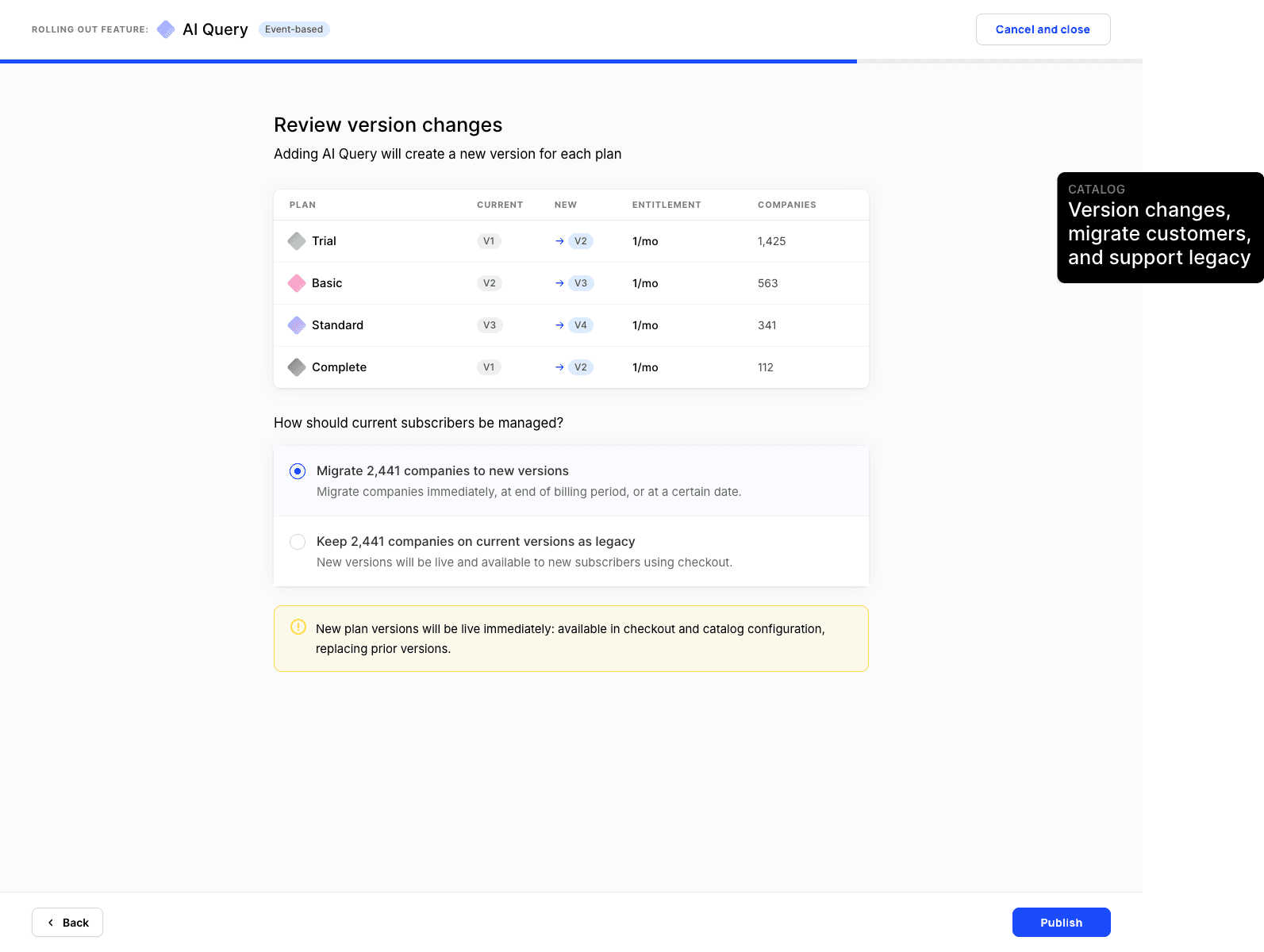
Stigg also supports no-code pricing and packaging changes. It works by decoupling entitlement logic from the application's codebase.
With Stigg, you can ship new pricing models, tiers, and features without deploying code. You no longer need to rely on engineering if you need to update plans, usage limits, or credit grants.
9. Integration Capabilities
Schematic integrates with your existing tech stack. It connects to Stripe's payment solution, customer relationship management (CRM) software, data warehouses, and identity providers. It also provides webhooks to keep external services up to date when data changes.
In setups where Stripe Billing manages subscriptions, collects payments, and calculates taxes, Schematic offers a two-way sync. That means subscriptions and customers flow into Schematic to power entitlements. Pricing changes made inside Schematic are sent back to Stripe.
Stigg takes a more vendor-neutral approach. It layers on top of existing billing systems, such as Stripe Billing, Chargebee, and Zuora.
Then, it feeds entitlement, credit, and usage data into the rest of the revenue stack. That can include CRM software, enterprise resource planning (ERP) and accounting systems, data platforms, and invoicing tools.
For companies with more complex sales flows, integrations with procurement and marketplace tools are also useful.
10. Pricing Plans
Schematic offers three pricing plans that bill companies on a monthly or yearly basis.
- Starter (Free): Comes with 10 subscriptions, 2 company overrides, 500k events per month, and unlimited flags, companies, components, and features.
- Growth ($400/month): Includes unlimited subscriptions, 20 overrides, 10m monthly events, a single webhook, and a 30-day audit log retention.
- Enterprise (Custom pricing): Offers everything in Growth plus unlimited overrides, events, premium support, role-based access control, and other premium features.
Stigg's pricing is more complex. Customers can choose from four different tiers.
- Build (Free): Offers 5M usage events per month, 10k managed entities, and 1k events per second.
- Pro ($499/month): Adds 25M usage units, 10k managed entities with support for graduated pricing, and 10k events per second.
- Scale (Custom pricing): Growing teams get committed event volumes, committed entity blocks, and 50k events per second.
- BYOC (Custom pricing): AI companies can deploy Stigg in their environment and receive unlimited entities, fixed license fees, and 1M events per second.
How to Choose Between Schematic and Stigg
The choice between Schematic and Stigg will depend on how much ownership you need over the AI and SaaS monetization platform.
Both solutions can manage entitlements, enforce usage limits at runtime, and give customers self-service controls. But Schematic is specifically designed for companies that sell to enterprises because it provides billing, price modeling, credit management, and revenue recognition tools.
Choose Schematic when you need:
- Complete usage-based billing in one platform
- Enterprise credit wallets and credit-based pricing
- Usage metering that powers entitlements, invoices, and subscription analytics
- Runtime entitlement checks and limit enforcement
- Spend forecasts, self-service controls, and spending limits configured by customers
- Sales-led overrides and custom enterprise terms
- One engine to carry a customer from first checkout to renewal
- A built-in MCP server for AI tooling
Stigg makes sense if you need:
- Runtime entitlement checks
- Live access decisions before a request runs
- Decoupled software entitlements
- Financial-grade credit infrastructure
- Flexible deployment methods
- Usage governance
- More out-of-the-box integrations
Schematic is the better fit when you want metering, billing, pricing, credits, runtime enforcement, and customer controls in one system. Stigg makes more sense when billing already lives elsewhere, and you only need to control live enforcement inside the product.
Launch Usage-Based Billing Your Customers Trust and Enforce Limits With Schematic
Schematic is the best usage-based billing platform for software and AI companies selling to enterprises. It delivers customer trust structurally by providing detailed invoices, clear usage caps, alerting policies, and self-service controls.
Your app does not need to know each customer’s billing state. One call can allow or deny an action before a feature runs. Engineering no longer builds entitlement infrastructure from scratch.
Schematic stands out for its native credit wallets and a runtime entitlement engine. These give enterprise customers real-time visibility into usage, spend forecasts, and configurable spending limits.
Buyers no longer fear surprise bills or unexpected access throttling. Instead, they gain confidence that usage will stay within budget and that they will only be charged for what they expect.
As a result, companies can close enterprise accounts faster, drive expansion, and earn more revenue over time.
FAQs About Schematic vs. Stigg
How do Schematic and Stigg handle access to AI products?
Both platforms can check entitlements, credits, and usage limits before an AI action runs. Schematic ties those checks to billing and customer plans. Stigg focuses more on runtime enforcement for AI products and API monetization.
Which is better for subscription billing and subscription management: Schematic or Stigg?
Schematic is the better fit if you need a subscription billing platform with usage metering, billing, price modeling, credit management, entitlement checks, and customer controls. Stigg falls short as a subscription and recurring billing platform because it only handles usage runtime enforcement.
Does Schematic support revenue reporting and recognition?
Yes. Schematic records credit grants, deductions, and other billing activity in an append-only ledger. Teams can use this data for revenue reporting and recognition. It also provides billing automation tools to reduce manual work tied to usage and credit-based charges.