All posts
What Is Custom Pricing Software and Do SaaS Teams Need It?
Blog· Ryan Echternacht·Aug 27, 2026
Ryan Echternacht·Aug 27, 2026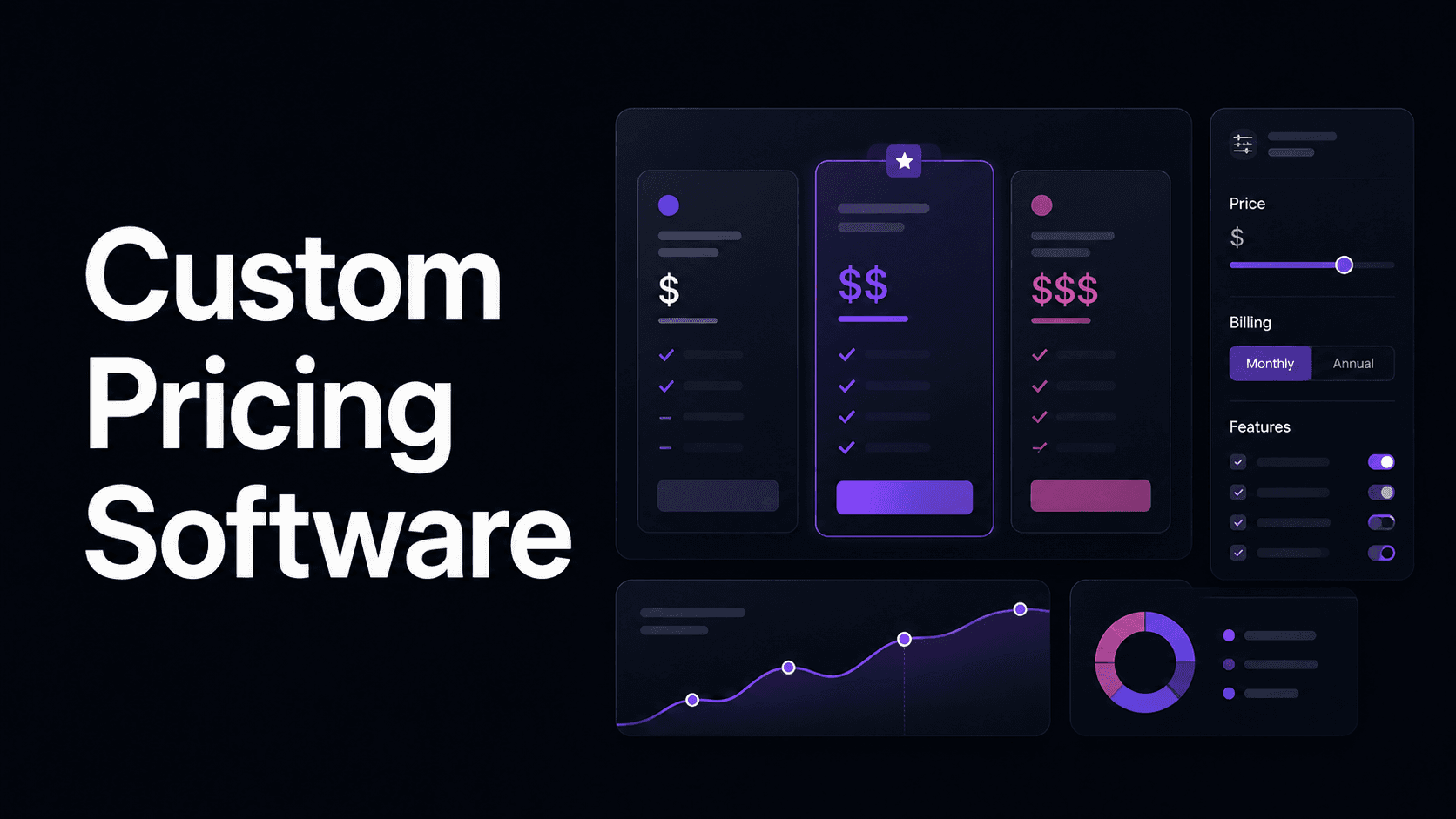
SaaS pricing often starts simple. You may offer a few subscription plans with fixed recurring fees. But as your company grows and attracts different customer segments, software monetization becomes more complex.
Enterprise buyers may ask for custom pricing, additional features, volume discounts, or special usage limits. Commercial teams might also want to test new pricing models, grant credits, or build custom plans for strategic accounts.
This is where custom pricing software can help. It gives you more control over how you set up and manage prices, plans, and billing rules. It can also reduce manual work and eliminate the need for constant engineering support.
In this guide, we’ll explain what custom pricing software means and whether SaaS companies need it.
What Is Custom Pricing Software?
Custom pricing software is a dedicated pricing solution that lets SaaS companies set tailored pricing rules and strategies that go beyond standard subscription models.
Unlike traditional SaaS pricing software, it supports complex pricing structures, such as metered billing, hybrid models, enterprise overrides, dynamic discounts, and multi-dimensional rules.
It also helps SaaS teams offer customer-specific prices based on the buyer's account size, order volume, region, and requested product configuration.
Custom pricing software usually integrates with CPQ (configure, price, quote), CRM (customer relationship management), and ERP (enterprise resource planning) solutions to centralize pricing workflows.
It empowers sales reps to close complex deals faster and allows RevOps teams to iterate on pricing strategies without engineering support. It turns pricing into a scalable, strategic lever for growth.
Schematic Is the Best Pricing Software for Launching Custom Plans
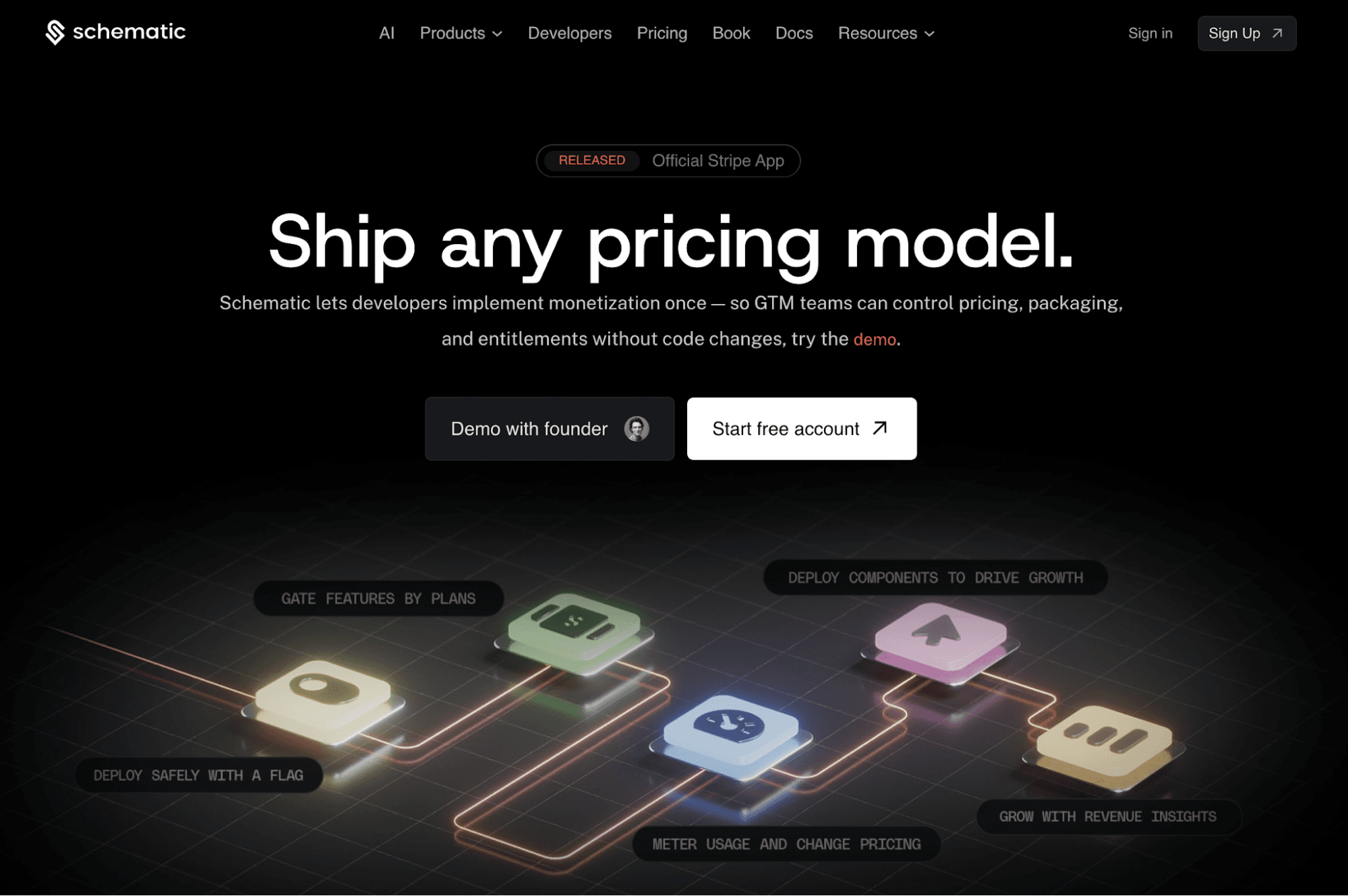
Schematic provides a complete monetization platform for SaaS and AI companies selling custom plans to enterprise customers. It makes usage-based billing and hybrid models something that buyers can trust by giving them complete visibility and control over their usage.
Schematic treats custom plans as a first-class object. Commercial teams build the plan with the negotiated pricing terms and software entitlements and assign it to a single company. Then, they send a payment link or allow the customer to pay by invoice.
Custom pricing stops being a bottleneck because engineering teams are out of the per-deal path. They simply need to instrument entitlement checks, send usage events, and handle the webhook callbacks.
After that, future custom plans run through the same system. The same person who created the initial plan changes it when the terms get renegotiated.
The result? Buyers get faster price responses. The customer success manager has everything they need for account renewals. The business unlocks deal velocity and real quote-to-cash motion.
Do SaaS Companies Need Custom Pricing Software?
Yes, some SaaS companies need custom pricing software. Below are several signs that indicate your business might require one.
Enterprise Deals Require Exceptions and Non-Standard Terms
Enterprise buyers often ask for custom terms that are not included in traditional plans published on your pricing page. They may want volume discounts, minimum commitments, special billing schedules, higher usage limits, or custom service-level agreements (SLAs).
If your sales team handles these requests using spreadsheets, email threads, or manual approval workflows, pricing can become hard to control. One buyer may receive terms that differ from another account with a similar deal.
Custom pricing software becomes a strong option when these exceptions become common rather than rare. It gives revenue teams a structured way to define special terms while retaining control over profit margins, discounts, and contract rules.
Customers Demand Flexible Packaging
Some customers do not fit into good-better-best plans. They might request certain modules, extra add-ons, pooled credits, or a mix of services that do not match your standard packages.
The problem arises when your current pricing engine only supports fixed plans. Your team may have to create one-off workarounds each time a buyer requests a different package.
Custom pricing software is worth considering in this case. It lets you define how products, modules, limits, and add-ons can be combined without forcing every customer into the same plan structure. You also avoid manually setting prices for each deal.
Frequent Pricing Errors Cause Revenue Leakage
Pricing errors can happen when custom agreements are stored in several places, and teams have to manually reconcile data.
Sales reps usually record a discount in the CRM. Finance teams do not see the same data reflected in their tools, so they may generate inaccurate invoices.
Engineering, on the other hand, may apply a different rule inside the product. A week later, the customer is asking when they can see the discount reflected in their dashboard.
These gaps can lead to missed charges, incorrect discounts, or customers paying less than agreed. According to a KPMG survey, 25% of respondents said that billing errors cause revenue leakage.
Custom pricing software helps reduce these mistakes to prevent revenue leakage and protect margins.
It works by centralizing product prices, contract terms, discount rules, and credit rollover policies. Teams can rely on a single system instead of sorting through different files and spreadsheets.
Custom Plans Take Engineering Time
Launching custom plans often requires weeks of engineering work.
A sales rep may close an enterprise deal, then send a request to engineering to add special features, pricing rules, or billing logic.
That process can slow down both sales and product. Developers spend time building one-off pricing logic instead of fixing bugs or releasing software updates.
Custom pricing software gives RevOps teams control over pricing management without asking engineers to ship software.
Custom plans stop being a sprint-long project. They become a quick setup that an account executive or solutions engineer can handle directly.
Lengthy Sales Cycles Due to Manual Pricing Processes
Manual workflows can slow down deals even when a buyer is ready to move forward. Sales reps may need to ask finance for approval, check discount rules in spreadsheets, confirm product limits with engineering, and wait for someone to prepare a custom quote.
These steps create delays between negotiation and contract signing. They can also make it harder for reps to answer pricing questions during live sales calls.
Custom pricing software becomes useful when manual pricing processes repeatedly slow down deal approval.
If your team spends too much time checking rules or building custom offers from scratch, a dedicated pricing solution can standardize how they create and approve non-standard offers.
Unable to Support Usage-Based and Hybrid Pricing Models
Traditional billing platforms may work well for flat-fee subscription plans. However, they might struggle when custom deals include usage-based charges, seats, credits, and volume tiers.
For example, a SaaS company may charge a base platform fee plus usage, or combine seats with AI credits that have varying burn rates. These complex pricing structures require different rules than a simple subscription plan.
Custom pricing software may be needed when your current system cannot implement these monetization models without manual calculations or one-off code.
It's especially useful when customers have different usage rates, tier thresholds, minimum commitments, or billing terms that must be handled under the same product offering.
Benefits of Using Custom Pricing Solutions
If your SaaS company decides to use custom pricing software, you can benefit from it in several ways.
Launch Custom Plans Faster
Custom pricing software solutions allow sales and revenue teams to create custom plans without asking engineers to build a new code path for every deal.
Commercial teams can define pricing, limits, usage rates, billing cycles, and feature access independently from developers.
This speeds up the entire quote-to-cash motion. The quote, order form, metered billing, lifecycle management, and renewal flow into one source of truth.
When terms change after the deal closes, authorized team members can also make price changes without filing a new ticket for each update.
Engineering can focus on core product development, while commercial teams handle approved plan changes through the pricing system.
Support Flexible and Dynamic Pricing
Custom pricing software can support flexible pricing that changes based on customer segment, usage volume, contract agreements, or other defined rules.
SaaS companies can easily combine flat fees, seats, credits, usage charges, add-ons, and overages within the same pricing setup.
This flexibility gives teams more room to adjust offers as customer needs and market conditions change. They can use internal sales data and external market data when making pricing decisions, then update pricing rules without rebuilding the entire billing infrastructure.
SaaS companies can sell to different customer segments and use more than one pricing model for any go-to-market strategy.
Increase Customer Satisfaction
Enterprise customers may need different pricing structures. One account might need higher usage limits, while another wants custom add-ons, a longer grace period, or a different billing schedule.
A custom pricing solution can apply those special requests to the customer’s actual plan. Buyers are less likely to face a gap between what sales promised and what the product or invoice shows.
Teams can also set optimal prices based on the value, usage, and terms tied to each deal instead of forcing every account into a fixed package. This leads to a positive purchasing experience, especially for enterprise customers who expect pricing and access rules to match their unique needs.
Gain Competitive Advantage
SaaS buyers often compare more than product features. They may also look at contract agreements, additional services, payment methods, billing schedules, and whether a vendor can support their long-term needs.
Custom pricing software helps you respond quickly when a strong prospect asks for a plan that falls outside standard packages. That flexibility can help your company stay competitive without adding more work for your developers.
It can also become a strategic advantage when competitors only offer fixed plans or require long internal approval processes for custom terms. Your team can handle qualified deal requests faster while still keeping pricing rules, access, and billing details under control.
Support Scalability
When a custom deal closes, it's quick to hardcode a special seat count, usage cap, feature, or discount for one customer. This setup can work if you only have a few custom plans.
The problem starts when dozens or hundreds of accounts get unique terms. Each new exception can add another rule to the product and billing software. Over time, teams may struggle to see exactly what each customer bought and which rules apply to them.
A custom pricing tool gives teams one place to define and manage those account-specific terms. This makes it easier to support more custom plans as your business grows.
Build vs. Buy: Custom Pricing Software
Many SaaS companies never plan to build a custom pricing solution. They just want to launch custom plans and close deals.
The fastest path typically involves adding a one-off feature flag or a special-case configuration in application code for a specific account. Developers hardcode the custom limit or the feature that isn’t in any standard plan.
That works for a few accounts. But as the number of customer exceptions increases, so does the code.
Teams end up with scattered pricing logic, no clear source of truth, and an ad hoc system that becomes harder to maintain and scale.
Below, we'll discuss why building custom pricing software is generally a bad idea and why teams should consider buying an established platform instead.
Why You Shouldn't Build Custom Pricing Software
While having a system built around your own business logic may sound appealing, pricing changes often involve many moving parts. Developing custom pricing software can impact business efficiency and your bottom line.
- High maintenance burden: Every new plan, discount, usage rule, or contract exception can lead to a tangled mess of code that engineers need to maintain. Pricing logic is no longer predictable because it’s brittle and scattered across systems.
- Loss of customer trust: The system is not just hard to maintain; it’s also difficult to trust. Custom deals require manual work, which can result in pricing errors, inaccurate invoices, or mismatched contract terms.
- Opportunity cost for developers: When custom pricing is hardcoded, developers spend time writing billing code instead of building product features, improving performance, or addressing customer needs.
- Pricing bottlenecks: RevOps teams often rely on engineering for setting pricing rules, adding custom limits, or changing plan terms. That slows down deals and pricing changes.
Why You Should Buy Custom Pricing Software Instead
Buying a dedicated custom pricing tool makes more sense when engineering resources are limited and configurable software provides enough flexibility. Here are the main reasons to consider purchasing one:
- Reduced engineering burden: Commercial teams manage pricing changes, limits, and plan overrides without turning every request into a development task for engineers.
- Faster time-to-market: Your SaaS business can launch custom plans in weeks, not months.
- Lower upfront investment: Buying software often requires lower initial spending than designing, building, and testing an internal pricing system.
- Predictable ongoing costs: Subscription-based pricing makes it easier to plan software expenses than dealing with changing internal development and maintenance costs.
- Tried-and-tested scalability: Established pricing platforms are built to support growing transaction volumes, custom plans, products, and accounts.
- Access to experts: Vendors provide technical support and knowledge about industry best practices that internal teams may not have.
Key Features to Look for When Buying Custom Pricing Software
Once you decide to buy instead of build, you'll find several options on the market. Here are the key features you should focus on when evaluating different custom pricing solutions.
Support for Different Pricing Strategies and Models
Look for custom pricing software that can handle various pricing strategies and models. Popular examples include flat-rate subscriptions, usage-based pricing, per-seat pricing, value-based pricing, and hybrid models.
It should also enable teams to execute price segmentation for multiple customer groups or product categories.
A unified platform makes it easier to manage different pricing structures without spreading logic across billing tools, spreadsheets, and application code.
Price Optimization and Management
Some platforms use pricing algorithms to suggest prices based on internal data, market trends, and competitor pricing.
SaaS companies receive valuable insights that help them set the ideal price point that can maximize revenue earned from one account.
The best custom pricing software also enables revenue teams to manage prices, rules, discounts, and contracts in one place.
Workflow Automation
Pricing software should reduce the number of manual steps needed to create and launch custom plans. Some AI-powered tools can also help flag unusual discounts or pricing requests.
Look specifically for automated workflows, rule-based approvals, proactive notifications, and no-code plan configurations. These controls help SaaS businesses maintain consistent pricing while allowing sales and RevOps to close deals faster.
Built-In Integrations
Choose custom pricing software that connects to your existing tech stack. This typically includes your CRM software, CPQ platform, accounting tools, payment solutions, and data warehouses.
Built-in integrations reduce manual data entry by automatically syncing records between different systems and sales channels.
Pricing Analytics
Pricing analytics show how different custom plans, segments, selling channels, and pricing models perform.
Confirm that the custom pricing solution can track key metrics, such as monthly recurring revenue, average deal size, expansion revenue, churn rate, and customer acquisition cost.
These clear pricing insights help you understand which offers are working and where buyers usually drop off. You can use this data analysis to refine your custom pricing strategy.
How to Choose the Right Custom Pricing Solution
Choosing the right pricing software goes beyond looking at features. Here are other factors to keep in mind when evaluating pricing platforms.
Assess Pricing Flexibility
Look for pricing software that can support your current pricing model and future changes. You should be able to adjust tiers, usage rates, discounts, add-ons, and contract terms without overhauling the entire system.
Check whether it can respond to market changes and competitor data. Then, make sure you can conduct tests around demand and price elasticity.
Avoid choosing a tool that becomes too rigid and limiting as your SaaS pricing grows more complex.
Evaluate Usage Billing and Metering Capabilities
Many SaaS companies are turning away from seat-based and static subscriptions. They are switching towards usage-based or hybrid pricing models, where product value is closely tied to how modern customers use the product.
If you charge for usage, verify that the custom pricing tool supports real-time metering and aggregation. Check if it can process different usage metrics (e.g., API calls, tokens, or transactions) and translate them into accurate invoices.
Then, review how the software handles tiered usage, overage pricing, minimum commitments, and prepaid credits. It should help you ship any usage-based model without complexity.
Look at APIs and Developer Experience
Evaluate the quality of the pricing platform’s APIs, documentation, SDKs, and testing tools. Your developers should be able to connect pricing with your product, checkout pages, billing system, and internal tools without heavy custom work.
Strong API support also allows your application to deliver prices in real time when customers upgrade, purchase add-ons, or request overrides.
Review Compliance and Tax Support
Check whether the custom pricing software supports the tax, invoicing, and compliance needs of the regions where you sell. This is especially important if your SaaS company serves customers in different countries.
Review how the platform handles tax calculation, audit logs, user permissions, and data security controls. Make sure these features meet your finance and legal requirements before you commit.
Calculate Total Cost of Ownership
It's tempting to go with the vendor that offers the lowest price. However, you should look beyond the subscription fee and calculate other expenses. These include integration work, training fees, and implementation costs.
Then, consider how much time the platform can save your entire team. A lower monthly fee may cost more overall if the pricing software still requires heavy engineering work or frequent manual fixes for custom plans.
Request a Product Demo
Once you've narrowed down your options, you can request a demo tailored to your company's needs.
Give the vendor examples of your custom plans, discount rules, contract agreements, and billing needs. Ask them to show how the platform would handle those cases. This makes it easier to identify limitations before signing a contract.
Involve product, engineering, sales, and finance teams during these demos so they can share honest feedback on whether the software is the right fit.
FAQs About Custom Pricing Software
How much does custom pricing software usually cost?
The exact cost of custom pricing software varies by vendor, features, integrations, and support needs. Some tools charge a fixed recurring monthly or annual fee, while others create custom quotes based on company size, transaction volume, or pricing complexity.
What companies are doing personalized pricing?
Personalized pricing is common among B2B SaaS companies and AI businesses. Asana and Zoom are popular examples. While both organizations offer tiered pricing, they also use custom pricing for their most advanced plans to address enterprise buyers' needs.
Is custom pricing software the same as dynamic pricing software?
No. Custom pricing software helps SaaS teams create tailored pricing rules for specific products, plans, contracts, or customers. Dynamic pricing software focuses on changing prices based on market shifts, product demand, stock availability, customer behavior, or other real-time conditions.