All posts
What's the Best Real-Time Billing System? 7 Options in 2026
Blog· Ryan Echternacht·Aug 25, 2026
Ryan Echternacht·Aug 25, 2026
A real-time billing system records product usage and calculates customer charges as each event happens. It does not wait until the end of the month or billing cycle to process usage-based fees.
Unlike traditional billing systems, which are too slow for AI monetization, real-time billing software receives usage events immediately rather than operating downstream of batch updates. Then, it automatically updates the customer’s balance or invoice total.
SaaS and AI companies can get paid faster, improve cash flow, lower credit risk, and reduce missed charges. They also give customers real-time visibility into current usage, spending, and credit balances.
This article breaks down the best real-time billing systems and their key features. We'll also discuss their importance and the criteria to consider when evaluating different tools.
7 Best Real-Time Billing Systems in 2026
Below, we'll compare the best real-time billing solutions and their core capabilities.
1. Schematic
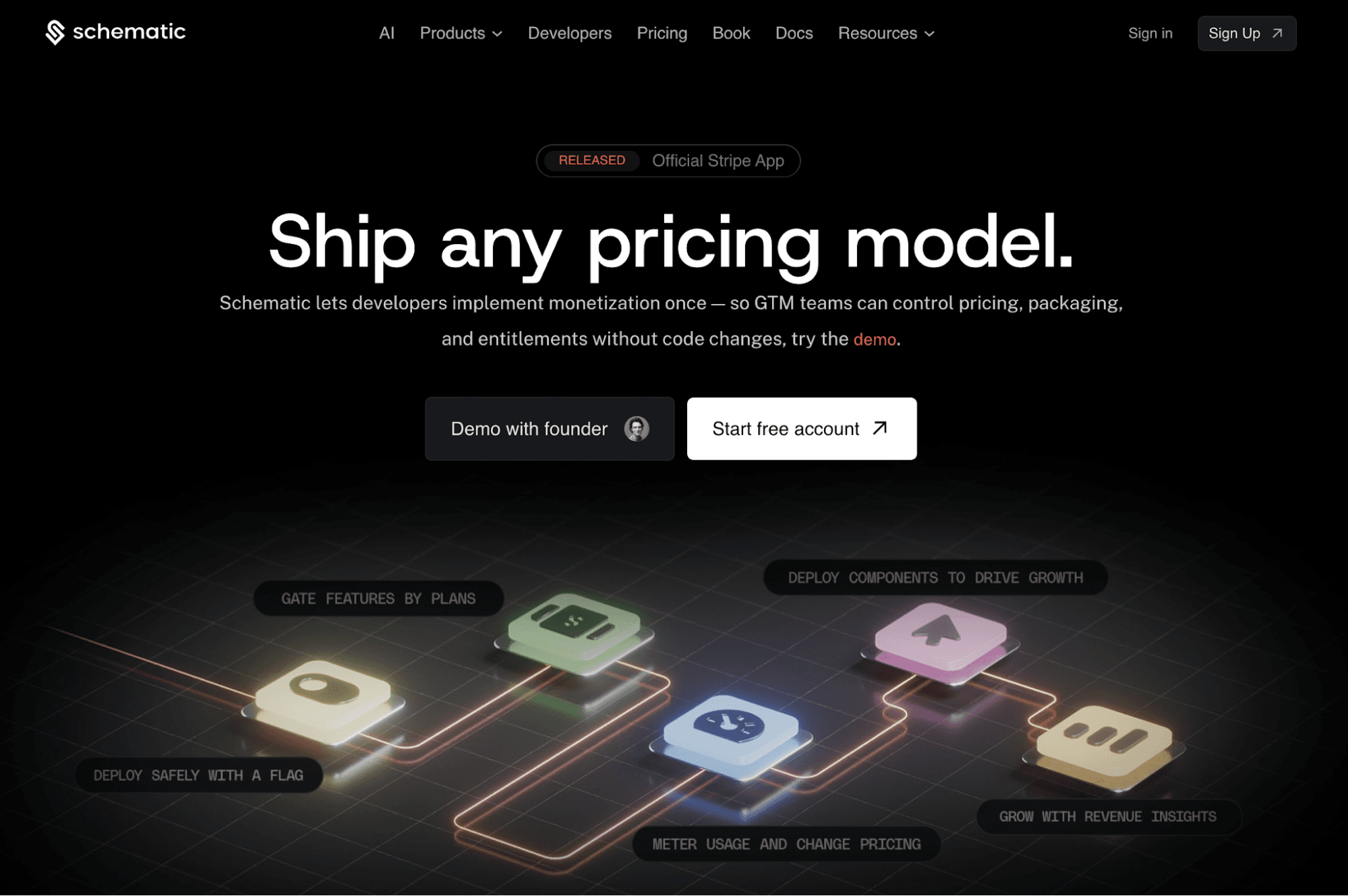
Schematic is the best real-time billing system for SaaS and AI companies that want to bill clients for usage. It helps close large accounts by solving the trust problem in usage-based pricing, whether you're charging for seats, credits, or API calls.
Schematic tracks usage events in real time through its client-side SDKs and server-side APIs. Then, it automatically translates them into billable totals.
The platform can process more than one million events per second, replay or backfill data, and update balances within one second. Idempotent ingest also stops retries from counting the same event twice.
What sets Schematic apart is its real-time entitlement system and enterprise credit wallets. It also provides an accounting-grade ledger that records each credit grant and deduction.
Exactly-once processing, safe retries, and an append-only record draw down the balance in real time to ensure accurate billing.
Unlike traditional billing platforms, Schematic gives enterprise customers visibility into usage, spend forecasts, self-service controls, and configurable spending limits. Customers will only be charged for what they expect and won't be surprised by runaway bills or unexpected access throttling.
This leads to less friction during procurement, faster sales cycles, more predictable expansion, and higher long-term revenue.
Key Features
- Unified product catalog: Define custom plans, add-ons, trials, overrides, limits, and feature access in one place.
- Usage metering: Track millions of usage events and turn them into billable totals within seconds.
- Enterprise credit wallets: Record every credit grant and burn to close the books faster and recognize revenue accurately.
- Entitlement checks: Learn who gets access to what based on boolean flags, event counts, trait thresholds, and one-off grants.
- Usage limit enforcement: Customers can apply hard usage caps, soft limits, or overage pricing.
- Real-time event log: View live grants, deductions, usage events, and access checks for software testing and debugging.
- Plan versioning: Version plans, migrate customers, and launch trial pricing without filing an engineering ticket.
- Company profile: Check each customer’s plan, usage, credits, payment details, and plan history on a single scrolling page.
- Customer visibility tools and self-service controls: Give customers real-time visibility and control over their usage.
- Built-in integration capabilities: Schematic offers bi-directional sync with Stripe, which handles payment collection and tax management. It also connects to data warehouses, customer relationship management (CRM) software, and accounting systems.
2. Metronome
Source: Metronome.com
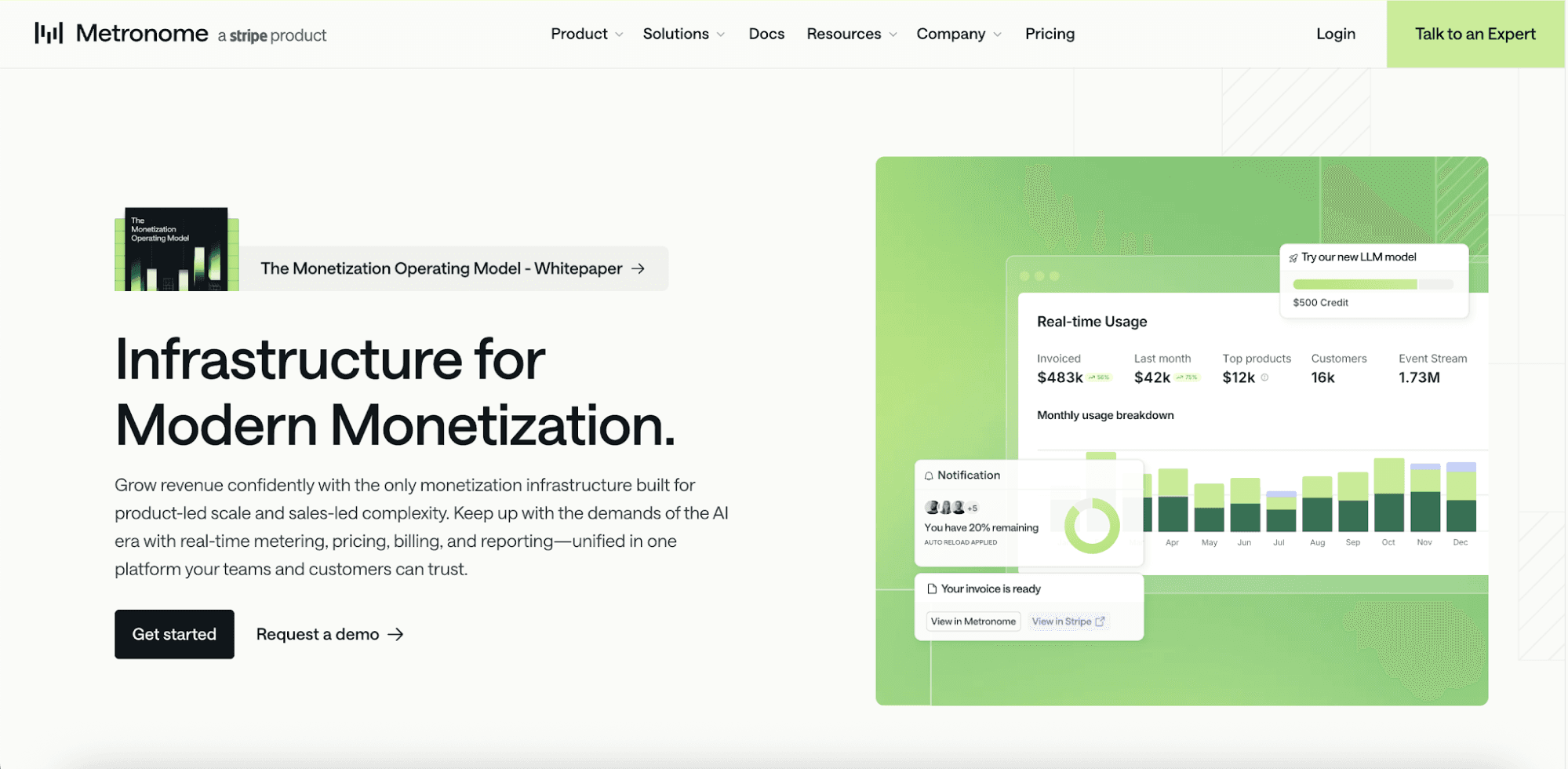
Metronome is a usage-based billing platform with real-time tracking, pricing, and reporting capabilities. It's the single source of truth that the whole team can use to handle monetization for product-led scale and sales-led motions.
Metronome can ingest usage events via APIs, process events through streaming metrics, and generate invoices instantly. It can also apply billing logic and discounts dynamically.
The platform offers a billing dashboard inside the product. This provides clear visibility into real-time usage and spending.
Meanwhile, configurable alerts notify relevant team members of cost-intensive use cases, such as fraud and abuse. They can then act on real-time data to solve billing issues and protect profit margins.
SaaS teams can even manage and update pricing without messy customer migrations. They can use centralized rate cards, commitments, and credit-based models to handle monetization.
Key Features
- Usage tracking and billing: Meter raw usage events and turn them into billable charges in real time.
- Low-latency alerts: Get notified when fraud and abuse happen.
- Modular pricing engine: Configure pricing with rate cards, credits, commitments, discounts, and contract terms.
- Pricing levers: Align pricing with any go-to-market strategy, such as product-led growth, product-led sales, or sales-led growth.
- In-product billing dashboards: Treat billing as part of the product experience by offering customer dashboards, spending thresholds, and cost previews.
3. Orb
Source: withOrb.com
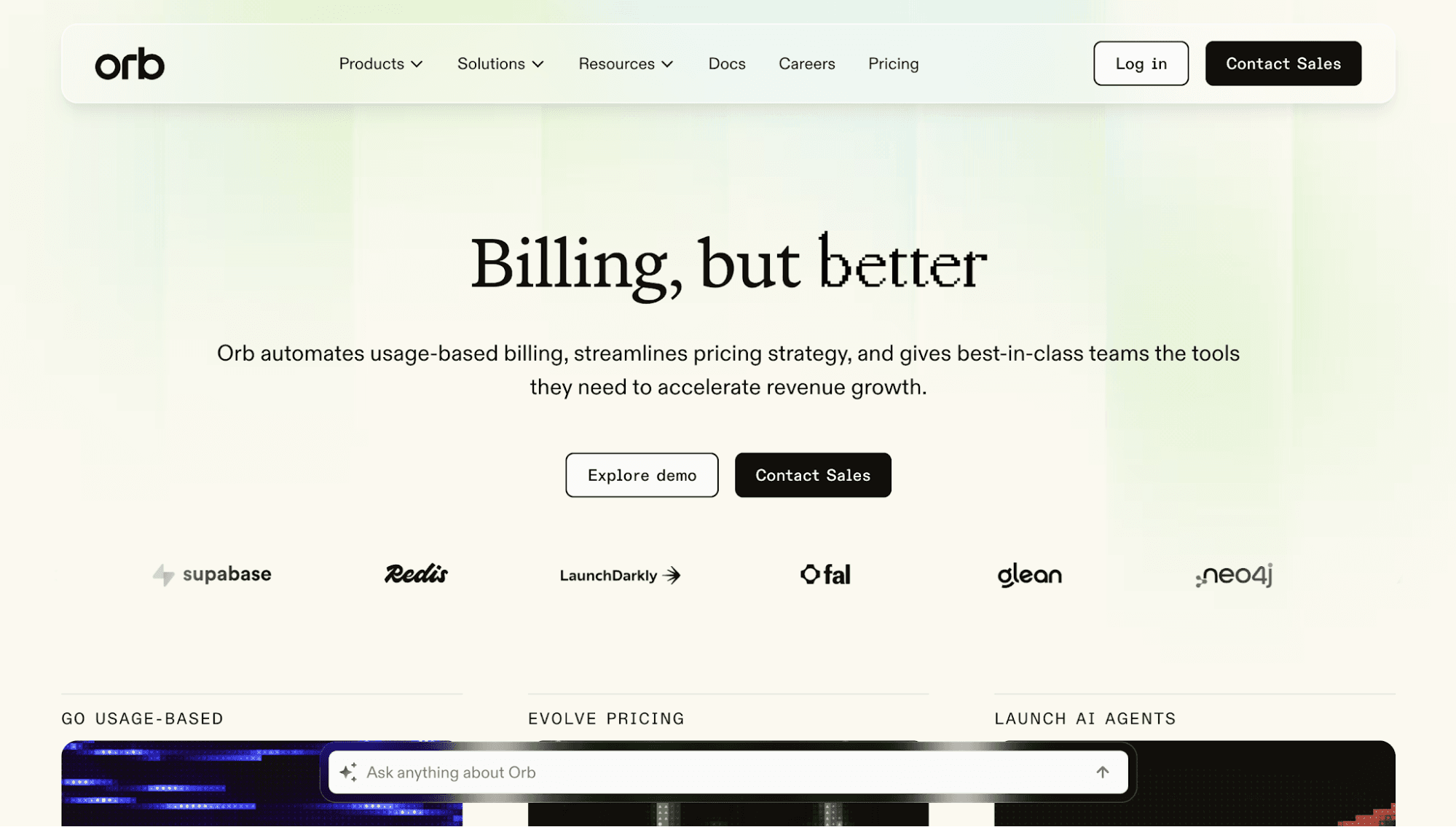
Orb supports real-time billing through a dual architecture. The stream-based alerting system keeps running usage totals in Redis as events arrive. When a customer reaches a set threshold, Orb sends a webhook within seconds.
SaaS and AI businesses can use these signals for usage alerts, rate limits, threshold invoices, and in-product spending controls.
On the other hand, the query-based billing architecture stores raw usage events in a columnar data store. Then, it calculates invoices from that source data within minutes, rather than relying on cached values.
That means teams can apply pricing retroactively, prevent late-arriving events from corrupting existing state, and maintain complete audit trails.
Orb also gives customers real-time visibility into their current billing period usage, credit balance, and line item breakdowns. This improves trust and prevents disputes.
Key Features
- Query-based billing: Store usage events immutably and compute invoices by querying event data.
- Price modeling and simulations: Ship any pricing model and test pricing changes before a full rollout.
- Flexible invoicing: Apply changes retroactively, edit drafts, and send invoices without time-consuming manual reconciliation.
- Spending controls: Usage alerts and automated responses help customers avoid surprise invoices and billing errors.
- Experience kit: Gain customer trust through usage dashboards, pricing calculators, and checkout flows.
4. Stigg
Source: Stigg.io
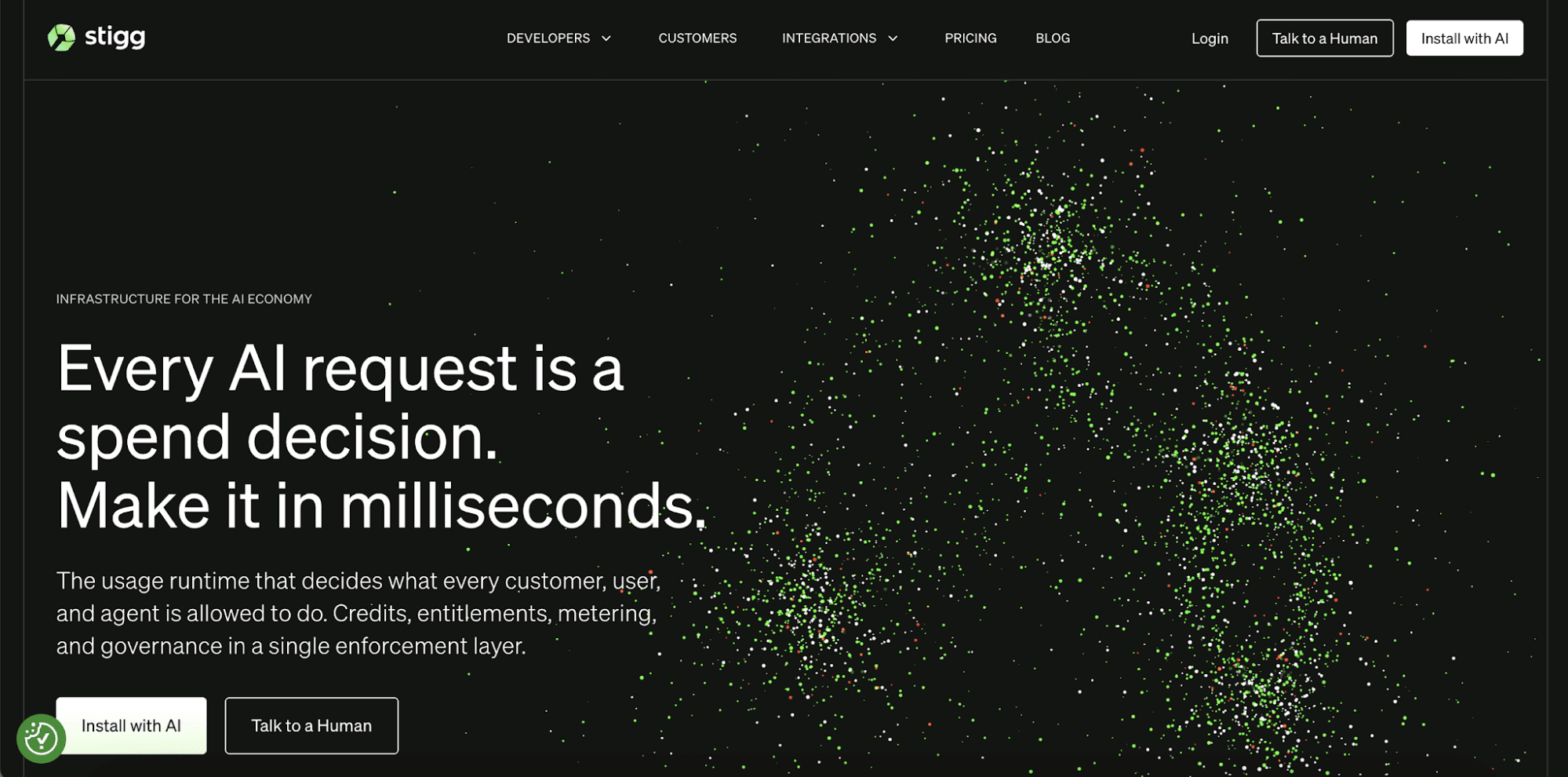
Stigg acts as a usage runtime layer for AI products rather than a traditional billing system. It sits between the product and the billing infrastructure to decide what every customer, user, and agent is allowed to do.
Stigg checks remaining credits, plan limits, and software entitlements before allowing the request. It prevents accounts from running over their budget.
The platform also captures tokens, inference calls, and agent actions through a real-time metering pipeline. It aggregates usage events by model, feature, region, team, or other dimensions.
With Stigg, entitlement logic lives outside the application's codebase. SaaS and AI teams can launch a new tier, gate features, and implement different pricing models without deploying code.
Key Features
- Runtime enforcement: Check credits, usage limits, and entitlements before an AI request runs.
- Real-time usage metering: Capture and aggregate usage events at scale.
- Credit system: Manage wallets, ledgers, expiry rules, burn orders, and priority consumption logic.
- Governance controls: Allow enterprise customers to set budgets, limits, and alerts for every user, team, or AI agent.
- Native integrations: Stigg works with billing providers and other external systems to simplify the billing process.
5. Alguna
Source: Alguna.com
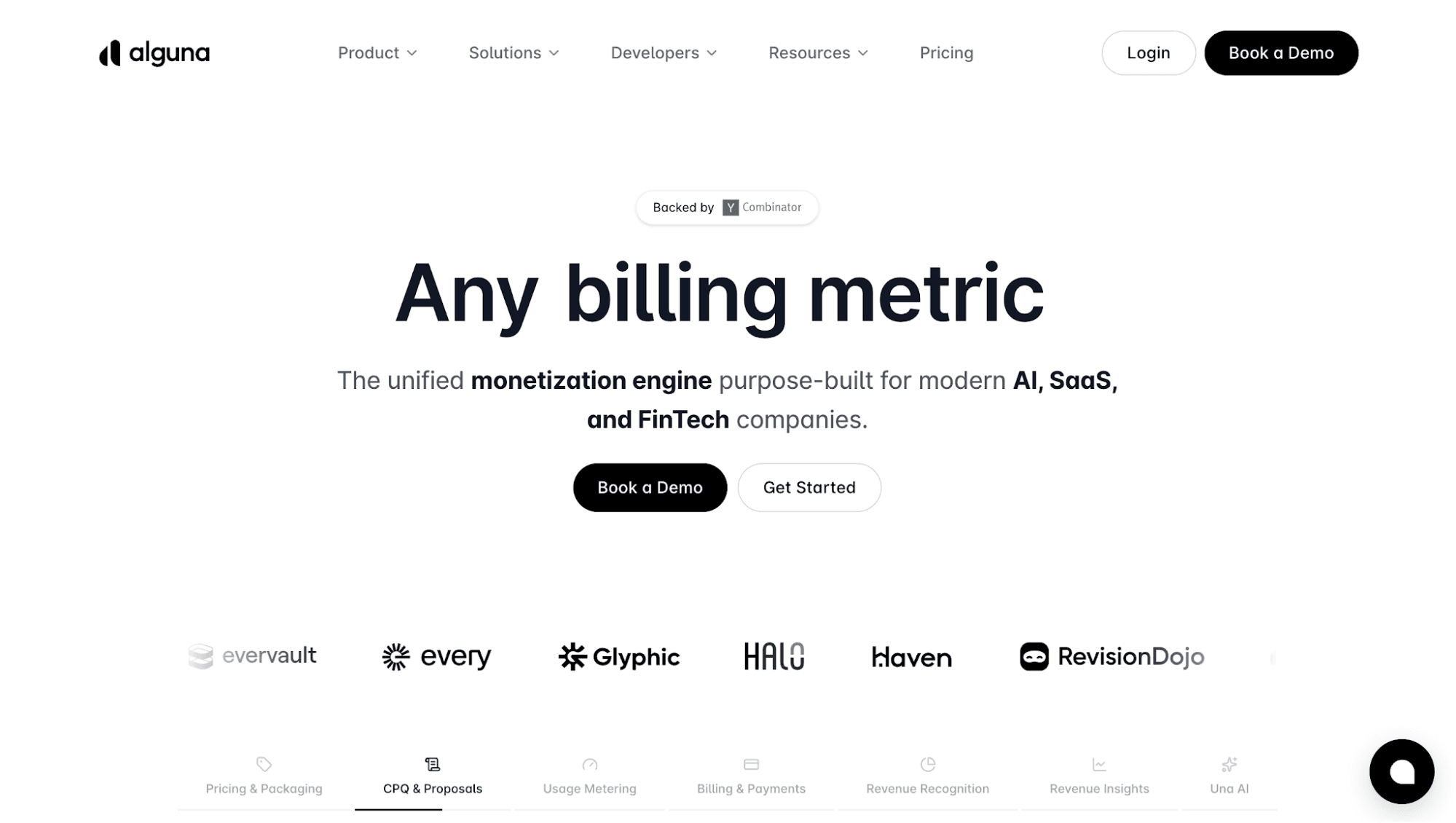
Alguna is a real-time billing system for SaaS, AI, and FinTech companies that use recurring or metered billing.
Alguna's flexible metering engine tracks any usage event, such as API calls, messages, or feature access. Then, it automatically calculates usage-based fees, overages, discounts, or custom rates.
Teams can configure pricing plans without code or manual work required. They simply design subscription plans, add usage billing components, and establish overage rules through a visual interface.
Alguna is also known for its no-code CPQ platform. It can speed up the entire sales cycle by allowing customers to review pricing, accept terms, and sign without leaving the quote.
Plus, Alguna integrates with CRM and enterprise resource planning (ERP) systems to provide a real-time overview of deals and client invoices.
Key Features
- Real-time usage metering: Track billable events and apply pricing rules as usage occurs.
- Flexible pricing and packaging: Build recurring, usage-based, and hybrid plans without engineering involvement.
- Unified sales channels: Manage all channels in one place to save time.
- No-code integrations: Connect Alguna to multiple systems with just a few clicks.
- Revenue recognition: Simplify ASC 606 and IFRS 15 compliance to reduce time spent on closing the financial books every month-end.
6. Maxio
Source: Maxio.com
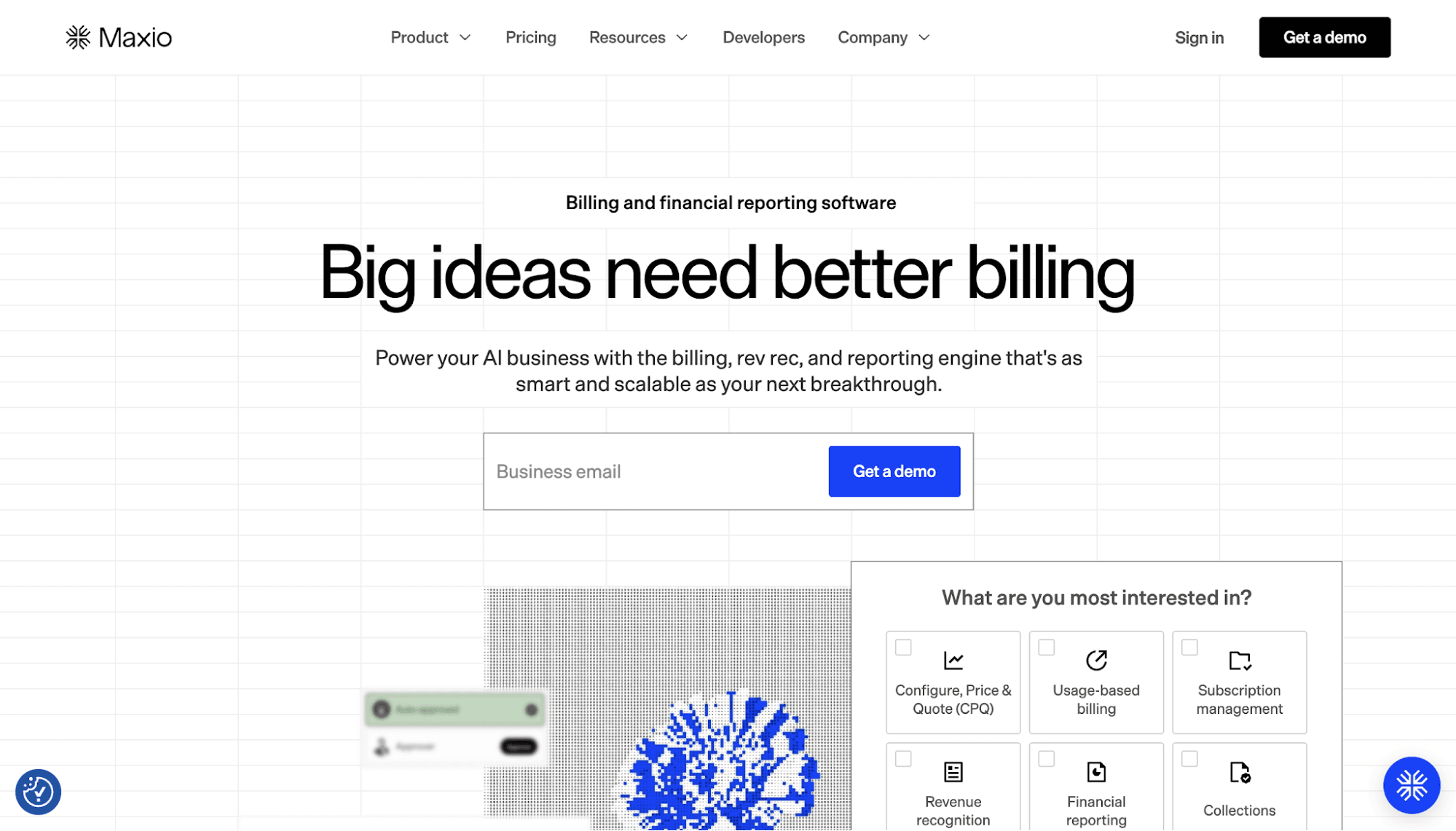
Maxio combines real-time billing, revenue recognition, and financial reporting in one platform. It is built for B2B SaaS and AI businesses that need to track large volumes of customer activity at scale.
Its metered billing solution can capture usage events directly from the product in real time. Teams only need to define pricing once. Maxio takes care of data aggregation based on location, customer segment, and other user attributes.
The platform also applies pricing rules automatically and generates invoices using aggregated usage data. Companies can bill accurately without manual entry.
Besides metered billing, Maxio supports event-based billing and value-based pricing. Teams can use real-time data streaming and analytics to build a multi-dimensional billing strategy tailored to specific business needs.
Key Features
- Usage metering and rating: Ingest usage data at scale and apply pricing rules automatically.
- Event-based billing: Stream event data through one API and create multi-dimensional billing models.
- Financial reporting: Review SaaS metrics through custom dashboards and one-click reports.
- Subscription management: Manage plans, run dunning workflows, send alerts for overdue payments, and allow customers to upgrade, downgrade, or cancel their subscriptions.
- Payment gateways: Connect to multiple payment gateways or use Maxio’s built-in payment solution to process online payments.
7. Zuora
Source: Zuora.com
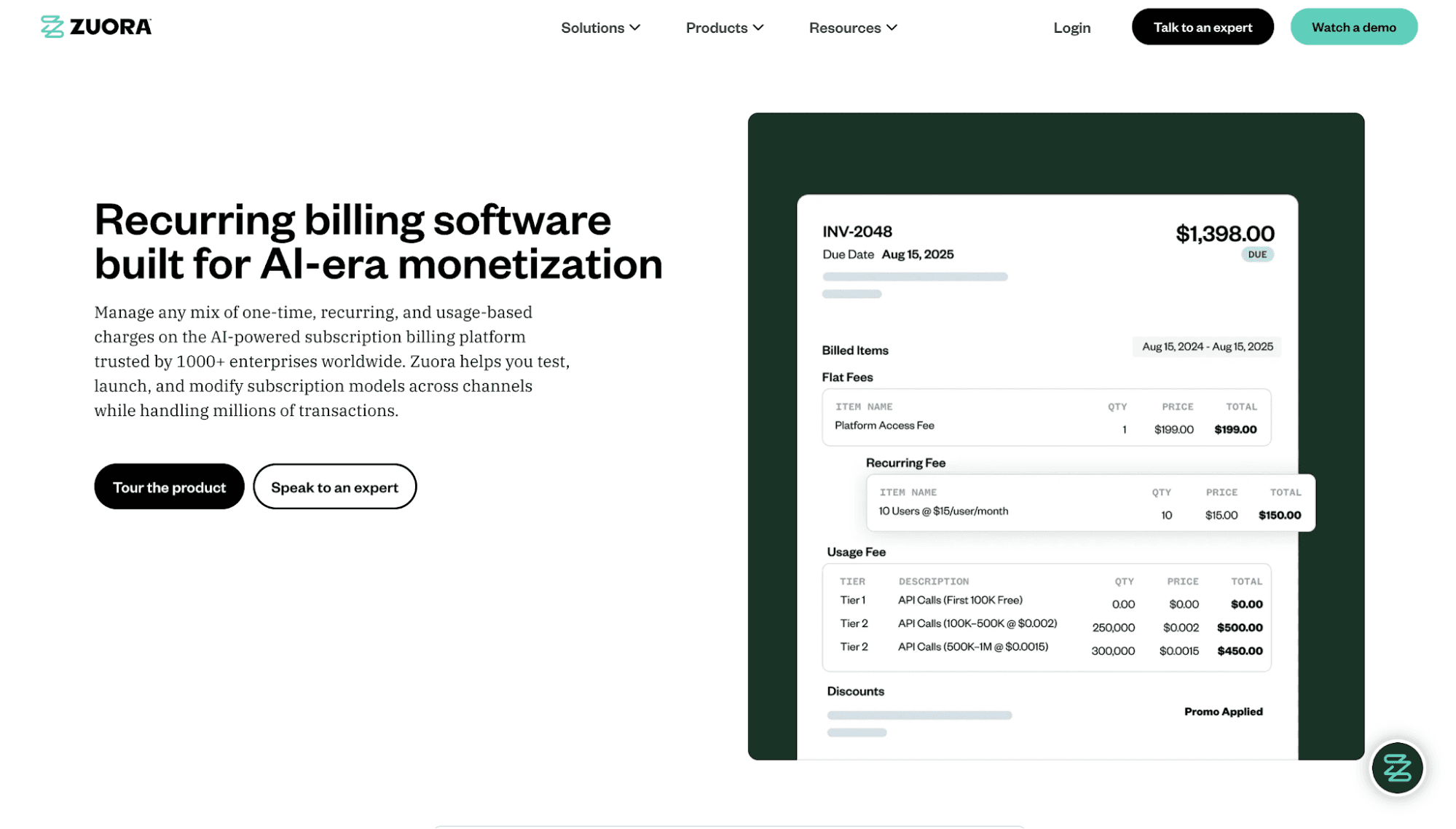
Zuora is a recurring billing solution designed for large AI companies with usage-based, hybrid, and multi-attribute pricing.
It supports real-time billing through built-in mediation and rating tools. Usage events are accurately and automatically tracked, which can provide live insight into actual consumption.
Teams can recognize revenue as soon as the system ingests the event. They can then automate journal entries and data reconciliations to reduce compliance risks.
Zuora also includes configurable widgets, proactive threshold alerts, and detailed usage invoices. Surfacing usage and billing details directly to customers can improve trust and help them avoid surprise charges.
On top of these capabilities, Zuora can generate real-time reports and track subscription performance metrics. These help companies make better-informed financial decisions.
Key Features
- Mediation and rating: Ingest, group, and rate usage events against set pricing rules in real time.
- No-code pricing designer: Build recurring, usage-based, hybrid, tiered, and prepaid pricing without custom code.
- Reporting and analytics: Analyze current billing performance, recurring revenue trends, and customer behavior.
- Automated revenue recognition: Automate ASC 606 and IFRS 15 steps to maintain compliance.
- Built-in extensibility: Adjust pricing strategies, configure business logic, and create custom solutions.
Why Do SaaS and AI Companies Need a Real-Time Billing Solution?
Here are the reasons why real-time billing software is important for SaaS and AI businesses.
Support Usage-Based and Hybrid Monetization
SaaS and AI products often charge by tokens, API calls, storage, seats, or active users. Traditional billing systems fall short when it comes to usage-based and hybrid billing because they rely on manual inputs or batch processing.
A real-time billing system, on the other hand, uses streaming architecture to meter millions or billions of usage events per second. It automatically calculates invoices and updates balances without relying on error-prone spreadsheets. This supports pay-as-you-go, prepaid credits, tiered plans, and hybrid subscription models.
Teams can apply customer-specific pricing without waiting for month-end processing. Meanwhile, users can see their current usage and control their spending limits.
Prevent Revenue Leakage
Missed events, duplicate records, and slow billing updates can lead to lost revenue.
A real-time billing solution captures usage when it happens and checks each event before adding it to the customer’s final invoice.
The system can also apply overage rules, credit limits, and contract terms before unpaid balances grow.
Finance teams gain a clear record of how the platform created each charge. This makes it easier to correct billing issues and collect the full amount owed.
Ensure Transparent Billing
Customers need to understand how their charges are calculated, especially when costs change with product usage.
Real-time billing software can show current usage, remaining credits, spending totals, and upcoming charges within the product. These live views help customers adjust their activity before they reach a limit or trigger an overage.
Clear invoice line items also connect each fee to a specific metric, feature, or tier. They can reduce billing disputes and improve customer trust.
Simplify Compliance
ASC 606 and IFRS 15 require companies to recognize revenue when they meet their performance duties, not simply when they send an invoice or collect payment.
A real-time billing solution connects usage events, contract terms, invoices, and revenue schedules in one system. It can separate recurring fees from variable usage charges and update revenue records as customers consume services or credits.
A reliable system cuts manual tasks, supports consistent reporting, and helps finance teams track what was actually consumed for appropriate accounting.
Improve Decision-Making
Live billing data helps software companies understand how customers use the product and how that activity affects revenue.
Finance leaders can track unbilled usage, credit balances, overages, and account growth before the billing period ends. Product teams can see which features drive paid usage and growth, while sales reps can identify accounts that are ready to upgrade.
Real-time insights support better capacity planning by linking product demand with expected costs and revenue. They also help teams adjust pricing strategies, set limits, and respond to customer behavior before small issues become larger problems.
Factors to Consider When Evaluating Real-Time Billing Systems
Here's what you need to evaluate when choosing a real-time billing platform.
Throughput Rate
The throughput rate is the speed at which a billing system can ingest and process usage events per second. Compare this limit with your current event volume and expected growth.
A traditional tool that works for small businesses may slow down when an AI product starts processing millions of tokens, calls, or actions.
Check how the platform performs during traffic spikes and how quickly it updates usage totals. Then, review how it handles duplicate events, late data, retries, and backfills. High throughput has little value if billing totals become inaccurate under load.
Automated Billing and Invoicing Tools
Invest in a real-time billing system that can turn rated usage into accurate invoices without manual input. Make sure it can create invoice lines, apply credits, calculate overages, and handle plan changes automatically.
Then, test how the software manages failed charges, payment reminders, and credit notes. These tools can reduce late payments by sending accurate bills and follow-ups on time.
Support for Flexible Pricing Models
The billing system should support the pricing models you currently offer and may add later.
Check if it can handle subscriptions, prepaid credits, tiered usage, volume discounts, minimum commitments, overages, and custom contracts. You should be able to combine these monetization models without rebuilding your billing infrastructure.
You can also review how the platform defines meters and applies billable rates to different events or customer groups.
Integrations With Accounting Software and Other Existing Systems
According to m3ter and PwC's joint report, nearly 9 in 10 companies surveyed (87%) said their billing and financial systems were not integrated. They still use spreadsheets and other manual methods to set prices, monitor usage, and reconcile revenue. These make it difficult to implement usage-based pricing.
That's why it's important to choose a real-time billing system that connects seamlessly to your existing tech stack.
Look for native integrations with your accounting software, CRM platform, ERP system, data warehouses, and other tools.
APIs and webhooks are also useful to avoid building integration glue from scratch.
Don't forget to confirm how data moves between systems and which platform acts as the main record for invoices and customer balances.
Finance teams should be able to track expenses, payments, credits, and revenue without manually copying data between tools.
Customer Usage and Spending Visibility
Select a billing platform that provides customers with real-time visibility and controls over their spending.
In-product dashboards and alerts can warn users before they reach a spending threshold or run out of credits.
Configurable spending limits give both buyers and sellers confidence that usage will stay within the set budget.
These customer-facing tools help give enterprise buyers the trust to say yes.
Ship Real-Time Usage-Based Billing Your Enterprise Customers Can Trust
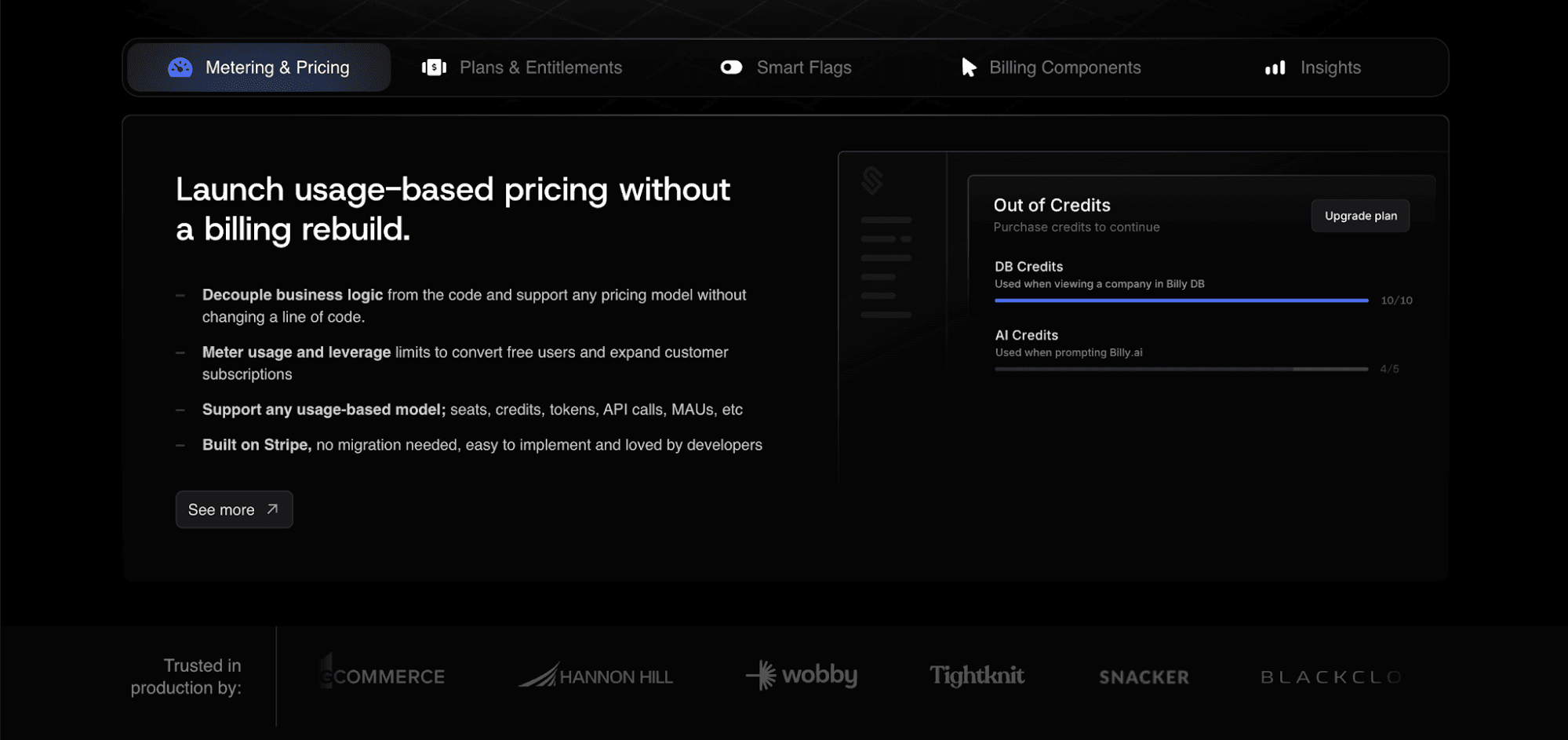
Schematic provides an all-in-one usage-based billing platform for SaaS and AI companies selling to enterprise customers. It can ship usage-based plans, meter credits, enforce usage, manage entitlements, and enforce limits in real time.
Enterprise buyers often hesitate to accept usage-based pricing because they cannot predict or control spending. Schematic solves this trust problem with enterprise credit wallets that show live usage, remaining credits, spend forecasts, and limits. Customers avoid runaway bills or unexpected access throttling.
That real-time visibility helps sales teams answer billing concerns during procurement and close large accounts faster. It also drives revenue expansion by allowing buyers to top up credits or increase usage limits with confidence.
FAQs About Real-Time Billing System
What is the best free billing software?
Schematic and Alguna are free usage-based billing platforms that software companies can use. Schematic suits businesses selling to enterprises because it helps them close accounts faster by providing real-time visibility and control over usage.
What are three different types of billing systems?
Three common types are subscription billing, usage-based billing, and hybrid billing platforms. Subscription billing systems help teams charge a fixed recurring fee. Usage-based billing software bills clients for actual product consumption. Hybrid billing tools allow companies to combine a base subscription with usage-based charges, credits, or overage fees.
Can I create my own billing system?
Yes, you can create your own billing system. However, it requires ongoing engineering work. As your business and product grow, building your billing software slows down your pricing experiments, sales deals, and product launches. Consider buying a reliable system instead so that you can focus on building your product, not billing infrastructure.