 Ryan Echternacht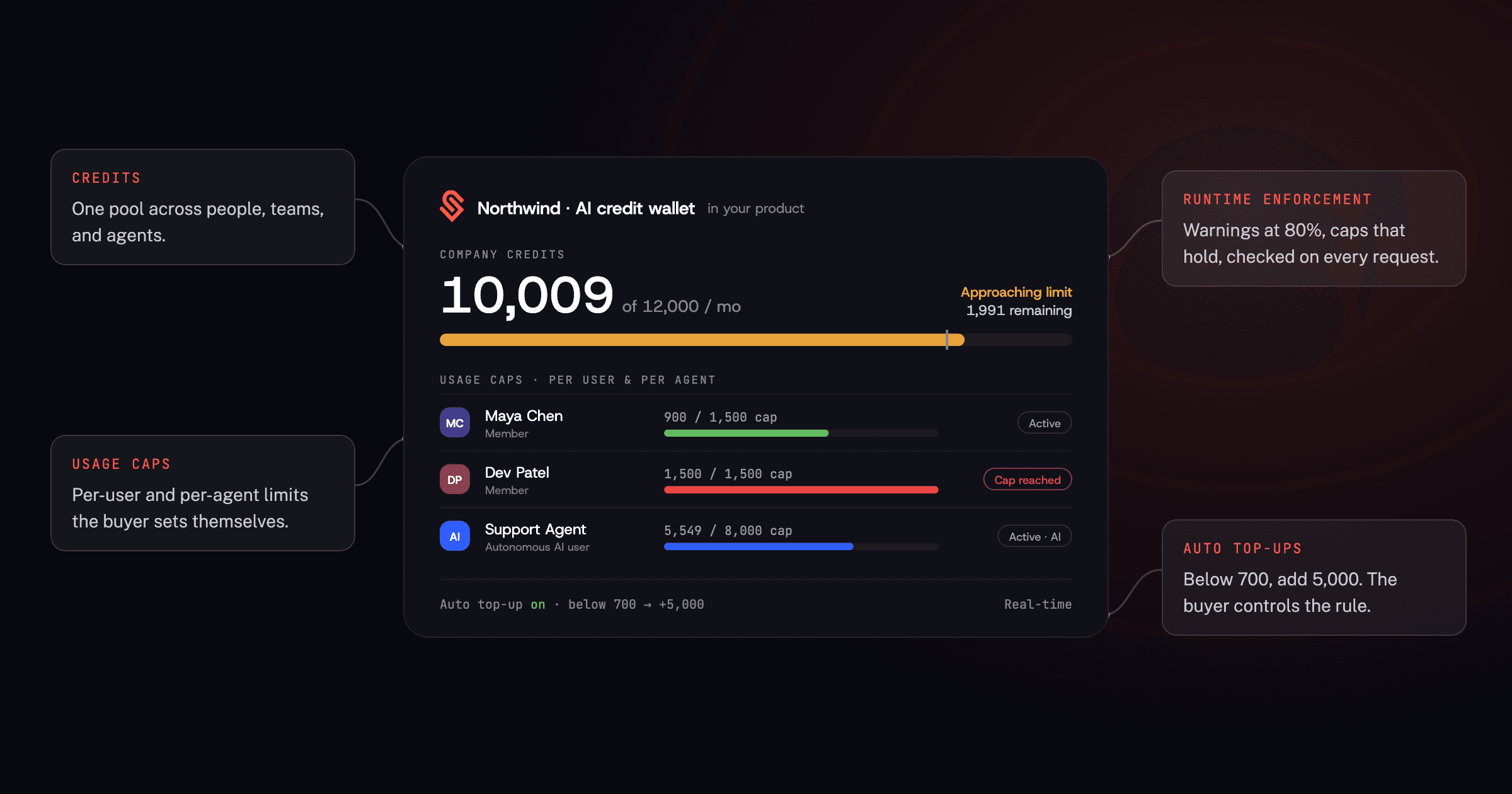
Usage-based billing can be a trap.
It is becoming the default for AI-native products and for any platform adding AI features. Customers now expect to pay for what they use.
But usage-based pricing is hard to sell, especially to enterprise clients. These buyers fear unpredictable spending, and sellers lose deals to that fear. According to the 2026 State of B2B Monetization report, 37% of companies said that usage-based pricing is difficult to predict.
Once a deal closes, the risk is real. One overzealous employee can burn the month's credits by the 10th. An AI agent left running overnight can drain a quarter's budget without a human touching the product.
The fix is to implement credit-based billing and remove the fear. Give buyers visibility into spending, control over it, and assurance that the product will not stop working mid-quarter. The structure that delivers all three is a credit wallet.
In this article, we'll discuss what credit-based billing means and break down the anatomy of a credit wallet.
TL;DR
- Credit-based billing prices a product in credits instead of raw units like tokens or API calls.
- A credit wallet serves as the customer-facing layer of a credit billing model. It allows buyers to view balances, set limits, manage spending, and control how credits are used in one place.
- The anatomy of credit billing includes usage visibility, spend limits and usage caps, runtime enforcement, pooled or per-seat credit allotments, top-ups or rollovers, and a real-time credit ledger.
- Schematic offers enterprise credit wallets that give customers visibility and control over their actual consumption. It helps SaaS and AI companies close deals faster, drive expansion, and earn more revenue.
What Is Credit-Based Billing?
Credit-based billing is a type of usage-based pricing model. It charges customers for actual consumption using credits instead of raw units, such as tokens, API calls, or compute time.
In a credit-based model, customers purchase credits upfront or receive them as part of a subscription plan.
Usage credits act as a common pricing unit or universal currency for different types of product activity. Each action burns a set number of credits at varying rates. For example, one credit represents one high-resolution image export. Meanwhile, five credits may equal a minute of video rendering time.
Credit-based pricing gives SaaS companies a stable price abstraction over variable usage costs while providing buyers with a single number to budget against.
Why Do You Need a Credit Wallet in Credit-Based Billing?
A credit wallet is important because it's the customer-facing layer of credit-based billing. It shows balances and per-user usage, enforces spend limits at runtime, and holds the top-up and rollover policies the buyer controls.
Selling credits means selling trust. Usage-based pricing aligns pricing with customer value better than any flat fee. But it also transfers risk to buyers, and they know it.
The credit wallet is how you minimize that risk. It provides real-time visibility so customers never fear a surprise bill. It also gives them control over usage caps to prevent runaway spending.
A credit wallet even includes allotments that match how customers budget and top-up rules to ensure uninterrupted work.
The products winning with usage-based pricing already ship some version of this anatomy. Claude Code has a spend cap that a buyer sets in one click. Cursor attaches credit allowances to seats. OpenAI sells prepaid API credits with budget caps.
The credit wallet is the standard for selling usage at any scale. Enterprise buyers will ask for it in writing before they sign the contract.
The Anatomy of a Credit Wallet
Here are the elements that shape the structure of a credit wallet.
1. Per-User and Per-Agent Usage Visibility
The first question every admin asks about a usage-priced product: how much is my team using, and who is using it most?
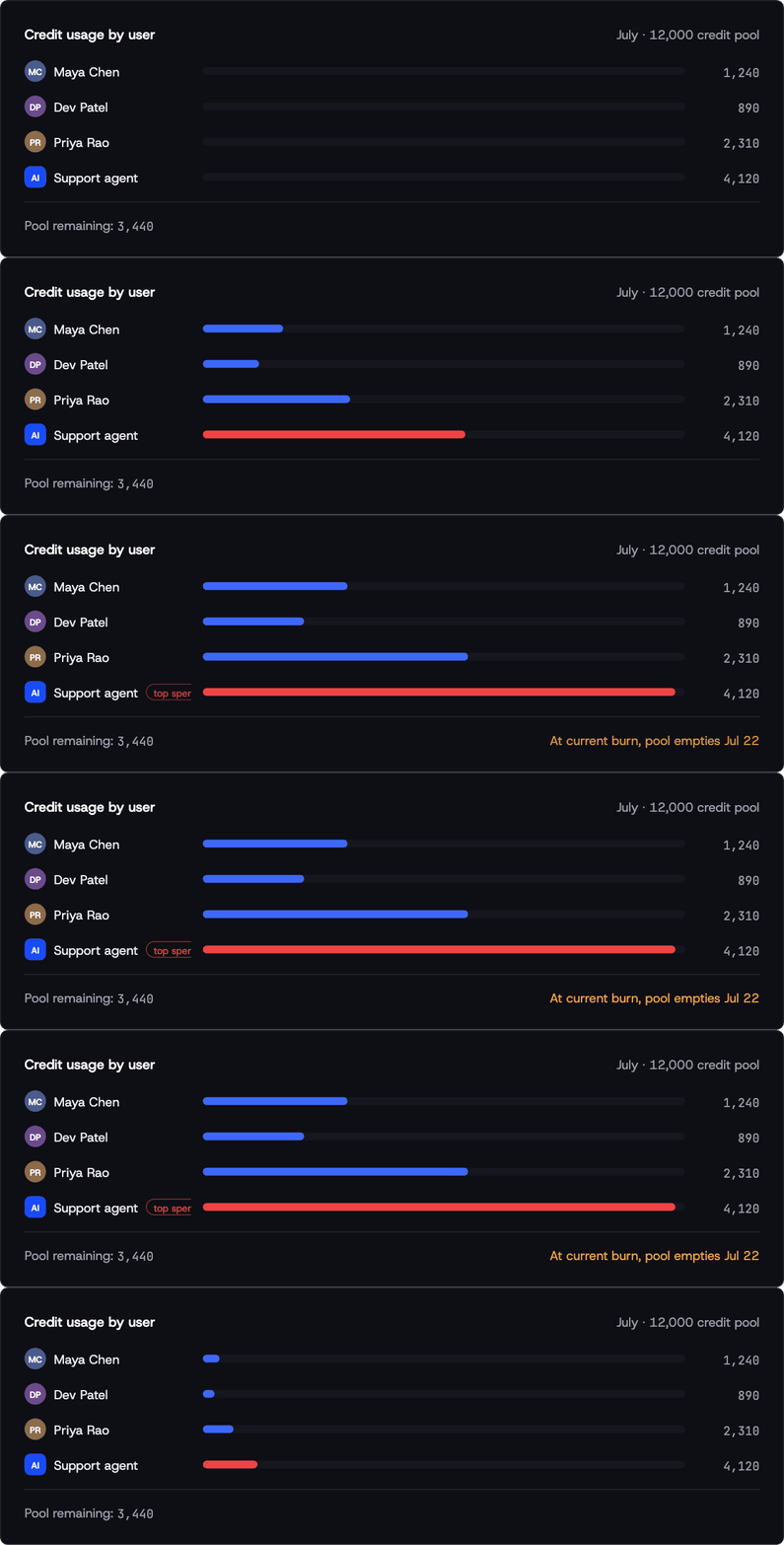
A wallet answers how many credits an account consumes without a support ticket. It shows credit burn per user and per agent, over time, against the period's allotment. It also displays pacing: at this rate, the credit pool runs out on the 22nd.
It can even surface the outliers, whether that is a power user defaulting to the most expensive model or a support bot retrying itself into a four-figure bill.
Agents need the same treatment as people. Every autonomous agent should appear in the credit wallet as its own line with its own burn history. If your customer cannot tell whether a human or an AI is burning down credit balances, they cannot manage either.
Visibility turns the first big invoice from a churn event into a conversation the admin saw coming.
2. Credit Spend Limits and Usage Caps
Visibility tells the admin who is spending. Caps let them act on it.
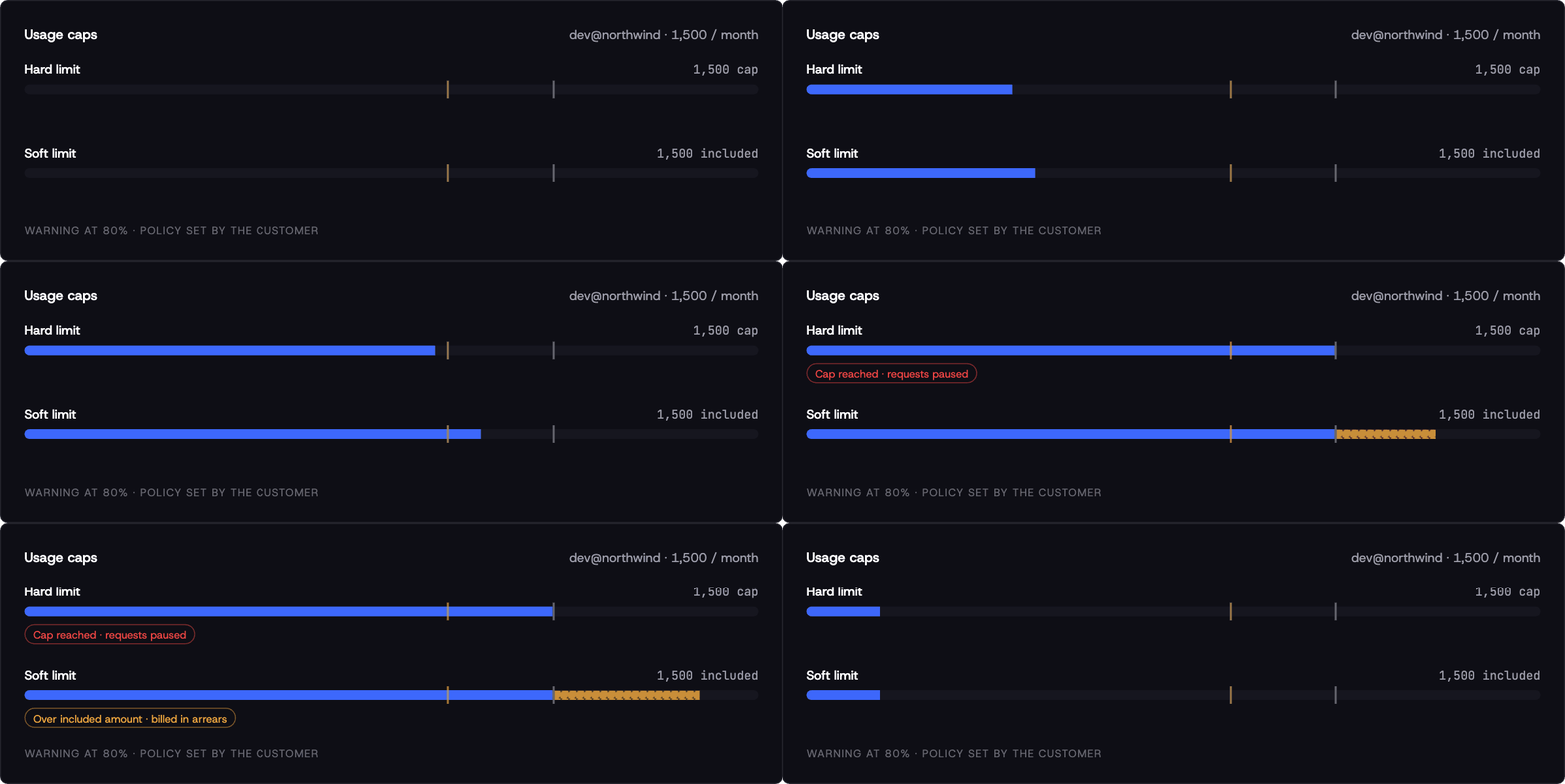
A credit wallet lets the buyer set spend limits per user and per agent, per day, week, or month. A hard limit stops requests at the cap. A soft limit lets usage continue and bills the overage in arrears.
The buyer picks the policy, and everyone receives low balance alerts before anything stops. 80% is the common threshold.
Usage caps matter more for agents than for people. A human notices friction and slows down. An agent will loop until the credit pool is empty. A per-agent budget drawn from the company pool is the difference between an automation experiment and a budget incident.
Buyers bring up spend limits unprompted. Anthropic made the Claude Code spend cap settable in one click, and buyers cite it as a reason they trust the company's pricing. A cap the customer sets themselves does more for the deal than any assurance on a pricing page.
3. Runtime Enforcement
A usage cap is only as good as its enforcement. A credit balance checked nightly, or reconciled after the invoice, lets an AI agent overdraw the pool all afternoon.
Limits need to be enforced at runtime. Every request checks entitlements and the account's live balance before the work starts.
If there is sufficient balance, the product will accept the request. However, a request past the limit applies the cap policy the buyer has previously set, not a retroactive apology.
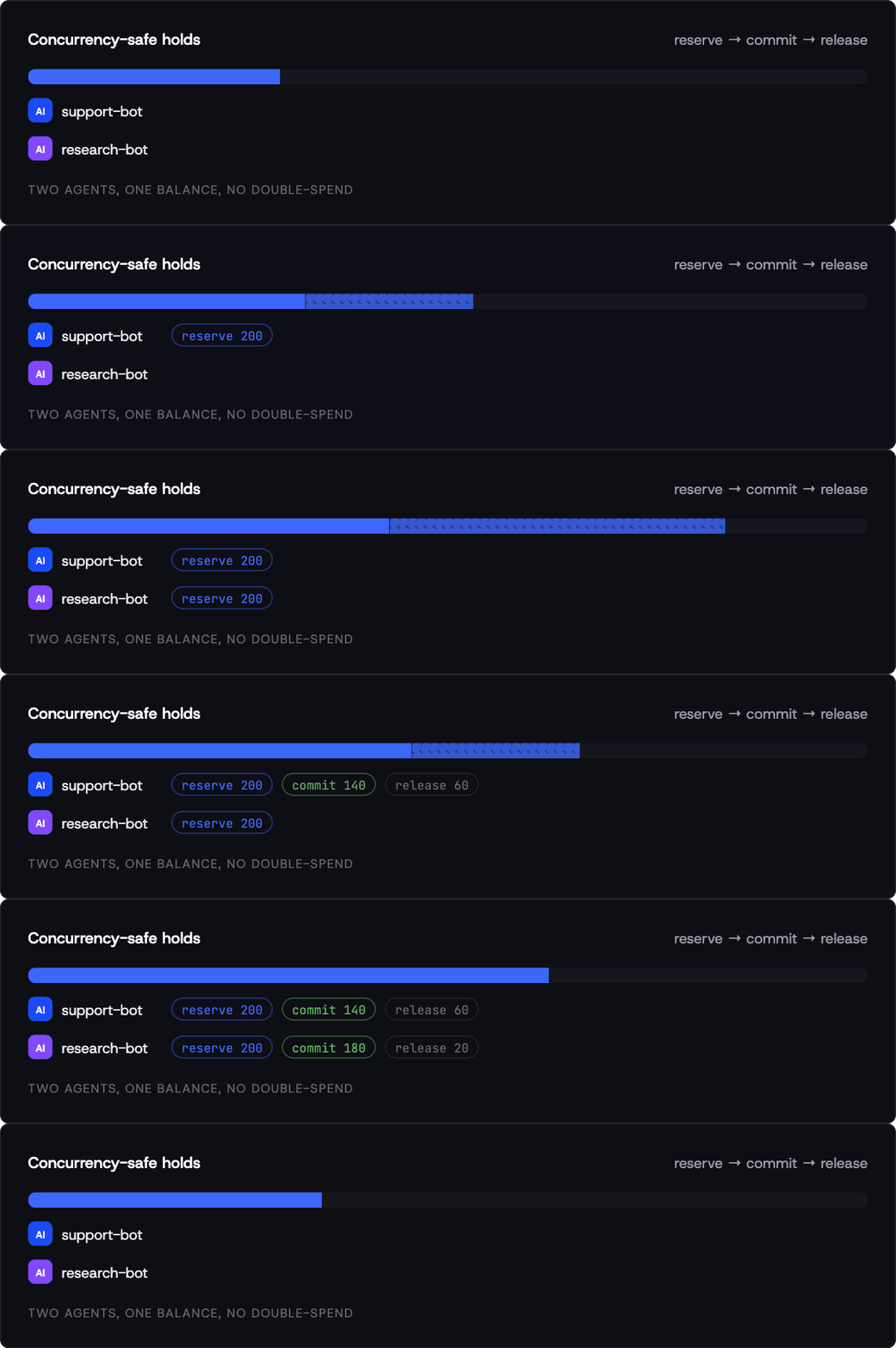
Concurrency makes runtime enforcement harder than it looks. When two agents draw from the same balance at once, both see 400 credits remaining, both proceed, and the credit pool goes negative.
The common fix is a lease, sometimes called a hold. Reserve credits when work starts, commit the amount actually used when it finishes, and release the reservation if it fails.
Card payments have worked this way for decades with authorize, capture, and void. A credit-based system supporting agents needs the same primitive, or its caps are suggestions.
4. Credit Allotments (Pooled or Per Seat)
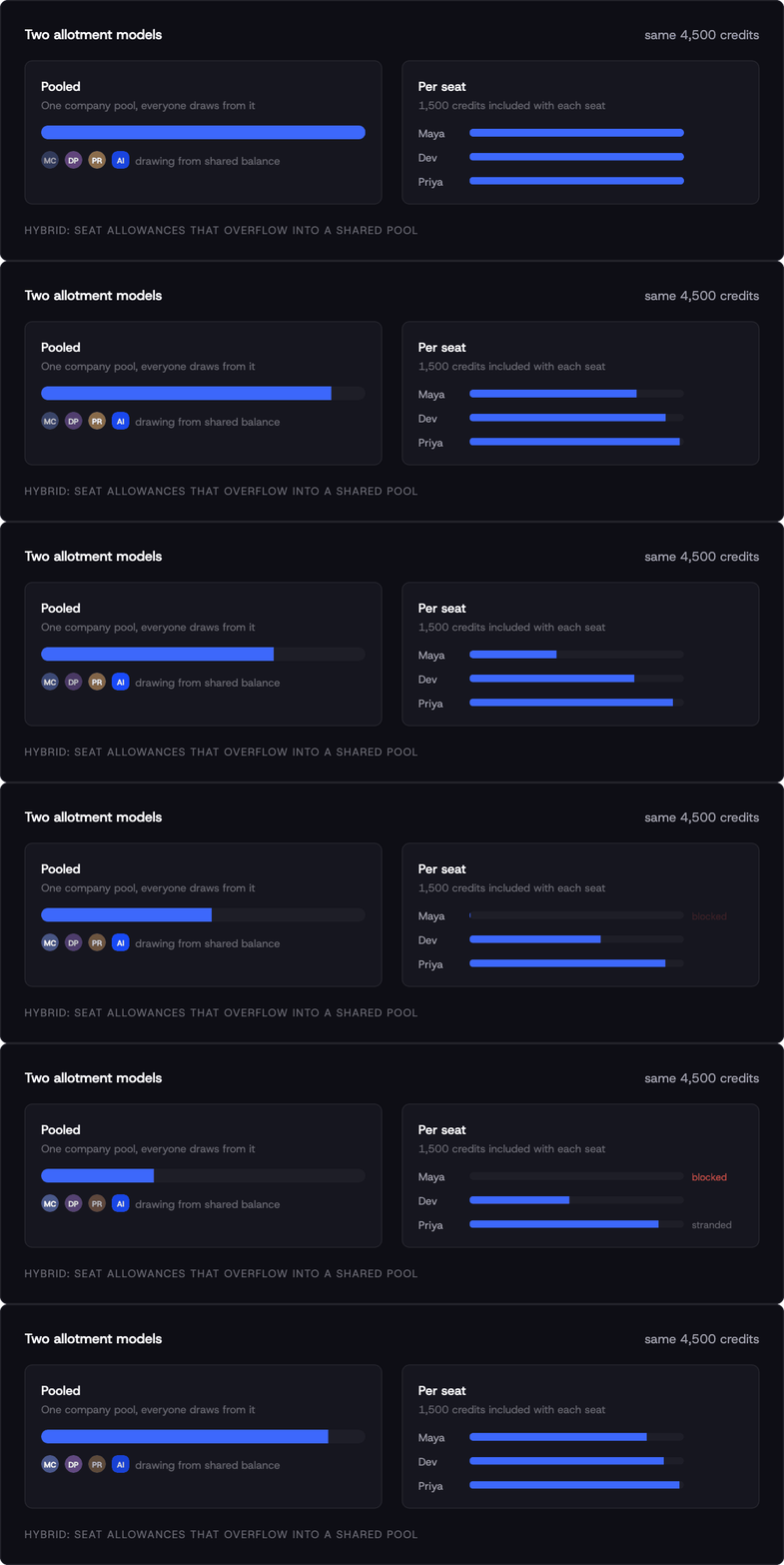
Enterprise already buys seats. Credits need to fit that seat-based pricing model, and there are two ways to do it.
In a pooled model, the company buys a block of credits, and everyone draws from it. It is flexible and efficient. No credits sit stranded on the seat of someone on leave. The risk is one user draining the credit pool for everyone, which is why pooled models depend on the caps above.
In a per-seat model, each seat includes its own credit allowance. It's similar to how Cursor prices. It also maps to how procurement already thinks: cost per head, budgeted per head.
The downside is rigidity. Light users strand credits while heavy users hit metered walls, and agents do not map to seats at all.
Neither model is wrong, and the choice belongs to the buyer. Pooled fits products with heavy agent usage. Per-seat fits products sold on headcount.
Many products use a hybrid approach, where every seat includes a set number of credits. Those allowances overflow into a shared company pool.
Offer both choices to the customer. How a buyer answers tells you how they budget.
5. Credit Top-Ups, Overflow, and Rollover
The worst thing a usage-priced product can do is stop working for a paying customer.
Running out of credits should never mean suspended service. Give the buyer several paths forward:
- An overflow pool that absorbs bursts
- Self-serve credit top-ups
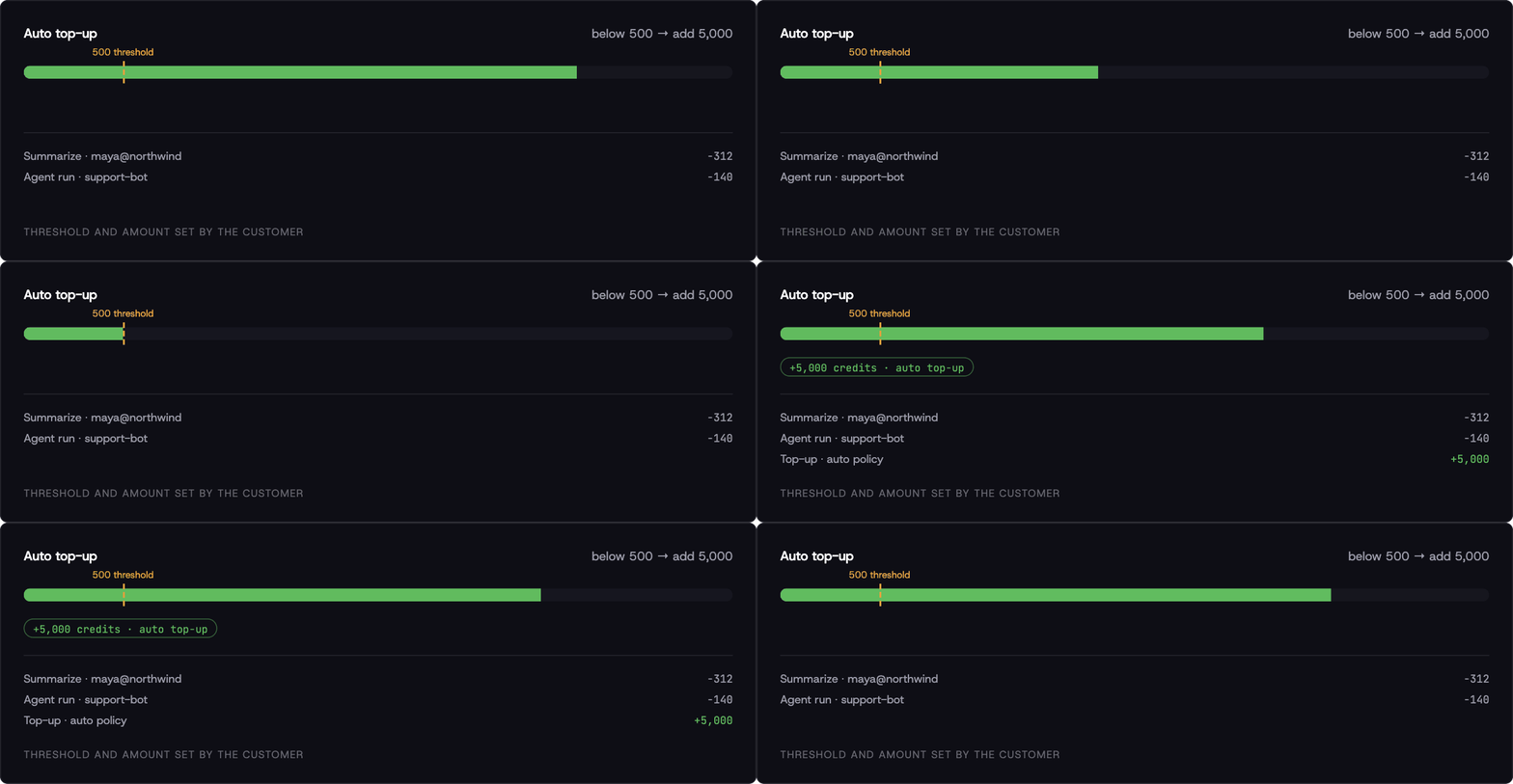
- Automatic top-up rules that the customer writes themselves (e.g., when the balance falls below 500, add 5,000 credits)
The buyer sets the policy. The credit-based system enforces it. Nobody files a ticket at midnight because the support bot went dark.
Predictability cuts both ways. Buyers fear surprise bills, and they equally fear paying for credits that expire unused.
Credit rollover fixes the second fear. You can carry some share of unused credits into the next billing period, or set expiry windows long enough that nobody feels cheated.
Credits that silently expire are recorded as breakage revenue, and enterprise buyers notice.
Get this section right, and the renewal conversation starts from usage data instead of resentment.
6. Credit Ledger
The ledger sits underneath all five components. It's invisible to end users and decisive in enterprise evaluations.
Every grant, burn, hold, top-up, expiry, and rollover should land in an append-only ledger that the customer can export.
Finance teams ask for it because prepaid credits are deferred revenue until they are consumed, and reconciling wallet activity against invoices is how both sides close the books.
Under ASC 606, your own accountants will ask the same questions your customers' accountants do.
A credit wallet without a ledger is a demo. A wallet with one can survive procurement.
Credit Pricing vs. Other Consumption-Based Pricing Models
Credit pricing is one form of usage-based billing. Other models charge for actual consumption in different ways, based on when payment occurs and how they track usage events.
Pay-As-You-Go
With pay-as-you-go pricing, customers pay for the exact amount they use during a billing period. Common examples include charges per API call, token, message, monthly active user (MAU), or other metered unit.
This usage-based model fits products with variable usage patterns because actual charges increase and fall with consumption.
Buyers can start small and scale usage over time without an upfront commitment. The lower barrier to entry can support product-led go-to-market strategies.
However, billing customers after consumption can hurt cash flow compared with credit pricing, where payment often happens before customers use the product.
Pay-in-Advance
Pay-in-advance pricing is a usage-based model where customers prepay and commit to a set amount of product usage at a known rate. For example, a buyer might purchase 1,000 API calls, 100 tokens, or 50 projects for a set period.
This pricing model suits scenarios where customers already know their expected usage and prefer buying in pre-determined chunks because they consume roughly the same amount per month.
Credit-based pricing also involves paying before usage in many cases. However, it uses credits as the common pricing unit. Customers spend these credits on several product actions and multiple features.
In traditional prepaid services, usage translates into one specific unit, feature, or quantity instead.
Fixed Fee With Overages
A fixed fee with overage pricing combines a recurring subscription plan with a set amount of included usage.
Once the customer exceeds their plan's usage allowance, the SaaS company bills them for extra usage. For example, a plan may include 500 API calls and charge $0.01 for every call beyond that limit.
This hybrid pricing model provides predictable revenue while still allowing profits to scale with usage.
In contrast, credit-based pricing offers a prepaid balance of monthly credits that customers spend on specific actions or features. These credits are abstracted, making it easier to adjust credit value and offer flexible credit pack sizes without overhauling the entire pricing model.
Volume Pricing
Volume-based pricing encourages higher usage through volume discounts. Usage is split into defined tiers, and the customer’s total usage determines which rate applies.
Here's a sample calculation:
Tier | Usage | Price |
1 | 0-100 | $20 + $1 per unit |
2 | 101-200 | $19 + $0.90 per unit |
3 | 201-500 | $18 + $0.80 per unit |
4 | 501+ | $17 + $0.70 per unit |
Let's say a customer uses 250 units. The vendor will charge them a total of $218 ($18 + 250 * $0.80) since the customer's usage fell into tier 3.
Unlike credit pricing, volume pricing still bills customers based on the raw usage metrics, such as tokens, API requests, or transactions.
Credit-based pricing converts product actions into credits. It can also apply different credit costs to various features while drawing down from the same credit pool instead of setting a separate usage tier.
Benefits of a Credit-Based Pricing Model
Credit-based pricing can benefit both SaaS and AI businesses in several ways.
Align Pricing With Actual Usage
Credit-based pricing connects what customers pay to how much they use the product. Each action consumes a set number of credits based on the value or cost tied to that action. This helps companies align revenue with product activity instead of charging every customer the same flat fee.
It also works well when different features have varying costs. With clear usage tracking, teams can assign more credits to costly actions and fewer credits to lighter tasks. Customers then pay based on the real value they receive from the product.
Give Customers More Predictability and Control Over Spending
Credits give customers one balance they can use to plan and monitor spending. Instead of tracking several raw usage metrics, they only need to look at their current credit balance.
A credit wallet also gives buyers the ability to set limits to prevent runaway spending. This is especially useful in credit-based subscription models, where each plan includes a set number of credits.
Customers know how much usage their plan covers before they reach a limit. Then, they can top up their account or upgrade to a higher tier with more credits.
Improve Cash Flow
Unlike pay-as-you-go and other usage-based billing models, credit pricing collects payment before customers use the product. This significantly improves cash flow for your business.
Prepaid credits can also close the gap between product usage and payment. You already received an upfront payment for the credits being consumed. Your billing systems can record each credit deduction and track the remaining balance as customers continue using paid features.
Support Flexible Pricing
You can sell credits in many forms without changing the basic pricing unit. You can include credits in subscription plans, offer prepaid credit packages, provide shared credit pools, or let customers top up when their balance runs low.
This creates flexible billing for customers with variable usage patterns. A small account may need only the credits included with its plan, while an enterprise buyer might require extra credits.
And since credits introduce an abstraction layer, you can easily change how many credits an action costs. You don't need to surface every technical detail. You simply communicate the product's value through a single unit: credits.
Create Natural Upsell Opportunities
A credit wallet shows when a customer has outgrown their current plan or is running out of credits.
If an account regularly runs low, the company can offer more credits, prompt users to upgrade to a higher tier, or encourage them to enable automatic top-ups.
The message is tied to actual credit consumption rather than an unrelated sales push. It creates a clear path for account growth.
Schematic Ships Credit-Based Billing Your Enterprise Customers Can Trust
Schematic is an all-in-one usage billing platform for modern SaaS and AI companies. It provides enterprise credit wallets that give customers real-time visibility and control over their usage, so they never fear a surprise bill.
Commercial teams use Schematic to sell credit-based plans, meter usage events, manage software entitlements, enforce limits at runtime, and grant overrides without filing an engineering ticket.
The system also tracks every grant and burn through an append-only ledger that is ready for export. It supports compliant, credit-based revenue recognition.
Other standout features include expiry windows, priority credit consumption, rollovers, concurrency-safe holds, credit allotments per seat or autonomous agent, self-serve top-ups, and a real-time event log.
Schematic provides all the necessary tools to make credit-based pricing transparent and trustworthy.
FAQs About Credit-Based Billing
How does credit billing work?
In credit-based billing, customers purchase prepaid credit bundles or receive credits through a plan. Their balance drops every time they use the product. Each action has a set credit value. For example, sending 50 emails costs one credit. Generating an AI video, on the other hand, consumes eight credits.
What is an example of usage-based billing?
A common example is API pricing based on tokens. A customer sends requests to an API, the provider measures the number of input and output tokens used, and the customer is charged for that metered consumption.
How do you make usage-based billing predictable?
You can show pacing against the period's credit allotment, warn before limits, let admins set spend caps for each user and agent, and never suspend service without a top-up path. Predictability comes from the controls the buyer holds.
Should unused credits expire or roll over?
Credit rollovers build trust. A common policy carries 50% of unused credits into the next period with an expiry date. Hard expiry with no rollover leads to customers distrusting prepaid credits.
How do you control credit usage across a team?
You can set per-user and per-agent caps that draw from a shared company pool. Hard limits stop requests at the cap. Soft limits allow usage to continue and bill the overage in arrears. Warn everyone at 80%.