 Ryan Echternacht
Stripe is primarily known as a payment solution for SaaS companies, but it's more than just a payment processor. It also provides the monetization infrastructure for launching usage-based pricing.
For teams already using Stripe payments, this setup makes it easier to charge customers based on usage. Stripe can meter, bill, and track revenue in one place while giving buyers real-time visibility into their consumption.
Stripe works well until billing requirements become more complex. An enterprise customer wants higher usage limits per seat but wants AI agent usage to be capped at a certain level. They also negotiate promotional credits during contract renewal.
Suddenly, teams need to track separate limits, apply priority consumption rules, enforce product access at runtime, and keep contract terms in sync with billing. That often means adding custom logic or more tools around Stripe.
In this article, we'll discuss how Stripe handles usage-based billing models and whether it is the right fit for your business needs.
TL;DR
- Stripe is financial infrastructure that handles usage-based billing, invoicing, payments, subscriptions, tax compliance, and revenue recognition in one place.
- Stripe partnered with Metronome to meter usage events, translate raw data into accurate invoices, and provide usage dashboards.
- Its main benefits include faster launch times, flexible billing options, built-in payment collection, and simplified compliance.
- However, Stripe does not enforce usage limits and access at runtime. It also lacks credit wallets, customer spend controls, and the ability to handle edge cases in consumption billing.
- Schematic fills the gap Stripe leaves open with enterprise credit wallets, a real-time entitlement engine, self-service controls, and configurable spending limits.
What Is Stripe?
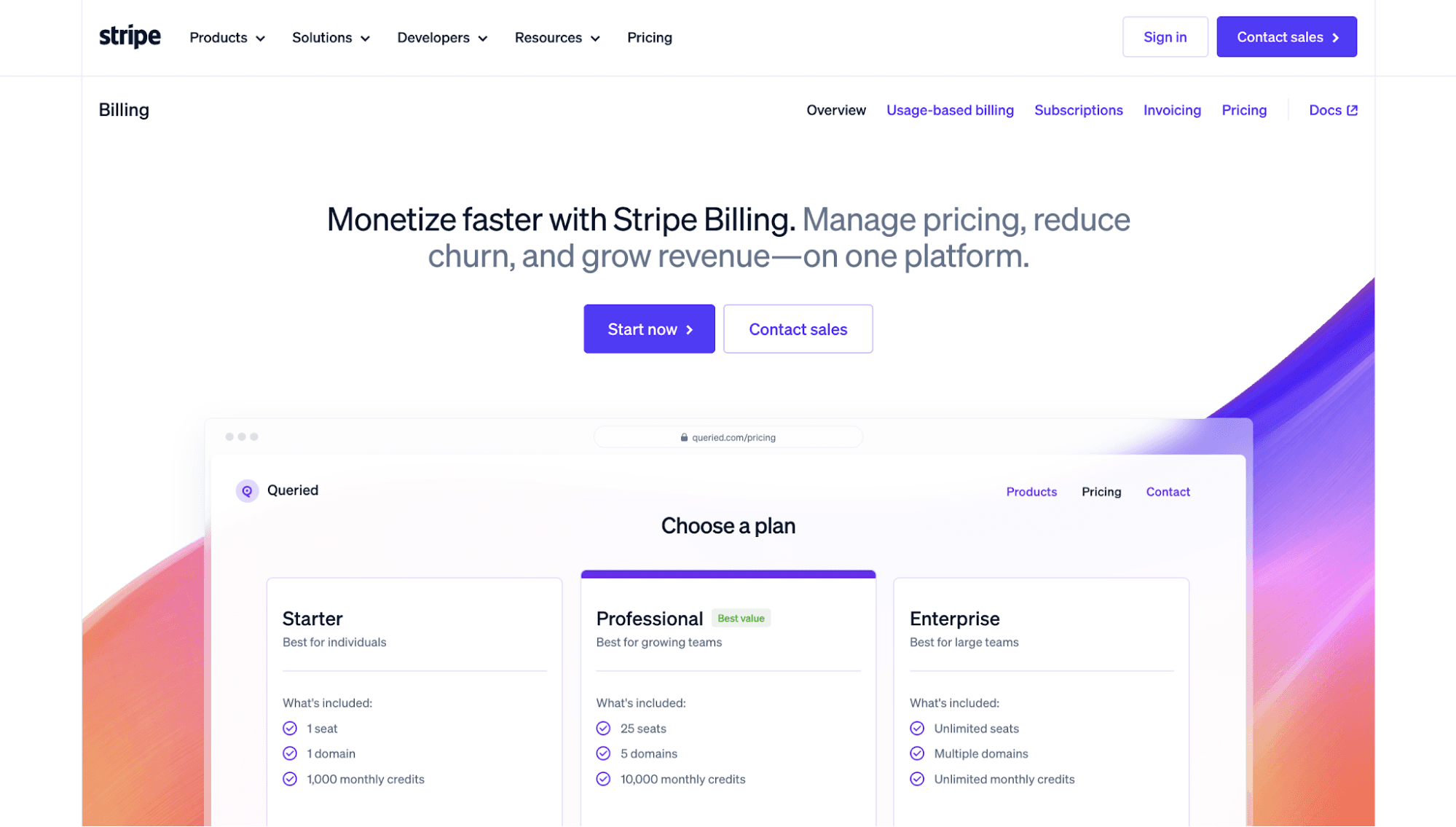
Stripe is a financial platform that provides tools for usage-based billing, invoicing, payment processing, subscription management, tax compliance, and revenue recognition. It unifies a company's entire revenue stack so that they can price, meter, bill, and invoice in one system.
Source: Stripe.com
It also offers Stripe Checkout, which allows SaaS businesses to develop conversion-optimized checkout experiences and send payment links. These accept one-time payments and recurring subscription fees.
Stripe supports any pricing model, from flat-rate pricing to variable consumption billing and hybrid models. Prebuilt templates enable teams to launch new billing models faster and with minimal overhead.
Stripe works well for companies that want to go to market quickly, simplify the quote-to-revenue cycle, collect payments faster, and scale globally without building a custom solution from scratch.
How Stripe Handles Usage-Based Billing
Stripe partnered with Metronome to manage usage-based billing. It collects usage events and turns them into accurate charges through real-time metering and aggregation.
The platform supports metered billing, subscriptions with overages, outcome-based pricing, and credit burndown. Teams can implement any usage-based pricing model without creating billing logic from scratch.
Stripe also provides real-time visibility into revenue and usage data. Finance teams can track pricing performance and revenue growth across go-to-market motions.
Meanwhile, proactive alerts on usage, credit, and spend thresholds can flag potential fraud and abuse before they affect profit margins.
Customers can even monitor their usage so they can manage their budgets and avoid billing surprises.
However, Stripe's usage billing system only handles standard use cases. It hasn't kept up with entitlement management, plan versioning, complex AI monetization, and sales-led growth support.
Stripe is the default for product-led startups because it works when pricing is simple and self-serve. But once you sell to enterprise customers, you need to offer custom plans, usage limits, overrides, and flexible billing periods. Stripe cannot handle edge cases, forcing developers to write one-off code.
Key Features of Stripe's Usage Billing Software
Stripe offers several features that help turn usage into revenue.
- Centralized pricing engine: Define pricing rules in one place, making it easier to manage products, costs, billing logic, usage metrics, and customer-specific pricing terms.
- Support for different pricing models: Implement pay-as-you-go, subscriptions, overage pricing, prepaid credits, and hybrid pricing models.
- Usage tracking: Meter raw usage units, such as API calls, tokens, transactions, gigabytes of storage, or compute minutes. Stripe aggregates those events for invoicing based on configured billing meters.
- Built-in usage dashboards: Allow customers to track their usage and spending inside the product through their Stripe account.
- Real-time consumption alerts: Identify fraud and abuse when you enable alerts and set usage thresholds.
- Automated revenue recovery: Use AI-powered payment retry logic, automatic card updates, and dunning workflows to optimize payment collection.
- Unified quote-to-cash workflows: Connect pricing, subscriptions, quoting, invoicing, payments, and revenue recognition workflows through the Stripe API.
Pros of Using Stripe for Usage-Based Billing
Stripe can help software companies launch usage-based billing models faster. Below are the other benefits to expect from Stripe.
Faster Time-to-Market
Stripe reduces implementation time by giving teams billing, metering, invoicing, and payment tools in one platform. G2 reviews mention an average implementation time of one month.
Developers no longer need to build every part of a usage billing stack from scratch. Instead, they can use prebuilt templates to implement usage-based billing with just a few clicks.
Commercial teams can define meters, connect usage events, set prices, and start billing customers without creating a full internal billing system.
Product and RevOps managers can test new offers with less engineering work. This can shorten the time between pricing design and launch, especially for companies that already use Stripe as their payment processor.
Flexible Billing Infrastructure
Stripe supports subscriptions, usage-based charges, overages, credits, and other billing structures within the same system.
It can also handle real-time billing workflows, allowing companies to react to customer usage as it happens. Teams can manage pricing changes, introduce new plans, or offer paid add-ons as customer needs change.
This flexibility is useful for SaaS businesses that expect pricing to change often. Instead of locking every commercial rule into product code, teams keep billing logic inside Stripe and adjust rules inside the app.
Seamless Payment Integration
Stripe connects usage billing directly to payment collection. That means companies can move from usage tracking to invoicing and payment without passing billing data between separate systems.
Stripe supports different payment methods, which can make it easier to serve customers in different markets.
It can also store and manage customer payment details securely. This reduces the amount of payment data companies need to handle themselves.
Simplified Global Tax Management and Compliance
Stripe also helps companies handle tax and compliance requirements as they expand globally.
Built-in tax tools can calculate and collect sales tax, VAT, and other regional taxes based on the user's location and transaction details.
Meanwhile, automated revenue recognition turns complex accrual accounting calculations into audit-ready reports. It helps finance teams close the books faster while meeting IFRS 15 and ASC 606 standards.
Cons of Using Stripe for Usage-Based Billing
Stripe covers many core billing workflows, but its limits become clearer when software companies start needing deeper product controls or complex enterprise rules.
Here are the downsides of using Stripe for usage-based billing.
Lack of Software Entitlements and Runtime Access Controls
Stripe can manage subscriptions, meter usage, and calculate charges, but product access often depends on rules that live outside the billing system.
Engineering needs to build separate logic to decide which features a customer can access, how much they can consume, and what happens after they hit a limit.
For example, a company may need to block a specific AI feature after a user reaches a monthly limit while allowing other features to remain active. That runtime logic usually requires added code or a dedicated entitlement management system.
Missing Credit Wallet and Ledger
Credit-based pricing is difficult to manage in Stripe when companies require more than basic prepaid tracking.
Modern SaaS and AI products may need separate credit pools, expiration dates, promotional credits, refunds, rollovers, or different rules for how credits are spent.
A common pattern is giving an enterprise customer a yearly credit grant while also allowing automatic top-ups during the contract. Teams need a real-time ledger showing when credits were added, used, refunded, or expired.
Although Stripe supports credit burndown, more advanced wallet behavior may require extra systems or custom logic to keep balances, usage, and contract rules in sync.
Customer Trust Issues
Usage-based pricing is hard to trust because buyers fear unpredictable spend. While Stripe includes real-time usage dashboards, it doesn't give users the ability to control their consumption and spend.
Stripe customers cannot set usage limits, adjust maximum spend per billing period, control credit top-up rules, and decide what happens at the cap.
Without strict usage controls, one power user can burn through the monthly credit allowance in the middle of the billing cycle. Meanwhile, an autonomous agent running overnight can consume a large amount of resources and drive up costs for the company.
This leads to billing disputes and loss of trust in the product.
Operational Overhead for Scaling Companies
Stripe works for standard usage billing scenarios when you only need to meter usage and translate it into accurate invoices.
However, scaling your company means selling to enterprises. These larger clients often demand custom limits, negotiated rates, promotional credits, special overage rules, and account-specific billing logic.
Stripe requires a custom build to handle these edge cases in usage-based billing.
Engineering teams need to connect product usage, contract data, entitlement rules, credit balances, and invoices with custom services or scripts. This increases ongoing maintenance work and makes pricing changes harder to manage as the customer base grows.
Why Schematic Is the Better Usage Billing Platform
Stripe falls short when it comes to entitlement management, runtime access enforcement, plan versioning, and usage controls.
Schematic provides a complete usage-based billing platform that can handle these things well. It can manage software entitlements, enforce access, version a plan change, and give customers usage controls.
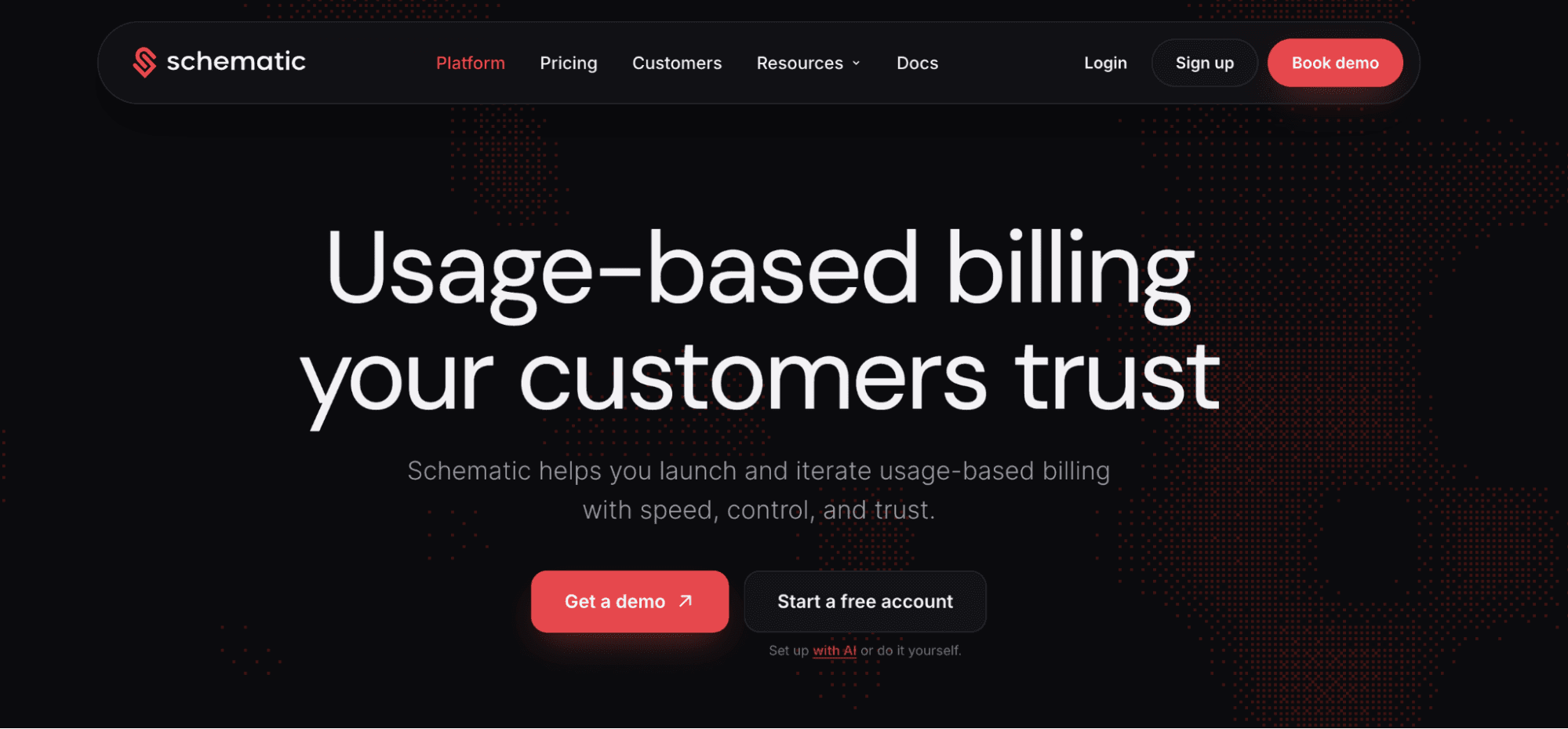
Schematic makes usage-based pricing something customers can trust instead of fear. Enterprise credit wallets show users exactly what they use and owe.
They can set usage limits per user or per agent. They also receive notifications about remaining credit balances or usage allowance before access stops.
Another standout feature is the entitlement engine. Schematic ensures that customer's access is in line with their subscription and payment state. Vendors protect gross margins and prevent revenue leakage due to over-entitlement.
Concurrency-safe holds can reserve credits and commit or release them based on the action's result. Two agents drawing the same balance can't double-spend it.
Schematic gives both buyers and sellers confidence that consumption will stay within budget. The result is less friction during procurement, faster sales cycles, more predictable expansion, and higher long-term revenue.
Schematic Fills the Gap That Stripe Leaves Open
Stripe is one of the most popular developer tools, and for good reason. It simplifies payment processing, enables different billing models, and manages recurring revenue. However, it's not the best fit for enterprises with complex usage billing requirements.
Schematic is the best Stripe alternative for software and AI companies that sell to enterprises. Credit wallets and an auditable ledger make every pricing change configuration, not code.
Model any usage-based pricing model with just a few clicks, from pay-as-you-go to hybrid models. Commercial teams can test plan changes and forecast future revenue before implementing the updates.
Schematic also provides full customization, control, and predictability over usage-based charges. Customers can set limits, control top-up rules, and define what happens at the usage cap.
The entitlement engine enforces whichever policy the customer has set. It can even version plans, migrate customers, and launch trials without filing an engineering ticket.
Companies can close enterprise deals faster, drive expansion, and earn more revenue.
FAQs About Stripe Usage-Based Billing
Does Stripe do usage-based billing?
Yes. Stripe supports usage-based billing through Metronome. Companies can meter usage events, apply pricing rules, and bill customers based on actual consumption.
What does usage-based billing mean?
Usage-based billing means customers pay according to how much of a product or service they consume. Charges may be based on API calls, tokens, credits, transactions, storage, compute, or another measurable unit tied to product usage.
Can I bill customers based on usage?
Yes. Many SaaS and AI companies track customer usage and bill users for the total amount they consumed during a billing period. Usage-based billing aligns pricing with the value the product delivers.
What is the Stripe Billing usage fee?
Stripe Billing's pay-as-you-go plan currently charges 0.7% of billing volume. Companies only pay for what they use, which is reasonable for those with low or unpredictable usage volume.