 Ryan Echternacht
SaaS companies need more than just checkout.
A checkout page can process payments, but it does not let you manage your pricing strategy. As your SaaS business grows, you may need to control tiered plans, subscriptions, product access, usage limits, discounts, and complex pricing structures.
That is where SaaS pricing tools come in.
The right software can help you launch any SaaS pricing model, manage software entitlements, track product usage, send invoices, and see which plans are growing your business.
In this guide, we'll compare the leading B2B SaaS pricing tools to help you find the best fit for your pricing goals, team size, and growth plans.
TL;DR
These are the best SaaS pricing tools in 2026:
- Stripe Billing
- Chargebee
- Metronome
- Orb
- ChartMogul
- Paddle
Common Types of SaaS Pricing Tools
SaaS pricing tools can solve different pricing problems. Some manage in-product access, while others handle billing, usage-based plans, analytics, or global tax compliance.
Pricing and Entitlement Management Platform
A pricing and entitlement management platform connects your pricing plans to what customers can access inside your product.
SaaS entitlements control which features, limits, seats, or add-ons an account can use.
For example, a Free plan includes basic features and a single seat with limited usage. A Pro tier unlocks advanced features, more seats, and higher limits.
An entitlement management system is often used when SaaS companies want to change pricing without hard-coding entitlement logic into the product.
You can test new SaaS pricing strategies, launch add-ons, and modify plan inclusions independently from engineering.
The platform makes sure customers receive the right access based on what they purchased, upgraded to, or added to their account.
Subscription Management Platform
A subscription management platform helps you manage recurring plans, customer accounts, renewals, upgrades, downgrades, cancellations, and invoices. It keeps subscription billing data accurate as your SaaS company grows.
Instead of tracking plan changes by hand, you can use this tool to manage plan logic, billing cycles, coupons, trials, and proration.
This type of SaaS pricing tool is helpful when you offer several pricing tiers or when a large number of existing customers change plans every month.
Usage-Based Billing Software
Usage-based billing software measures customer activity and converts that activity into billable charges.
You use this type of SaaS pricing tool when you charge customers for API calls, AI credits, seats, storage, or other usage units.
A usage-based pricing model works well for products where customers pay more as they get more value. However, predictable revenue growth depends on accurate usage data, clear pricing rules, and invoices that reflect actual customer behavior.
Choose usage billing software that supports diverse usage patterns and bills customers fairly based on what they consume.
Pricing Analytics Software
Pricing analytics software helps you understand how pricing affects annual or monthly recurring revenue, business growth, and customer satisfaction.
The platform can track key metrics tied to different pricing models, plans, and customer accounts. These include churn rate, customer lifetime value, customer acquisition costs, average revenue per user, and free-to-paid conversion rates.
Pricing analytics software can also reveal upgrade opportunities, churn risks, and poor upgrade paths.
Most SaaS companies need this tool because pricing should not be based on guesses. Clear pricing data helps teams make better-informed decisions.
Merchant of Record
A merchant of record (MoR) is a platform that sells the software on behalf of your SaaS business.
It handles payments, sales tax, VAT, fraud checks, chargebacks, and global compliance. This type of tool is useful if you sell to customers in many countries.
A merchant of record is different from a basic payment processor. A payment processor helps move money. A merchant of record assumes full responsibility for the legal and tax work tied to the sale.
SaaS companies need a MoR when global selling becomes hard to manage internally. It can reduce the manual work needed to support different tax rules, local payment methods, and regional accounting needs.
7 Best SaaS Pricing Tools in 2026
The best SaaS pricing tools below help organizations manage plans, product access, billing, usage, and compliance as pricing gets more complex.
1. Schematic + Stripe
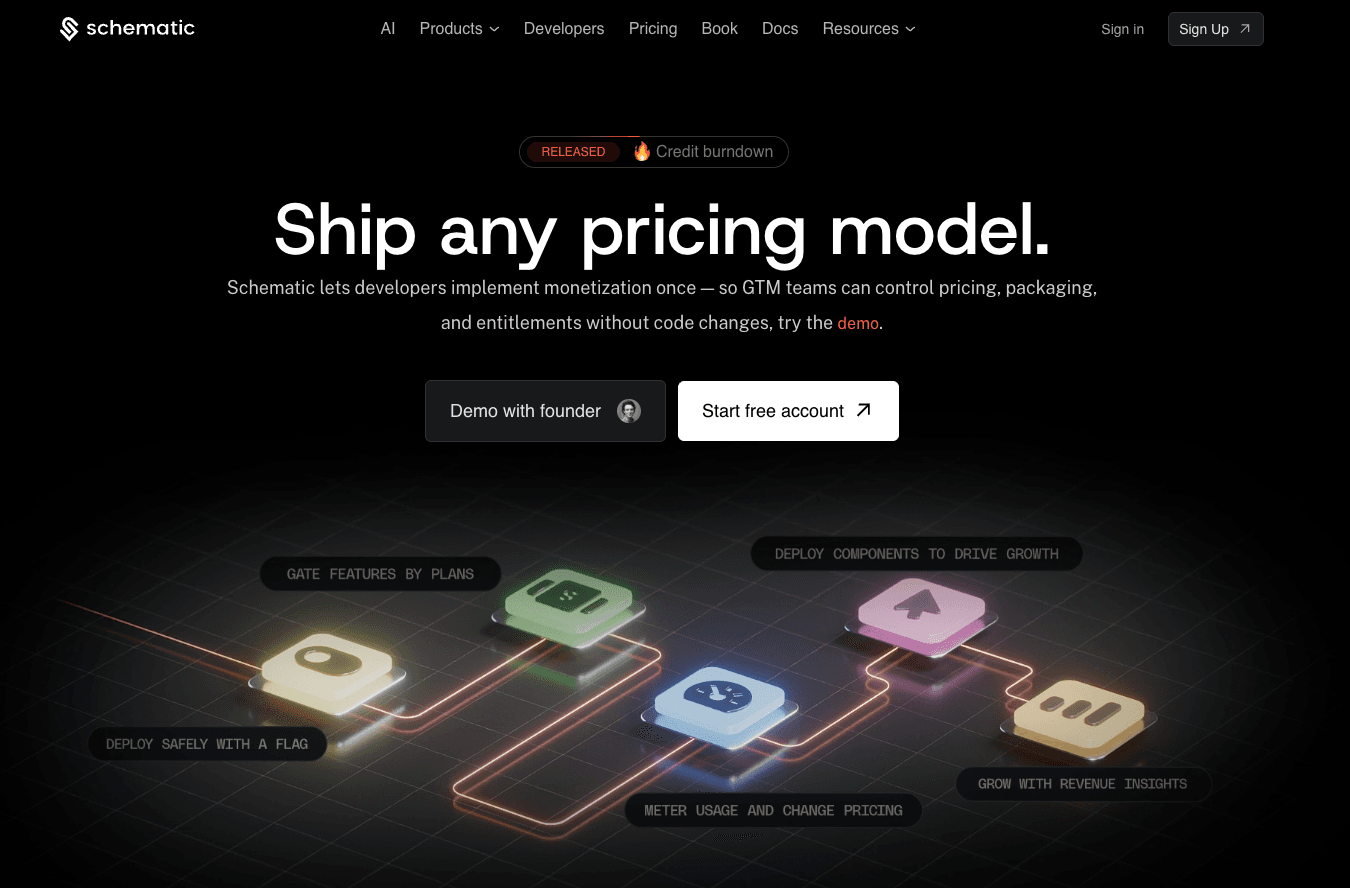
Schematic is the monetization operating system that handles SaaS pricing and packaging at every stage, from how you bill your customers to how they experience your product.
Ship popular pricing models, including usage-based and hybrid models, without code changes. You can also define plans, entitlements, limits, credits, trials, add-ons, and custom overrides inside Schematic.
Every change in Schematic propagates to the product, the billing system, and the customer portal. Engineering only implements monetization once, while go-to-market (GTM) teams can continuously iterate on packaging.
Schematic, built on Stripe, also provides entitlement management capabilities on top of your existing billing infrastructure. Enforce product access and usage limits directly from the Stripe app.
Stripe continues to handle invoices and payments. Schematic extends Stripe with usage metering, internal admin dashboards, feature flags, and revenue insights.
Key Features
- Native Stripe app: Turn Stripe billing into real-time access control, customer lifecycle management, and usage enforcement.
- Product catalog: Manage plans, entitlements, add-ons, limits, credits, trials, and exceptions in one place.
- Company profiles: Store company keys, traits, subscription details, and usage data into a single profile.
- Usage-based tracking and credit ledger: Launch any usage-based pricing model, track usage events, and issue loyalty credits to prevent customer churn.
- Feature access control: Use structured entitlements and smart flags to enforce in-product access at runtime.
- Embeddable billing components: Create flexible customer portals, usage dashboards, pricing pages, and checkout flows with a few lines of code.
- Revenue insights: Identify upgrade opportunities, spot churn risks, and receive alerts when customers are near their usage limits.
2. Stripe Billing
Source: Stripe.com
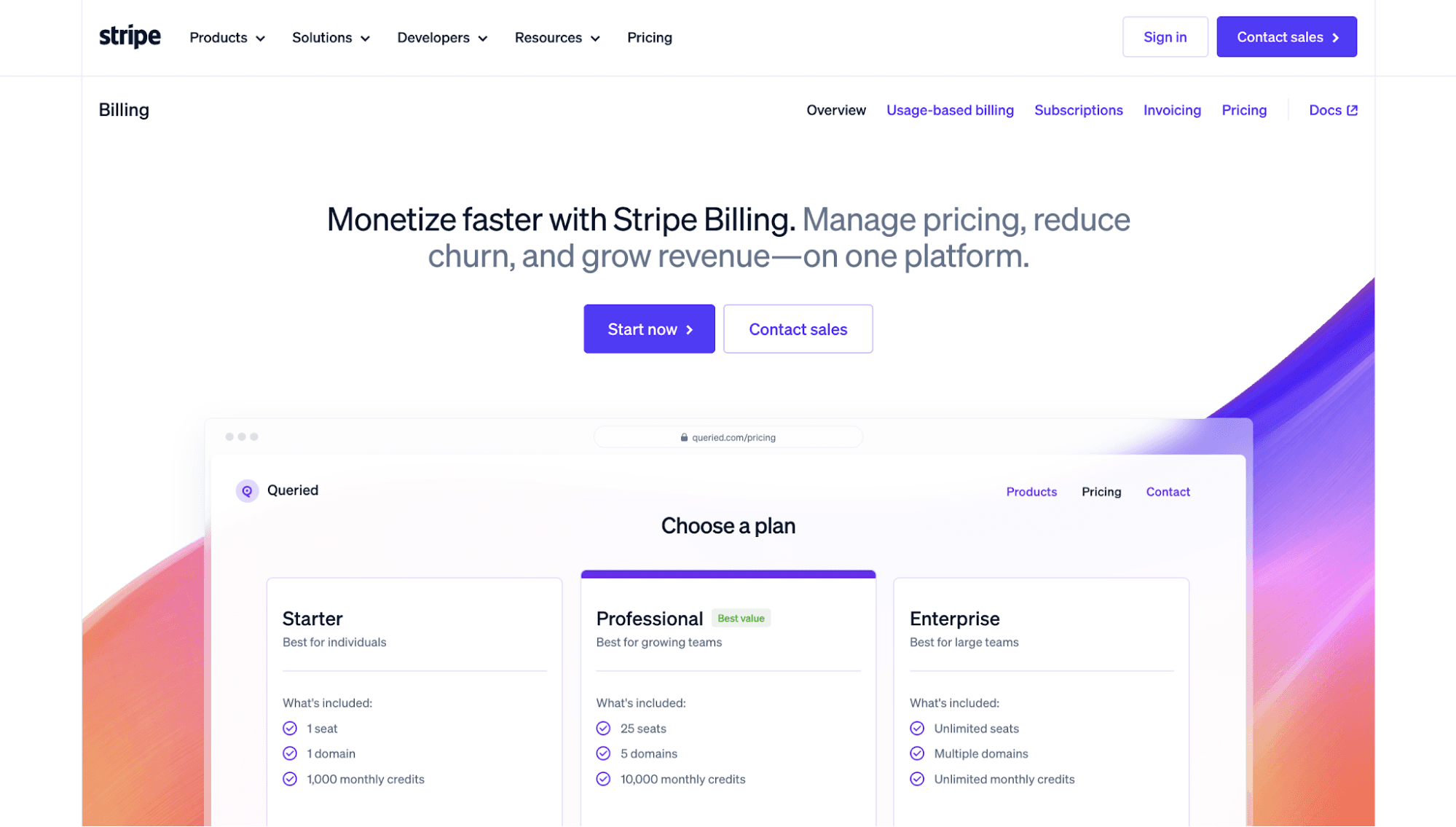
Stripe Billing is a great SaaS pricing tool for companies that want to manage subscriptions, usage-based billing, invoices, and customer payments in one platform.
It supports consumption-based pricing, tiered pricing, flat-rate pricing model with overages, hybrid monetization, and other pricing models.
You can launch popular SaaS pricing models in just a few clicks or create custom billing logic with minimal code. You can also define plans, bundles, and rate cards in one place.
Stripe Billing accepts over 100 payment methods in different currencies, making it easier to sell to internal customers. It uses automated adaptive pricing to manage localized pricing and taxes.
The platform even includes AI-powered tools that instantly recover revenue from failed transactions or expired payment methods.
Key Features
- Usage-based billing: Launch usage-based models with no-code setups for credits, meters, and flexible pricing plans.
- Online checkout and payments: Sell products through online checkout, payment links, and other supported payment methods.
- Subscription management: Manage recurring revenue, subscription plans, trials, invoices, and prorations.
- Smart payment retries: Use artificial intelligence to recover failed payments and reduce lost revenue.
- Tax calculation and collection: Stripe Billing automatically calculates and collects taxes for your SaaS business.
3. Chargebee
Source: Chargebee.com
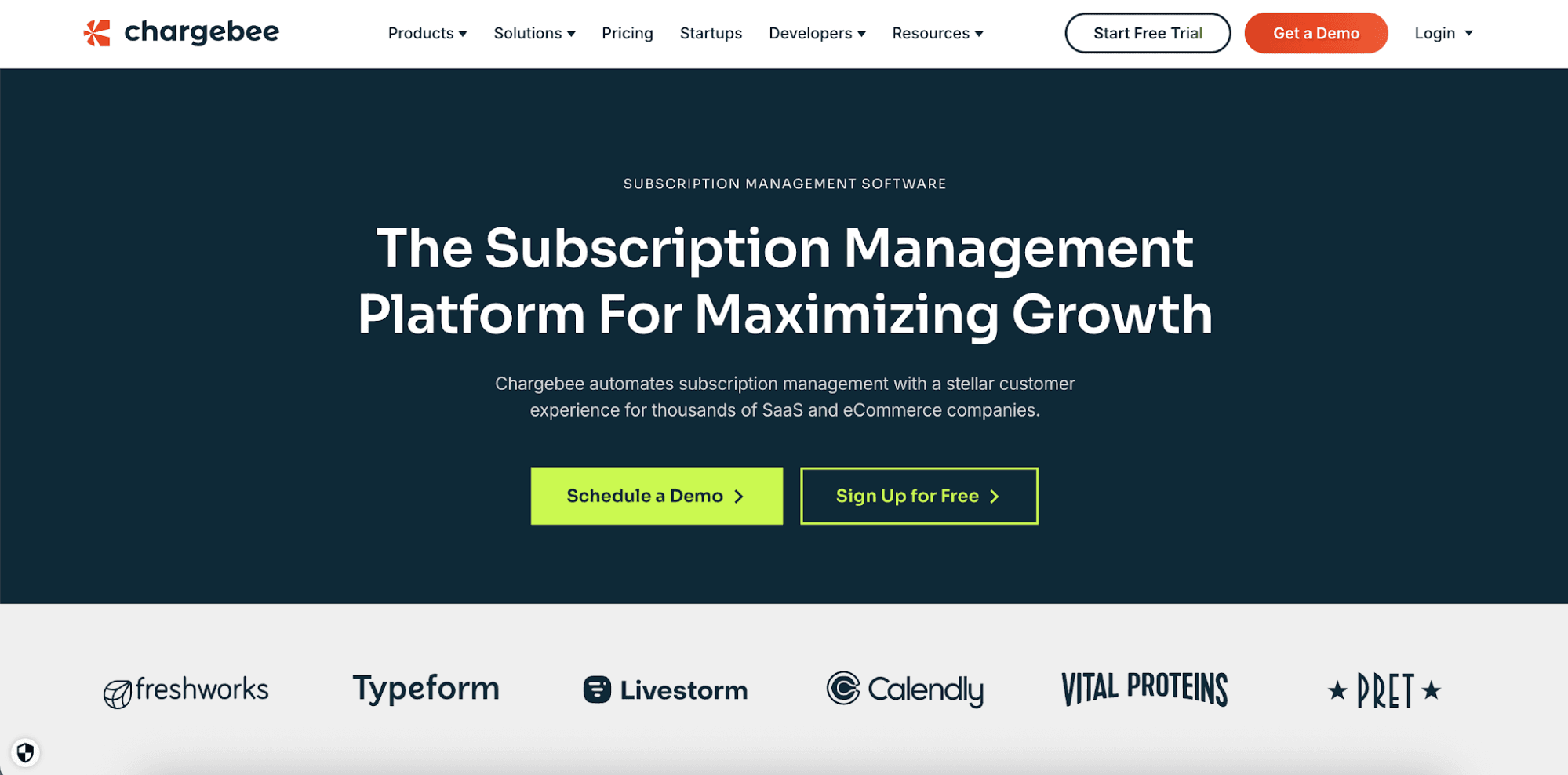
Chargebee is known for its subscription management platform. It automates every stage of the subscription lifecycle, including nudging free users to paid plans, collecting payment details, and adjusting billing due to upgrades or downgrades.
With Chargebee, you can reduce churn by offering personalized offers and tailored experiences to different customer segments. You can also automate revenue recovery to prevent income loss from failed payments and billing errors.
Chargebee also supports basic entitlement management. Set usage limits and provision feature access to encourage product expansion.
You also gain access to subscription analytics and interactive dashboards. Track key SaaS metrics, such as lifetime value, average revenue per subscription, and recurring revenue growth. Then, translate raw data into reports without code or Excel sheets.
Key Features
- Subscription lifecycle management: Manage upgrades, downgrades, and subscription renewals.
- Trial and coupon management: Offer free trials, paid trials, coupons, discounts, gift subscriptions, and email notices to convert customers.
- Automated revenue recovery: Chargebee instantly recovers failed payments to retain at-risk customers.
- Entitlement management: Map features to plans and manage access at the plan or subscription level.
- Subscription reports: Monitor revenue growth, revenue leakage, churn, customer lifetime value, and other metrics to inform pricing strategies.
4. Metronome
Source: Metronome.com
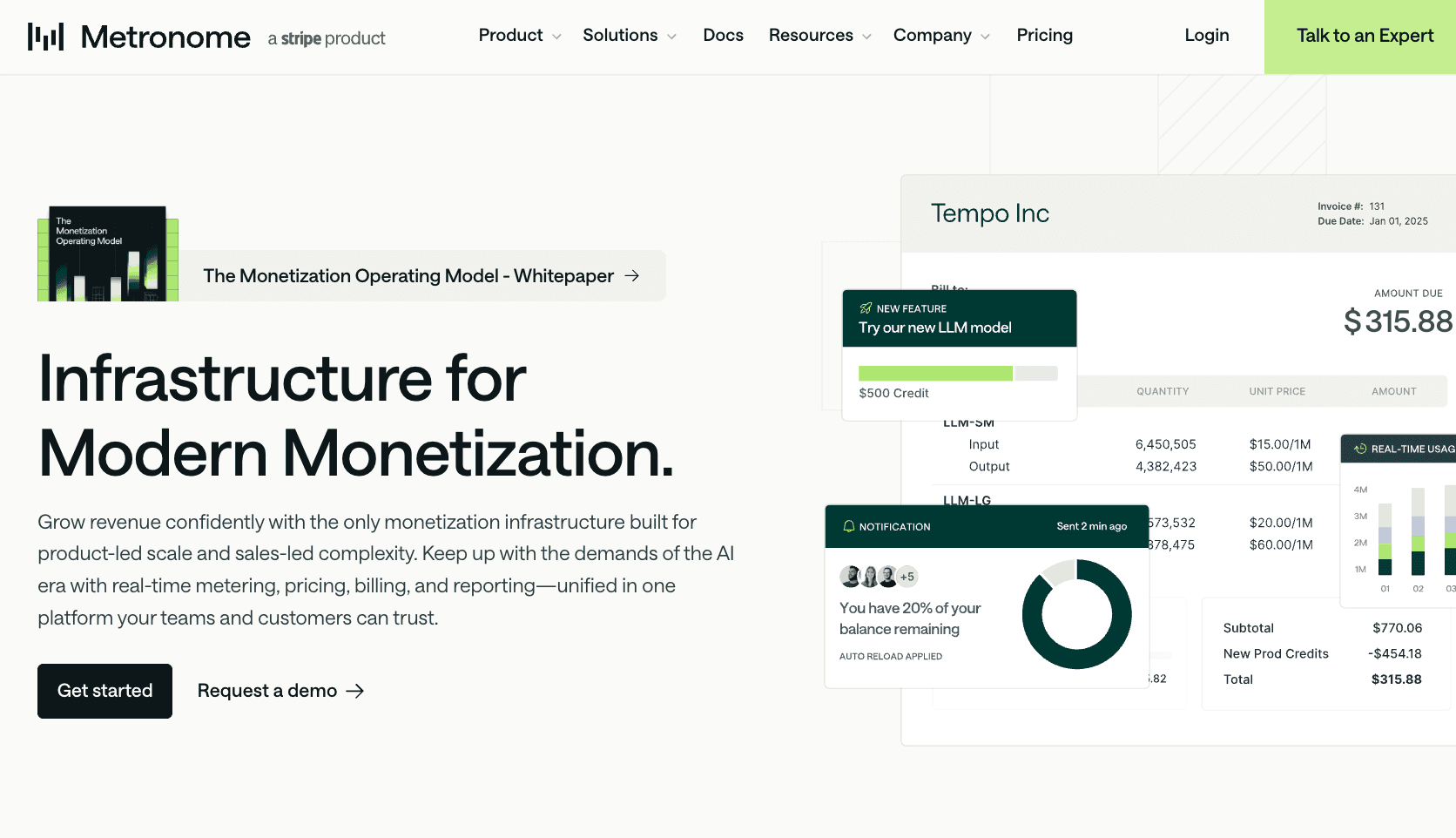
Metronome offers a usage-based pricing platform for SaaS businesses dealing with product-led scale and sales-led complexity.
It helps teams meter usage, build pricing rules, create rate cards, manage credit-based models, and turn customer activity into accurate invoices.
The platform can also set different price points and templates for self-serve, enterprise, marketplace, and reseller motions.
Metronome solves the pain of building and maintaining custom usage rating systems. A single source of truth means that teams can run experiments, launch new pricing models, and implement changes without operational complexity.
Plus, Metronome provides real-time insights into product usage and revenue data. These enable SaaS teams to track customer health, monitor credit usage, conduct margin analysis, and drive upsells at the right time.
Key Features
- Usage-based metering: Meter raw usage events and translate them into billable charges.
- Pricing levers: Manage rate cards, credits, commits, discounts, and custom contract terms for any go-to-market motion.
- Scheduled price adjustments: Pricing changes can take effect instantly, in the future, or retroactively.
- Custom pricing: Personalize contracts with flexible discounts, amendments, and overrides.
- In-app reporting: Track key SaaS metrics and show customers their real-time usage, spend, and billing data inside the product.
5. Orb
Source: withOrb.com
Orb is another usage-based billing platform for SaaS companies that charge customers based on product consumption.
Unlike Metronome, which focuses on usage metering, Orb provides the entire billing stack. It takes care of metering, billing, invoicing, and reporting.
The platform moves usage data to invoices, finance workflows, and customer-facing systems like calculators, dashboards, and checkout flows.
Orb also lets teams manage customers, contracts, and prices from a centralized platform. This makes it easier to iterate and optimize pricing strategies.
It even provides the necessary tools to simplify revenue recognition, dunning management, and accounts receivable reporting.
Key Features
- Usage-based billing engine: Ingest events, meter usage, and send accurate invoices based on actual product consumption.
- Price modeling: Launch different SaaS billing models and optimize pricing strategies.
- Invoice management: Create invoices, view their status, and plan next steps in one workflow.
- Experience kit: Changes in pricing are reflected in customer-facing systems.
- Financial tools: Close books faster with ASC 606-aligned reporting, advanced dunning, and AR aging reports.
6. ChartMogul
Source: ChartMogul.com
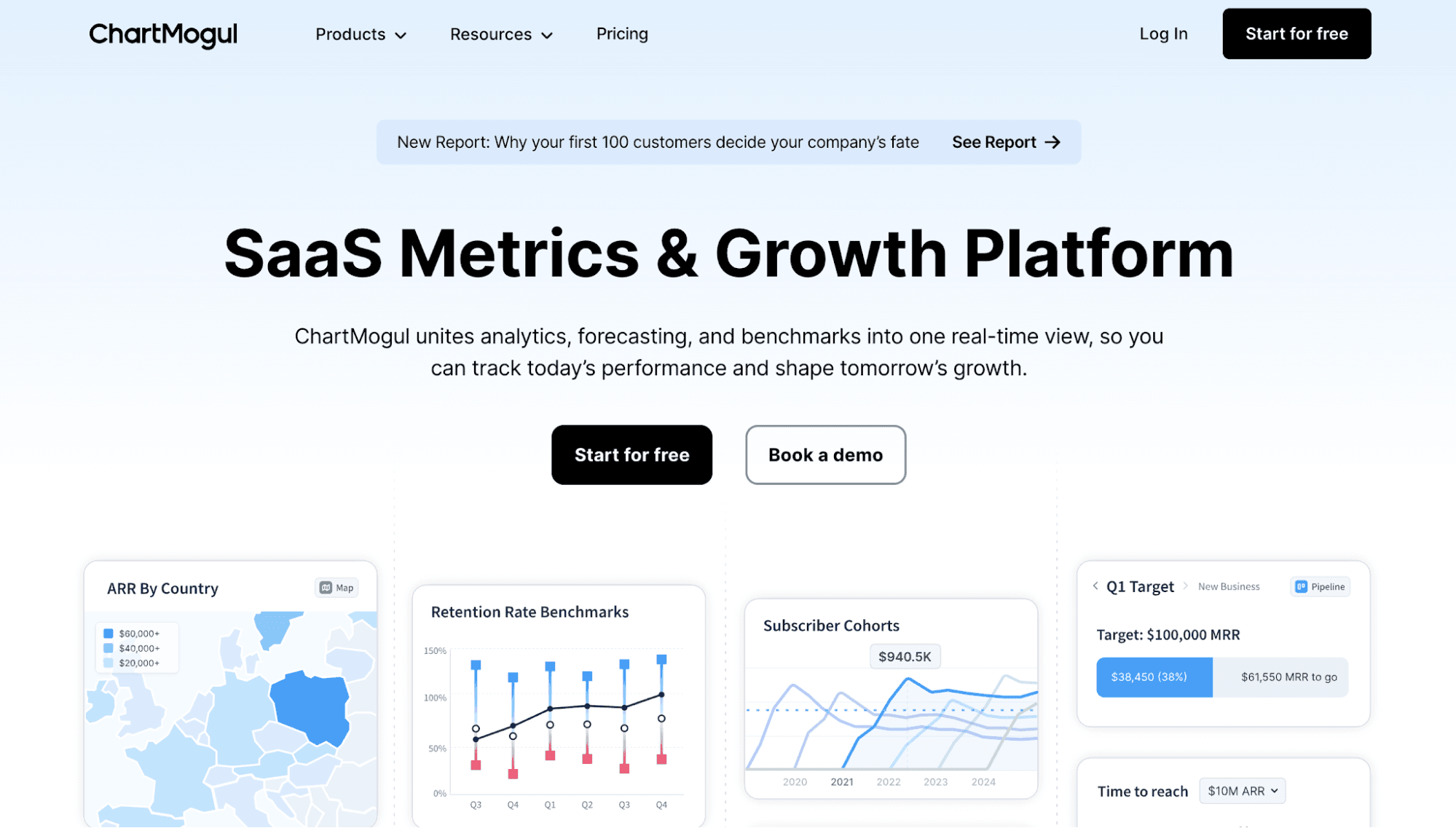
ChartMogul is a subscription analytics platform that helps SaaS companies understand revenue growth, subscriber cohorts, retention rate benchmarks, and other valuable metrics.
It compares the performance of various pricing plans to identify which ones are driving profits. At the same time, it can benchmark against competitors to reveal where your business currently stands.
ChartMogul also breaks down churn by reason, pricing plan, or any other dimension. These insights empower you to make data-driven decisions.
Plus, the platform can explore future scenarios and model revenue growth in the upcoming years. Extensive export capabilities let you feed data anywhere you need it.
Key Features
- Subscription analytics: Track every SaaS metric, including monthly recurring revenue, free-to-paid conversion rate, net cash flow, annual run rate, and customer retention rate.
- Benchmarking capabilities: Compare growth and retention against peers.
- AI-powered enrichment: Use enrichment to reveal important details about your subscriber, including their industry, headcount, and target market.
- Data export: Send key metrics to CSV exports, APIs, webhooks, and data destinations.
- Turnkey integrations: Connect ChartMogul to data warehouses, billing platforms, accounting software, and other existing apps that your SaaS business uses.
7. Paddle
Source: Paddle.com
Paddle acts as a merchant of record for SaaS businesses that want to sell in international markets.
It completely manages billing, subscriptions, localized checkout, churn prevention, and revenue reporting for organizations.
Paddle supports over 20 currencies and multiple payment methods, which can increase conversions and improve customer experiences. It also takes care of tax compliance requirements in more than 100 jurisdictions.
The built-in payment fraud protection can minimize card attacks, fight illegitimate chargebacks, and screen fraudsters to ensure businesses keep more revenue from each sale.
SaaS teams use Paddle to reduce manual work and sell in global markets without needing to register in every country.
Key Features
- Global payment support: Accept local payment methods and multiple currencies.
- Tax compliance management: Paddle fully manages sales tax and regulatory compliance for SaaS businesses.
- Fraud protection: Capture more revenue using built-in fraud protection capabilities.
- Subscription management: Handle multiple plans, calculate prorated payments, and reactivate churned customers.
- Payment analytics: Track real-time revenue, cash flow, and customer retention data in reporting dashboards.
Comparison of the Top 7 SaaS Pricing Tools
Below is a quick comparison table to help you evaluate the tools from above.
Tool | Best For | Key Features | Price |
Schematic | Pricing and entitlement management | Native Stripe app Product catalog Company profiles Usage-based tracking and credit ledger Feature access control Embeddable billing components Revenue insights | Free Growth at $200/month Custom pricing |
Stripe Billing | Subscription and invoice management | Usage-based billing Online checkout and payments Subscription management Smart payment retries Tax calculation and collection | Pay-as-you-go pricing (0.7% of billing volume) Monthly subscription ($620/month) |
Chargebee | Subscription management | Subscription lifecycle management Trial and coupon management Automated revenue recovery Entitlement management Subscription reports | Free for the first $250K of cumulative billing (then 0.75% on billing volume) Performance at $7,188/year |
Metronome | Usage-based metering | Usage-based metering Pricing levers Scheduled price adjustments Custom pricing In-app reporting | Free Custom pricing |
Orb | Usage-based billing and invoicing | Usage billing engine Price modeling Invoice management Experience kit Financial tools | Custom pricing |
ChartMogul | Subscription analytics | Subscription analytics Benchmarking capabilities AI-powered enrichment Data export Turnkey integrations | Free Starter at $59/month Pro at $99/month Enterprise at $19,900/year |
Paddle | Merchant of record services | Global payment support Tax compliance management Fraud protection Subscription management Payment analytics | Pay-as-you-go pricing (5% + 50¢ per checkout transaction) Custom pricing |
Tips for Choosing the Best SaaS Pricing Tool
If you're still unsure which SaaS pricing tool to choose, you can follow the tips below to make an informed decision.
Know Your Pricing Goals
Before comparing tools, identify where manual pricing work is slowing the business down.
Common issues include managing subscription changes, handling billing errors, enforcing feature access, or aligning pricing data across multiple systems.
The best SaaS pricing tool should remove operational friction.
By understanding your current pain points, you can narrow your options and focus on platforms that fit your existing workflows.
Review Supported SaaS Pricing Models
Make sure the software supports your current pricing model and any model you want to try as your product grows.
Here are the most common SaaS pricing models:
- Flat-rate pricing: Customers pay a fixed fee to access the product.
- Tiered pricing: Multiple plans offer various features, usage limits, or support. This model helps you serve different customer segments.
- Seat-based pricing: Also known as per-user pricing, it charges accounts based on the number of users or seats using the software.
- Feature-based pricing: Customers pay more to unlock advanced features or capabilities.
- Usage-based pricing: Charge users based on product consumption.
- Value-based pricing: Pricing aligns with the customers' perceived value of the product.
- Freemium pricing: A free plan gives users access to basic functionalities, while premium features require a paid upgrade. A freemium model can drive product adoption.
- Hybrid pricing: This approach combines multiple pricing models, such as flat subscriptions plus usage fees.
Most successful SaaS companies don't stick to a single pricing model. According to the 2026 State of B2B Monetization report, 37% of B2B SaaS companies have hybrid pricing.
Choosing a flexible pricing tool makes it easier to launch the most effective SaaS pricing models as customer needs evolve.
Evaluate Key Features
Not every SaaS pricing tool will have the same capabilities, so it helps to list the key features you need.
For example, if you are comparing subscription management tools, evaluate their ability to manage upgrades, downgrades, and renewals. Choose a platform that can automatically adjust subscription rates based on the customer's current plan.
If you want to control pricing and entitlements, make sure the software decouples billing logic from the application.
It should also provide a system of record for your product catalog. This allows you to adjust plans, feature access, usage limits, and exceptions from a centralized layer without changing code.
Verify Integrations
Invest in a SaaS pricing tool that works seamlessly with the systems you already use.
Check how it connects with your payment processor, customer relationship management (CRM) software, data warehouse, accounting system, and product analytics tool.
A platform with extensive integration capabilities can reduce manual data entry and automatically sync your pricing data across different systems.
Consider Future Scalability
Choose a SaaS pricing tool that can support your next stage of growth.
A platform may work well for managing subscription plans, but fail once you add usage-based fees, sales-led contracts, custom discounts, annual plans, or several products.
Look for software that can manage popular SaaS pricing strategies, payment methods, regions, and reporting needs. You should also review the vendor’s APIs, admin tools, support options, and migration process.
The best SaaS pricing tool should solve your current pain points and still support your team as pricing gets more complex over time.
Control Pricing, Limits, and Feature Access at Runtime With Schematic
Schematic helps modern SaaS and AI companies manage monetization everywhere it shows up in the product. It sits between your application and billing infrastructure.
Schematic works by decoupling pricing and packaging logic from the application code. Instead of rebuilding your billing stack every time you change plans, teams can configure everything in Schematic.
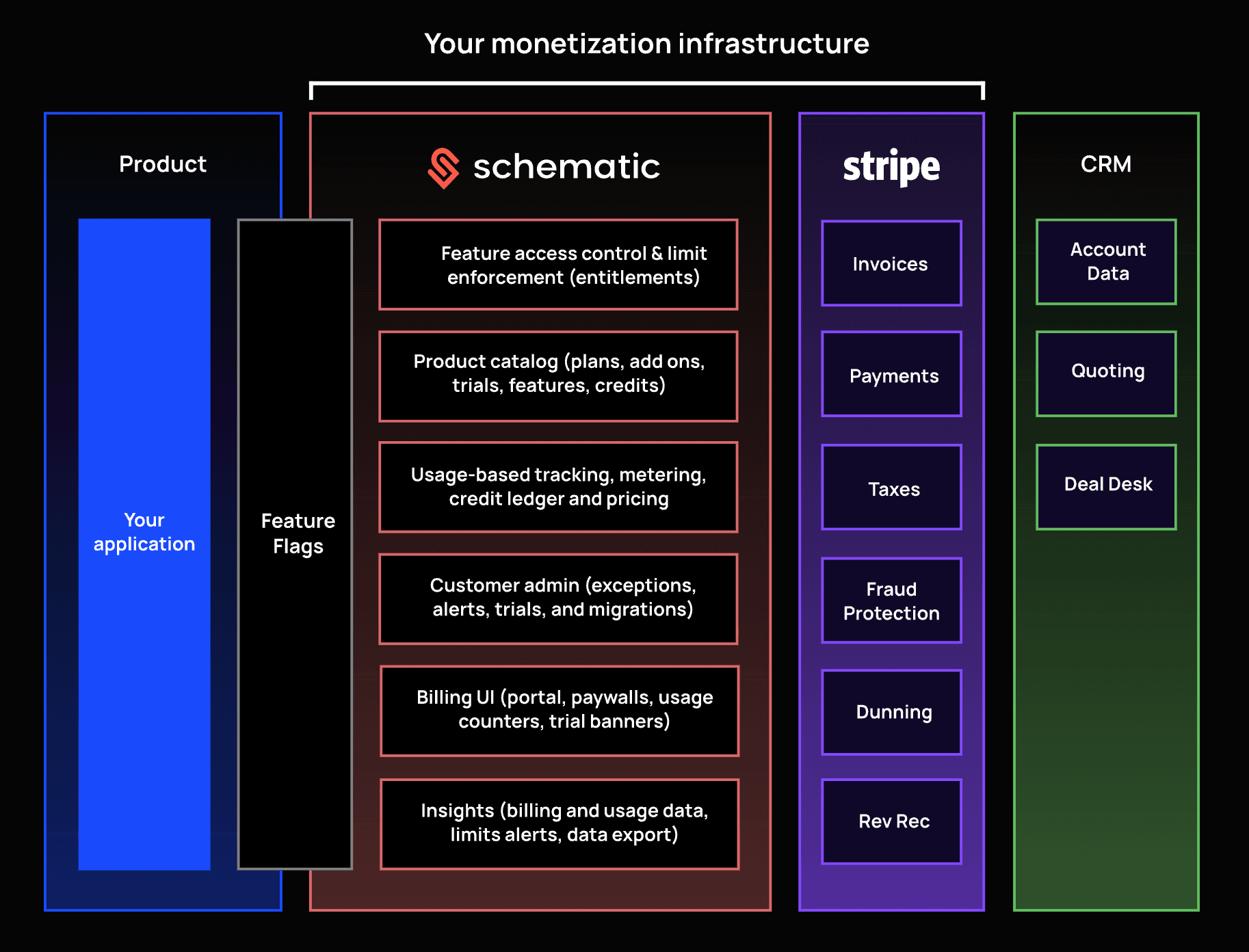
The platform serves as the system of record for your product catalog, from entitlements and usage thresholds to credits, trials, add-ons, and custom overrides.
Schematic also adds advanced capabilities on top of Stripe:
- Feature flags to control feature access at runtime
- Usage metering to track customer activity
- Embeddable billing UI components to show pricing and account options
- Internal admin dashboards to manage customers
For SaaS businesses that already use Stripe, Schematic turns billing into a full pricing and entitlement management system. It helps teams launch new packages, adjust limits, manage access, and connect what customers buy with what they can use inside the product.
FAQs About SaaS Pricing Tools
What are SaaS pricing tools?
SaaS pricing tools are software platforms that help companies create, manage, optimize, and analyze their own and competitors' pricing strategies. Different types include pricing and entitlement management software, subscription management platforms, usage-based billing systems, pricing analytics tools, and merchant of record solutions.
Why do SaaS companies use pricing tools?
SaaS companies use pricing tools to connect price with customer value. Businesses also rely on these platforms to manage plan changes, reduce billing errors, analyze customer behavior, find growth opportunities, and react to market trends faster.
How do SaaS pricing tools work?
SaaS pricing tools work by unifying pricing, billing, product usage, and customer data in one system. They help teams manage plans, track usage, control feature access, generate invoices, and review performance over time.