 Ryan Echternacht
Prices do not stay still for long. Competitors constantly adjust offers, offer discounts, change packages, and react to market demand.
That puts pressure on teams to move faster. But tracking price changes manually takes too much time and leaves room for mistakes.
Pricing intelligence software has become a must-have tool for growing businesses. It helps teams understand how their prices compare in the market and make data-driven pricing decisions.
This is important because price has a direct impact on buying choices. According to the EY Future Consumer Index, 50% of U.S. consumers say price is the main factor they consider before purchasing.
In this article, we'll look at the best pricing intelligence software that can help companies act on competitor prices and market data.
TL;DR
These are the best pricing intelligence tools:
- Schematic + Stripe — best for SaaS and AI businesses
- Zuora — best for media and entertainment companies
- Pricefy — best for eCommerce brands
- Competera — best for enterprise retailers
- Pricefx — best for manufacturing and distribution companies
Top 5 Pricing Intelligence Software in 2026
Here's a closer look at the best pricing intelligence solutions for each industry.
1. Schematic + Stripe — Best for SaaS and AI Businesses
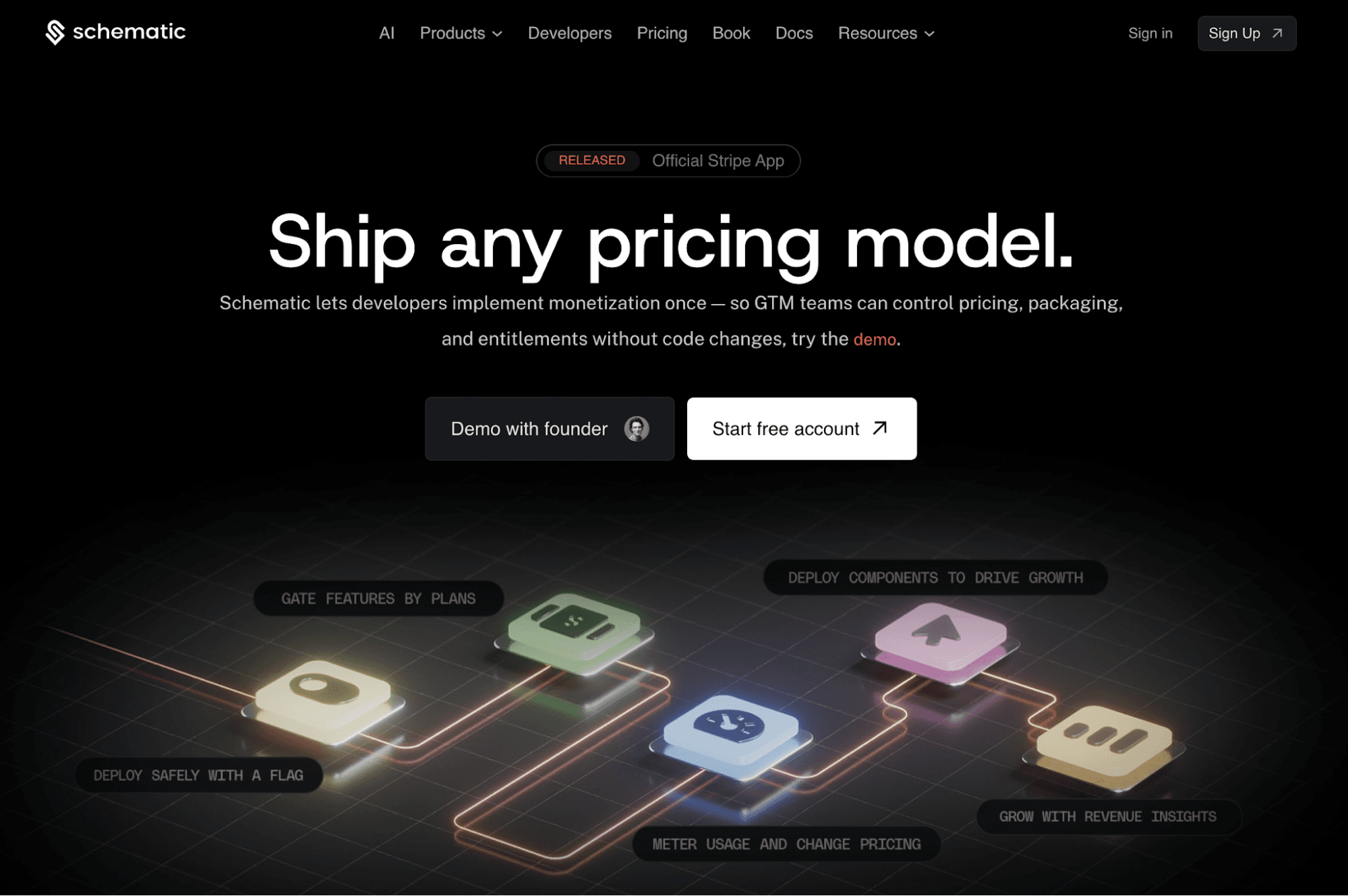
Schematic is the best pricing intelligence software and monetization platform for modern SaaS and AI companies.
It decouples billing logic from the application. This allows product and go-to-market teams to change pricing and packaging independently from engineering.
Schematic also serves as the system of record for your product catalog. Create custom plans, manage software entitlements, launch trials, offer add-ons, and adjust limits to match competitors' pricing strategies.
Schematic, built on Stripe, turns billing state into application behavior. It evaluates and enforces access inside the product at runtime. That means engineering stops writing billing code and maintaining complex entitlement management systems.
The platform also extends Stripe with usage metering, drop-in billing components, customer profiles, internal admin dashboards, and revenue insights.
With Schematic, you can control monetization everywhere it exists in your product. You can also learn which plans and pricing models contribute to revenue growth and focus on them.
Key Features
- Centralized product catalog: Manage plans, offer add-ons, launch trial pricing, adjust limits, and enable credit rollovers in one place.
- Usage-based billing: Charge customers for seats, credits, tokens, API calls, monthly active users (MAUs), overages, and other usage metrics.
- Feature access control and limit enforcement: Gate features by plan, usage, customer traits, and billing state.
- Bi-directional sync with Stripe: Import Stripe products, prices, subscriptions, and customers once. Schematic keeps everything in sync.
- Company profiles: View account traits, subscription details, current usage, limits, and exceptions from a single scrolling page.
- Revenue insights: Identify upgrade opportunities and churn risks. Then, set up triggers to act on them.
- Embeddable billing components: Use a drag-and-drop element builder to create customer portals, usage dashboards, and pricing tables.
- Built-in integrations and SDKs: Connect Schematic to WorkOS, Segment, Clerk, Salesforce, and Hubspot. You can also use simple SDKs to add Schematic to your application.
- SOC 2 and GDPR compliance: Schematic meets SOC 2 (Type 1 and Type 2) and GDPR requirements to protect data privacy.
2. Zuora — Best for Media and Entertainment Companies
Source: Zuora.com
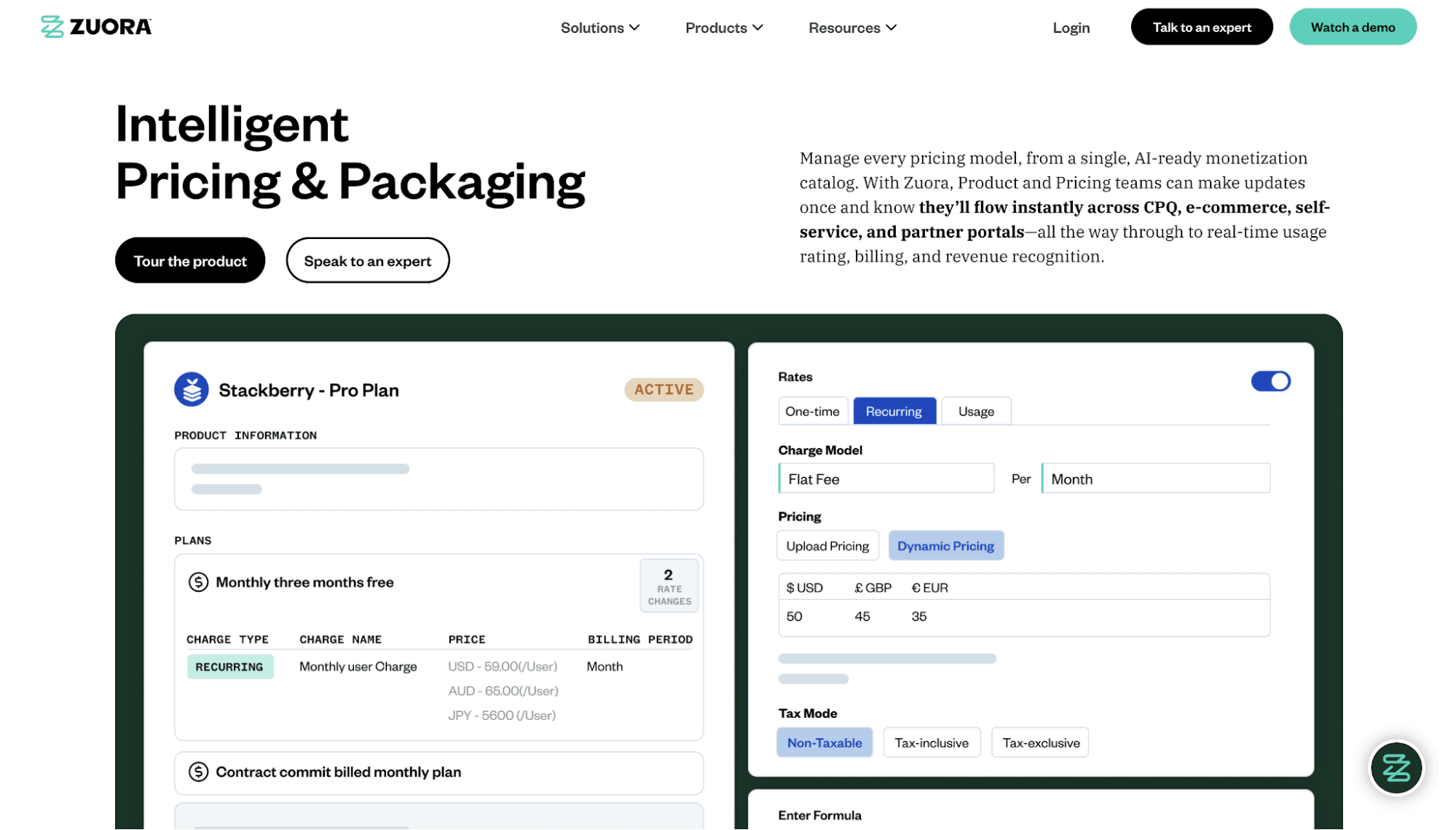
Zuora is an intelligent pricing and packaging platform that helps media and entertainment companies stay competitive. Teams can easily adjust pricing, promotions, and bundles in various distribution channels without complex coding.
Zuora's core capabilities include a monetization catalog, AI-powered paywalls, global price lists, and subscription management. The platform also supports out-of-the-box pricing methods that resonate with the target market.
Implementing dynamic pricing models and customizing paywall access is simple with Zuora. Businesses can increase conversions and maximize profitability from each visitor.
Zuora can even analyze customer behavior and churn risks. These data-driven insights allow media companies to align pricing with market trends and consumer preferences.
Key Features
- Flexible pricing strategies: Implement flat-fee, volume, tiered, prepaid, or usage-based pricing.
- Monetization catalog: Manage products, pricing rules, discounts, entitlements, and accounting policies in one shared hub.
- AI-powered paywalls: Enforce paywalls to convert casual readers into loyal, paying subscribers. You can then use actionable insights from AI to adjust your strategy.
- Dynamic content recommendations: Deliver personalized experiences based on customer behavior.
- Automated subscription renewals: Renew subscriptions on schedule to reduce churn and support long-term subscriber growth.
3. Pricefy — Best for eCommerce Brands
Source: Pricefy.io
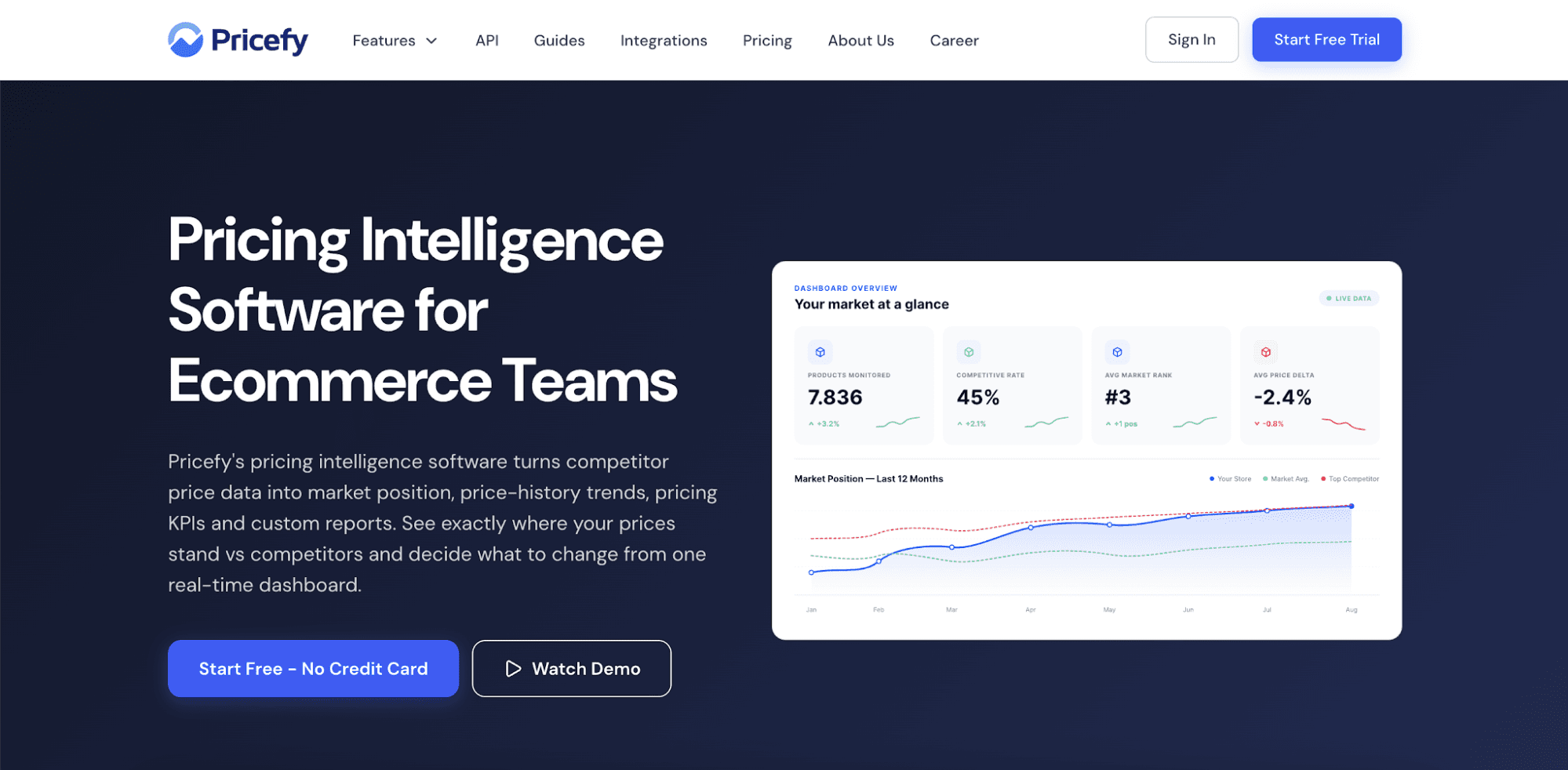
Pricefy's pricing intelligence software is built for eCommerce brands that want to closely monitor competitor prices. It collects raw data from websites and marketplaces, then turns that competitor pricing data into dashboards, custom reports, and trend charts.
Pricefy also tracks stock status, shipping cost, and price history. Then, it surfaces overpriced products, margin risks, and opportunities that your team can act on.
Besides competitor price tracking, the platform supports benchmarking. It shows whether each SKU is priced higher, lower, or aligned with the market. This lets you protect profit margins and respond to market changes with more confidence.
Pricefy also enables you to create custom reports for each competitor, product group, country, and price range. Schedule automated delivery so that stakeholders can quickly see structured data that's relevant for their role.
Key Features
- Competitor price monitoring: Track competitor prices, stock availability, shipping cost, pricing performance, and history.
- Benchmarking: Compare each SKU against competitors to see where prices are higher, lower, or aligned with the market.
- Automated repricing: Let Pricefy make real-time pricing adjustments based on predefined rules and price floors.
- Custom reports: Create and filter reports by brand, category, country, or marketplace.
- Proactive alerts: Receive price change alerts through email, Slack, or webhook.
4. Competera — Best for Enterprise Retailers
Source: Competera.ai
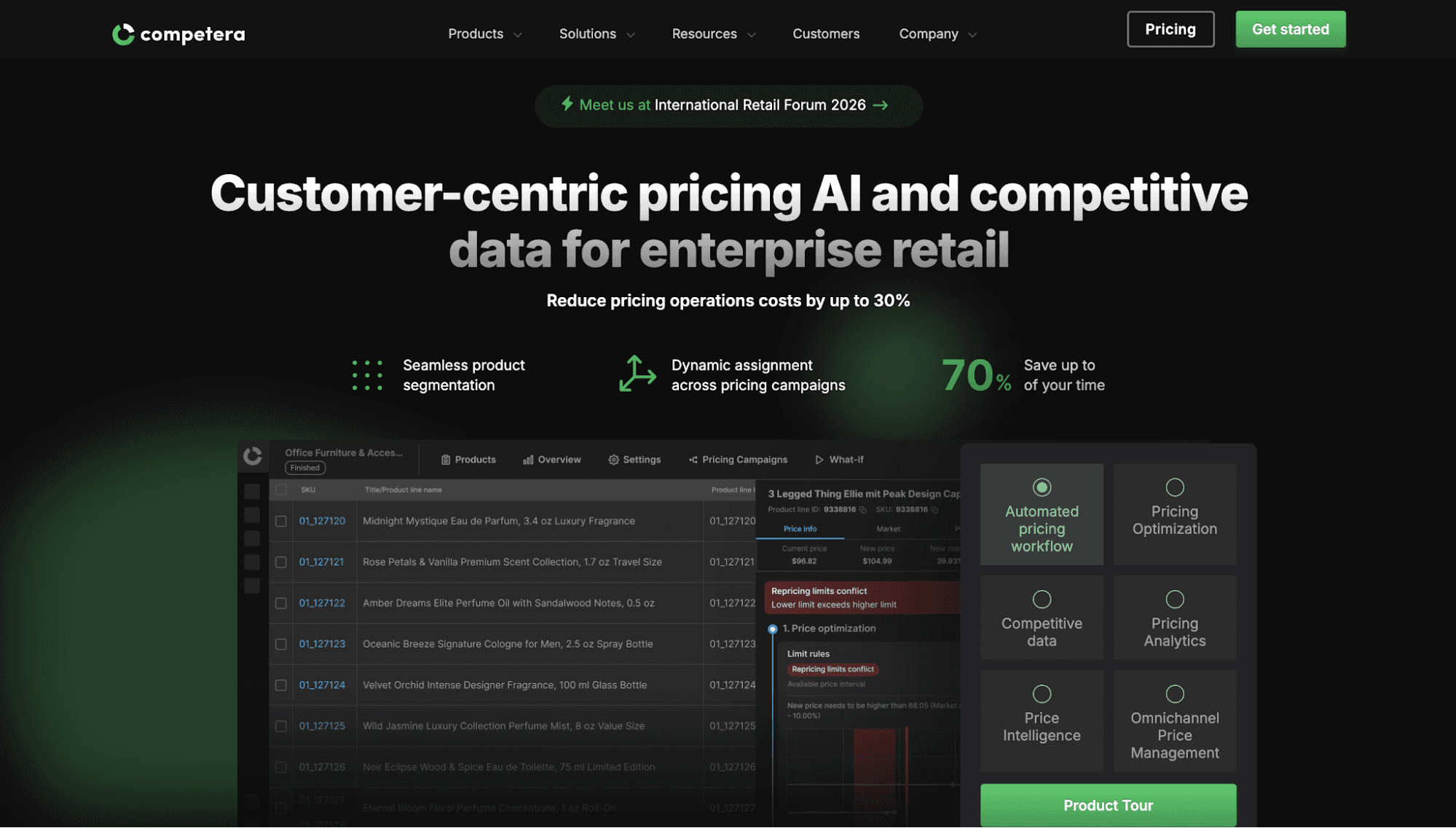
Competera combines automated data collection with AI-driven competitive price intelligence analytics. It works by turning competitive pricing data into actionable insights that help enterprise retail companies make confident pricing decisions.
AI models analyze competitor strategies, reveal pricing gaps, and detect demand signals. Then, they provide clear recommendations that support pricing optimization through intuitive dashboards.
Competera also compares product images, titles, and descriptions against competitors. This makes it easier to understand your company's current standing.
By providing a complete view of the competitive landscape, Competera enables pricing teams to stay ahead of competitor moves rather than reacting to them.
Key Features
- Competitor price tracking: Monitor prices automatically in different markets, channels, and categories.
- AI-driven pricing recommendations: Get clear pricing insights to improve competitive positioning.
- Product matching: Match exact and similar products across large retail catalogs.
- Content benchmarking: Compare product images, titles, descriptions, promotions, and installment options.
- Pricing alerts: Receive notifications when competitors change prices, launch promotions, or shift their pricing strategy.
5. Pricefx — Best for Manufacturing and Distribution Companies
Source: Pricefx.com
Pricefx is an AI-powered enterprise pricing intelligence platform for B2B companies with complex pricing needs. It is designed for manufacturers, distributors, sales teams, and pricing teams that need an intelligent decision system.
AI agents scan transactions and prices continuously to identify leaks and protect profit margins. They can also capture more upside by surfacing opportunities across thousands of quotes, products, and customers.
Pricefx also uses AI to deliver smarter product recommendations, optimize prices, and increase profitability on every deal.
The platform provides the necessary tools to help manufacturing and distribution companies respond faster to market shifts and automate pricing decisions at scale.
Key Features
- AI agents and copilots: Surface pricing risks, margin leaks, and revenue growth opportunities through AI agents and chat-like interaction.
- Intelligent price optimization: Use AI to guide price setting, improve profitability, and identify underpriced products.
- Price management: Create complex price lists, calculate price points, and manage claims.
- Rebate and promotion management: Centralize rebate design and run promotions in one governed system.
- Integrated quoting solution: Set up custom quotes and deliver more value in each deal through AI-powered product recommendations.
Benefits of Pricing Intelligence Platforms
Here are the advantages you can expect when using pricing intelligence software.
Stronger Competitive Positioning
Pricing intelligence software provides a clear view of how prices compare in marketplaces and different channels. It can also track pricing changes on competitor websites. This reveals whether the product is priced too high, too low, or right in line with the market.
The software can guide packaging strategies in SaaS companies. It can also show retailers and eCommerce brands when competitors lower prices, add discounts, or change product offers.
With greater visibility into the competition, pricing teams can protect and improve their current market position without relying on manual data collection.
Better-Informed Pricing Decisions
Smart pricing decisions depend on accurate market and competitor data.
Pricing intelligence platforms collect this information and organize it into dashboards, reports, and alerts that teams can act on.
The software removes the guesswork from pricing decisions. It lets you compare prices, track product availability, review promotional offers, and study channel performance using current data.
It also reduces back-and-forth between teams because everyone works from the same source of truth.
Increased Profit Margins
Pricing intelligence software can protect margins by showing if prices are too low, discounts are too generous, or competitors are charging more for similar products. It helps businesses know when to increase prices or adjust offers before profit decreases.
For example, the pricing intelligence platform can suggest retail products that generate strong demand without requiring aggressive discounts.
In SaaS companies, the software can highlight opportunities to adjust packaging, introduce premium tiers, or capture upside from high-usage customers.
These market insights give teams a clearer path to profitable growth.
Faster Pricing and Packaging Changes
Markets move fast, so businesses need a way to update prices and packages without delays.
Fortunately, pricing intelligence solutions make it easier to identify market shifts, track pricing trends, and act before competitors pull ahead.
This may mean changing plan limits, bundle offers, or trial periods for SaaS and AI products. Retailers, on the other hand, can quickly track regional price variations and adjust prices accordingly.
Smarter Demand Forecasting
Pricing intelligence platforms give teams a better view of how price changes may affect demand. They can show how products perform when prices rise, fall, or stay flat compared with competitors.
This is especially useful for businesses that manage stock, sales cycles, renewals, or usage-based plans. Retailers can plan inventory with more care. SaaS teams can test packages with less risk.
Pricing intelligence software can also show shifts in customer expectations, making it easier to create offers that match what buyers are willing to pay.
Tips for Choosing the Right Pricing Intelligence Software
Choosing pricing intelligence software should not be based on features alone. The right platform must fit your pricing goals, automation needs, and existing tech stack.
Set Clear Pricing Goals
Determine what you want to achieve with the pricing intelligence software. Some teams want to increase the average revenue per user or decrease churn. Others want to maintain a strong competitive position.
Your goals should guide every buying decision. A SaaS company often needs greater control over pricing and packaging, while a retail brand may require competitive data monitoring.
Evaluate Pricing Data Coverage and Quality
A pricing intelligence platform is only as useful as the data it collects. Review which websites, marketplaces, regions, currencies, and product categories the software can monitor.
You should also ask how the vendor checks data quality and handles product matching errors. Strong data reliability is important because poor matches, missing prices, or stale data can lead to poor pricing choices.
The best tool should provide access to accurate pricing information and real-time market data.
Review Automation and AI Features
Automation can save time, but it should still give pricing teams control.
Look for pricing intelligence software that can send proactive alerts, create reports, suggest prices, track usage, or apply pricing rules based on clear guardrails.
AI features should also be easy to understand. Your team should know why a price is being suggested before acting on it.
The right platform can simplify pricing workflows by eliminating manual processes and reducing human errors.
Check Integration Capabilities
Make sure the pricing intelligence software can connect to your existing tools. This may include billing software, enterprise resource planning systems, customer relationship management software, and data warehouses.
Strong integrations keep pricing data, billing information, and sales activity aligned. This is especially important for SaaS, retail, manufacturing, and distribution companies with complex pricing operations.
Test the Software Before You Buy
Test the pricing intelligence platform using your actual offerings, pricing rules, and sales channels.
Pay attention to how accurately it matches products, refreshes pricing data, generates reports, and supports daily tasks.
You should involve pricing, sales, and finance teams in the evaluation process. Their feedback can reveal whether the platform fits your workflows and provides the necessary information to make confident pricing decisions.
Make Smarter Pricing and Packaging Changes With Schematic
Pricing intelligence software only delivers value when your team can act on it. Schematic is the monetization platform that enables SaaS and AI companies to control pricing, packaging, and entitlements at runtime.
Schematic lets you define plans, add-ons, limits, trials, credits, and overrides from one place. It can also support hybrid pricing and hybrid selling, including self-serve and sales-led motions, without hard-coding logic.
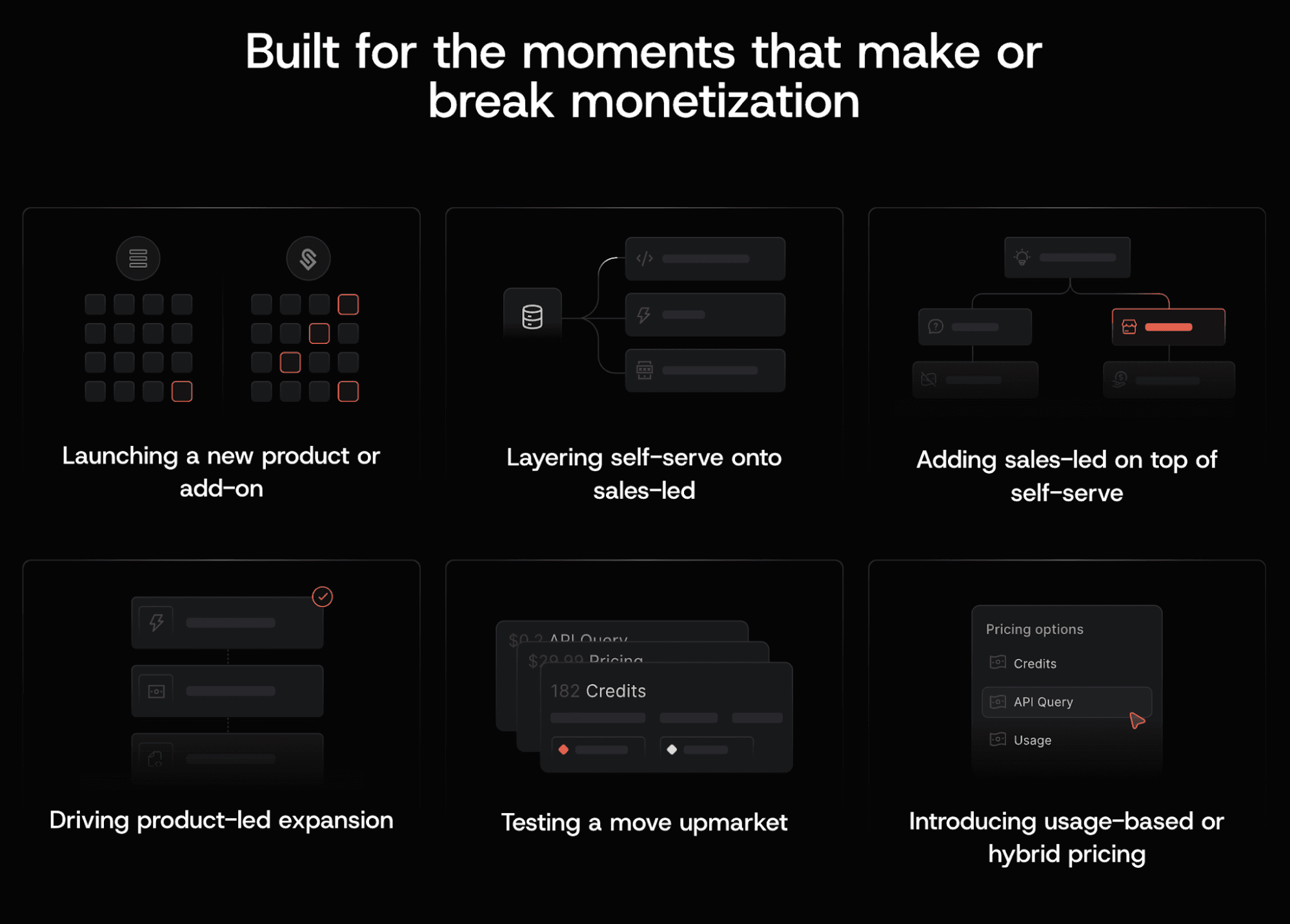
Schematic seamlessly integrates with Stripe. It provides real-time access control, usage enforcement, and customer lifecycle management on top of your existing billing infrastructure.
Go-to-market, product, and sales teams can change pricing and packaging without waiting for developers. Engineering can write two calls instead of two hundred lines, allowing them to focus on core product development.
FAQs About Pricing Intelligence Software
What is pricing intelligence with AI?
Pricing intelligence with AI uses machine learning to collect, compare, and analyze pricing data. It can track competitor prices, demand changes, pricing trends, and market dynamics. Then, it suggests actions based on patterns that are difficult to spot manually.
What are the different types of pricing intelligence software?
Common types of pricing intelligence software include competitor price monitoring tools, dynamic pricing software, and price optimization platforms. Some tools focus on data collection, while others provide automation, alerts, and pricing recommendations.
How do pricing intelligence tools support competitive pricing?
Pricing intelligence tools support competitive pricing by showing how your prices compare with those of other sellers. They track competitor prices, promotions, product availability, and stock status. These insights help you adjust prices faster and improve market positioning.