All posts
How to Grow Expansion Revenue: SaaS Strategies Worth Trying
Blog· Ryan Echternacht·Sep 3, 2026
Ryan Echternacht·Sep 3, 2026
SaaS growth is not only about closing new deals. It also involves growing the accounts you already have. This is where expansion revenue comes in.
Expansion revenue is the additional revenue your SaaS company earns from your existing customer base. It can come from plan upgrades, add-ons, cross-sells, or extra services.
This can be a strong path to steady revenue growth. Your current customers already know your product and have experienced its value. When their needs grow, your pricing strategy and product should give them a clear reason to spend more.
In this guide, we’ll teach you how to grow SaaS expansion revenue using 10 practical strategies.
TL;DR
- Expansion revenue is the additional income SaaS companies receive when existing customers upgrade, purchase related products, or increase usage.
- To grow expansion revenue, offer pricing that scales with customer growth, clear upgrade paths, strategic paywalls, steady product value, and relevant add-ons.
- You can also analyze customer behavior to determine the best time for upsells, cross-sell related products, send personalized offers, test different packages, and share customer success stories.
- Expansion revenue is important because it helps SaaS businesses grow from current accounts, increase customer lifetime value, and reduce reliance on new customer sales.
- Schematic helps teams grow expansion revenue by shipping any pricing model, enforcing usage limits, offering add-ons, using paywalls, and identifying accounts ready to upgrade through revenue insights.
What Is Expansion Revenue in SaaS?
Expansion revenue refers to the extra money a SaaS business earns from its current customers after the first sale.
It is not money earned from newly acquired customers. Instead, it is the additional revenue you receive from customers who already use the product and choose to spend more.
Expansion revenue can come from upsells, paid add-ons, extra seats, additional features, cross-sells, or increased usage.
For example, an existing customer may upgrade from a Basic plan to the Pro tier to unlock premium features and higher usage limits. Alternatively, they might want to purchase data migration services to move existing data from legacy systems to the new platform. Both are examples of expansion revenue.
Why Is Expansion Revenue Important?
Expansion revenue is important because it helps SaaS companies grow from their existing customers. Instead of relying solely on new customers, teams can increase revenue from accounts that already trust their product.
This can help offset customer acquisition costs and support profitable growth. When existing customers upgrade, add seats, buy add-ons, or use more of the product, their lifetime value grows.
A higher customer lifetime value indicates that customers are finding sustained value in the product and are more likely to remain loyal over time. This benefits SaaS companies by increasing revenue per customer and improving overall business stability.
According to High Alpha, businesses with over $50 million in annual recurring revenue (ARR) generate 60% of new income from existing customers. It emphasizes the need for effective expansion revenue strategies.
Expansion revenue can also reflect customer satisfaction. Satisfied users tend to upgrade their plans or expand their accounts.
Plus, when customers keep getting positive results from the product, they are more open to paying extra for additional product capabilities. That is why expansion revenue is closely tied to long-term customer relationships.
How to Grow SaaS Expansion Revenue: 10 Strategies to Try
Below are expansion revenue strategies that can help grow profits from your existing customer base.
1. Use a Pricing Model That Scales With Customer Growth
Your SaaS pricing model should scale as the customer receives more value from your product.
Consider implementing usage-based pricing, tiered plans, or hybrid pricing that combines a base subscription fee with usage charges.
These pricing models help you capture upside when customers add seats, process larger data sets, use more AI credits, or need extra storage.
Pricing also feels fair because small teams can start without a large upfront commitment. They can increase usage over time as their needs grow.
For recurring revenue models, scalable pricing models introduce a clear path from the first purchase to a larger account value.
2. Build Clear Upgrade Paths Into Your Pricing
Customers should know what they get when they upgrade to a better plan. Each plan should show a unique value proposition, such as more seats, higher limits, or premium support.
Clear upgrade paths help customers understand why higher-tier plans are worth the price. This reduces doubt and makes expansion easier.
They also support sustainable growth because revenue naturally grows from loyal customers.
3. Enforce Paywalls Strategically
Paywalls help SaaS companies connect access to revenue. The key is to gate the right features, limits, or actions without blocking the core product value.
Analyze customer usage patterns to decide where paywalls should appear. For example, you can use it when a customer reaches a usage limit, needs a premium feature, or wants to invite other team members.
Doing so can increase expansion revenue because the upgrade prompt appears when the need is clear. The paywall feels tied to value, not a random restriction that can negatively affect the customer experience.
Paywalls also play an important role in freemium pricing. They allow users to access basic features for free while reserving advanced product capabilities for paid plans. This approach helps users experience the product’s value before committing, while still creating clear moments where upgrading becomes necessary to unlock additional functionalities.
4. Provide Continuous Value
Customers upgrade or expand their accounts when the product continues to solve their pain points. That means SaaS businesses should keep improving the product experience, adding useful features, and showing clear results.
A strong value proposition gives customers a reason to stay and spend more. If they see the product helping them save time, reduce manual work, or minimize risks, revenue expansion becomes easier.
Providing continuous value can also improve customer loyalty and satisfaction.
5. Offer Relevant Add-Ons
Add-ons help SaaS companies sell extra value without forcing every customer into a higher-tier plan. They work well for features that some customers may need, but others do not.
Common examples include advanced analytics, admin controls, security features, premium support, or more integrations. These add-ons give customers a way to expand their accounts based on their needs.
Customer success managers and sales teams should work together to find which add-ons match each customer segment. Relevant add-ons are more likely to grow expansion revenue because customers can pay for clear value.
6. Analyze Behavior to Time Upsells
Upsells work best when they match actual user needs.
SaaS companies should analyze customer behavior to determine whether an account is ready to expand, upgrade to a higher-tier plan, add seats, or buy more credits.
Strong signals include frequent logins, exceeded seat limits, usage overruns, and repeated viewing of premium product pages.
These help customer success teams identify expansion opportunities without guessing. Then, they can reach out at the right time with an offer that fits the customer’s current needs.
7. Cross-Sell Products
Cross-selling helps SaaS businesses grow account value by selling related products to existing customers.
This strategy works best when the products complement the core platform and solve a connected problem. The goal is to provide extra value and a better solution.
For example, a customer relationship management (CRM) system can be sold with reporting tools. A vendor of HR software may cross-sell it with a separate payroll or time tracking module.
Cross-selling can create multiple revenue streams from the same account. Customers get more value from one vendor instead of buying many separate tools.
They already know the brand, product quality, and support experience. With the right nudge from sales or customer success teams, they are more likely to expand their account.
Your SaaS company benefits from increased total sales and more revenue.
8. Deliver Personalized Offers
Generic messages often miss the mark. SaaS companies should segment customers by plan, usage, company size, industry, team size, and product goals.
A small team may need more seats, while a fast-growing company often looks for admin controls. An enterprise account usually requires advanced security, SLA agreements, and a dedicated account manager.
Sales and customer success teams should develop tailored campaigns that prove the value of a plan upgrade or add-on to each customer segment.
Personalized offers are more compelling because they fit the customer’s use case and budget. They also help protect the business model by matching price to value.
When the offer lines up with need, customers have a clearer reason to expand.
9. Test Different Price Points and Packages
Try different SaaS pricing and packaging strategies to find what drives revenue expansion. A package that looks clear to internal teams may still feel confusing to customers.
You can test plan limits, feature bundles, add-ons, usage credits, seat tiers, and upgrade prompts. The goal is to see which offers lead to revenue growth.
Testing also helps you find pricing gaps. For example, customers may want a feature but not enough to upgrade to a higher-tier plan. In that case, consider offering an add-on or a mid-level package.
Better pricing and packaging give customers a clear next step when their needs grow.
10. Showcase Customer Success Stories
Customer success stories help existing customers see what is possible with a premium plan, additional services, or new products. They show real use cases, not just feature lists.
For example, you can share how one customer saved time or improved operational efficiency with automation. This can make expansion feel practical and low-risk.
Success stories also build a loyal customer base. Customers can see how other users grow with the product and apply those ideas to their own account.
These stories support expansion efforts by giving sales and customer success teams proof they can use in upgrade talks.
Key Metrics for Measuring Expansion Revenue Success
Here are the expansion revenue metrics to track to determine if current customers are spending more, staying longer, and getting stronger value from your SaaS product.
- Expansion annual recurring revenue: Expansion ARR measures the additional annual contract value from current customers. It may come from upgrades, add-ons, cross-sells, extra seats, or more credits.
- Expansion monthly recurring revenue: Expansion MRR calculates the additional monthly recurring revenue gained from existing customers. A good expansion MRR rate shows steady account growth.
- Net revenue retention: NRR shows revenue retained after upgrades, downgrades, churn, and expansion. Strong NRR can lead to net negative churn.
- Product adoption rate: It indicates the percentage of customers who use core features. Higher adoption often means customers see value and may be ready to expand.
- Customer churn rate: It tracks how many customers leave during a set period. Churn is the opposite of customer retention and can lead to lost revenue.
- Customer lifetime value: This SaaS metric refers to the total revenue earned from one customer throughout their entire relationship with the SaaS company. Higher CLV usually indicates that customers contribute more revenue, stay longer, and expand over time.
Grow Expansion Revenue With Schematic
Many SaaS teams handle expansion as one-off updates. They manually edit a subscription in the billing solution, bump a seat count, or add a new line item when a customer asks. This can work if you're only dealing with a few accounts.
However, manual revenue expansion does not scale or compound. Changes made straight in billing can fall out of sync with what your product actually allows.
Schematic gives modern SaaS and AI companies a better way to manage revenue expansion. It acts as a system of record for custom plans, add-ons, credits, trials, software entitlements, limits, and overrides.
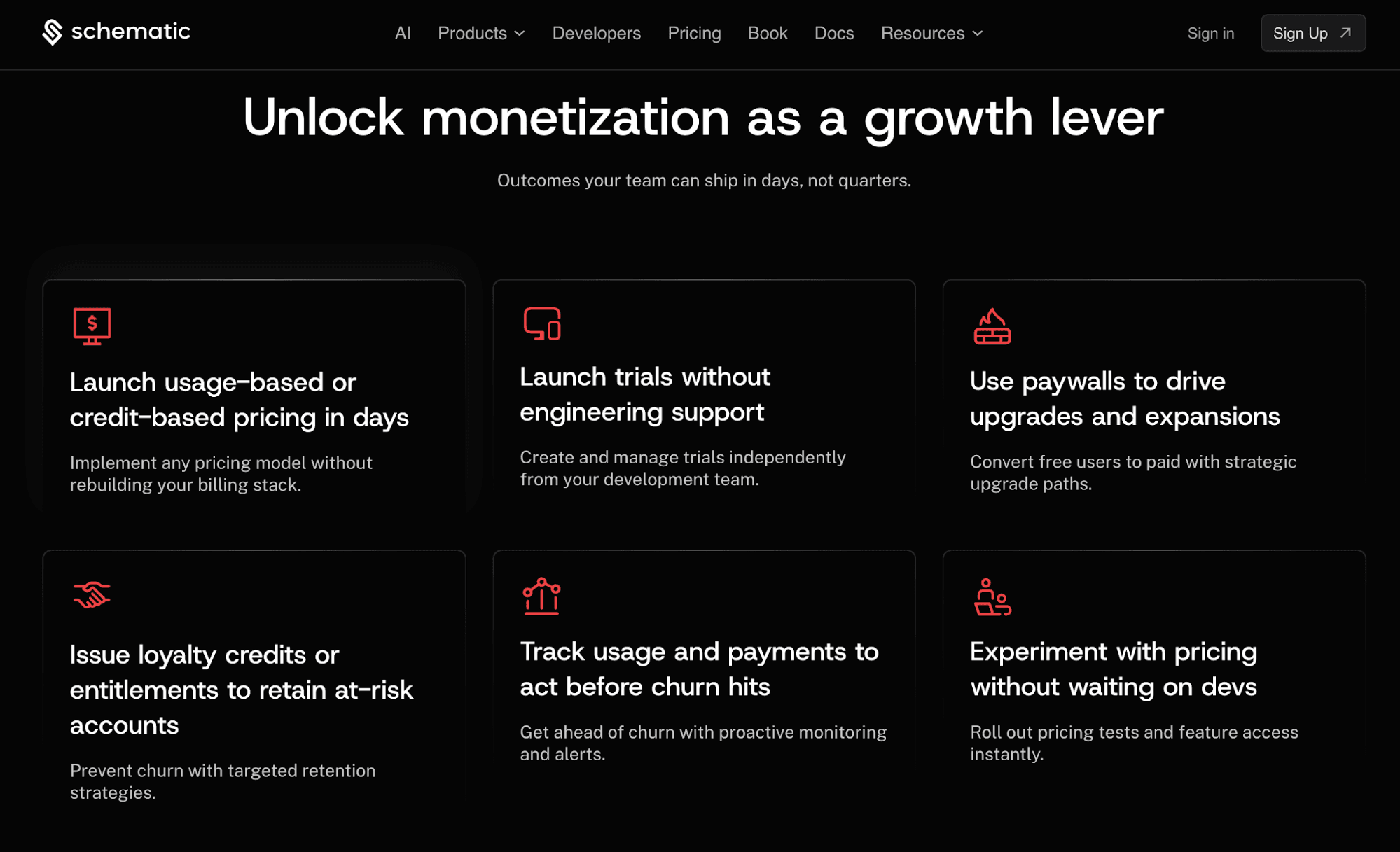
Commercial teams can model pricing and packaging in one place, then connect those rules to what customers can access inside the product. They can also enforce usage limits and paywalls at runtime to drive overall revenue growth.
Schematic is built on Stripe and makes your billing stack better by providing usage metering, internal admin dashboards, and drop-in billing components.
Manage the entire purchase, upgrade, and add-on workflow on top of Stripe. Then, provision entitlements the instant checkout completes without managing webhooks or building integration glue. You can even see which customers are ready to upgrade and expand through built-in revenue insights.
FAQs About Expansion Revenue SaaS
What is expansion vs. upsell?
Expansion refers to the additional revenue earned from existing customers. Upsell is one type of revenue expansion. For example, a customer upgrading to a higher plan is an upsell. Expansion can also include add-ons, cross-sells, additional seats, or increased usage.
How to calculate expansion revenue?
To calculate expansion revenue, add the extra revenue earned from plan upgrades, cross-sells, add-ons, and usage growth from existing customers. For monthly tracking, teams often measure the total expansion MRR. For annual contracts, they often measure the expansion ARR.
What are the challenges teams face when expanding revenue?
Common challenges include unclear upgrade paths, misaligned values, weak customer engagement, and manual billing changes. Teams may also struggle to grow revenue from existing customers when the pricing model is hard to understand and fails to scale with customer growth.