All posts
Runtime Authorization Explained for SaaS and AI Companies
Blog· Ryan Echternacht·Aug 17, 2026
Ryan Echternacht·Aug 17, 2026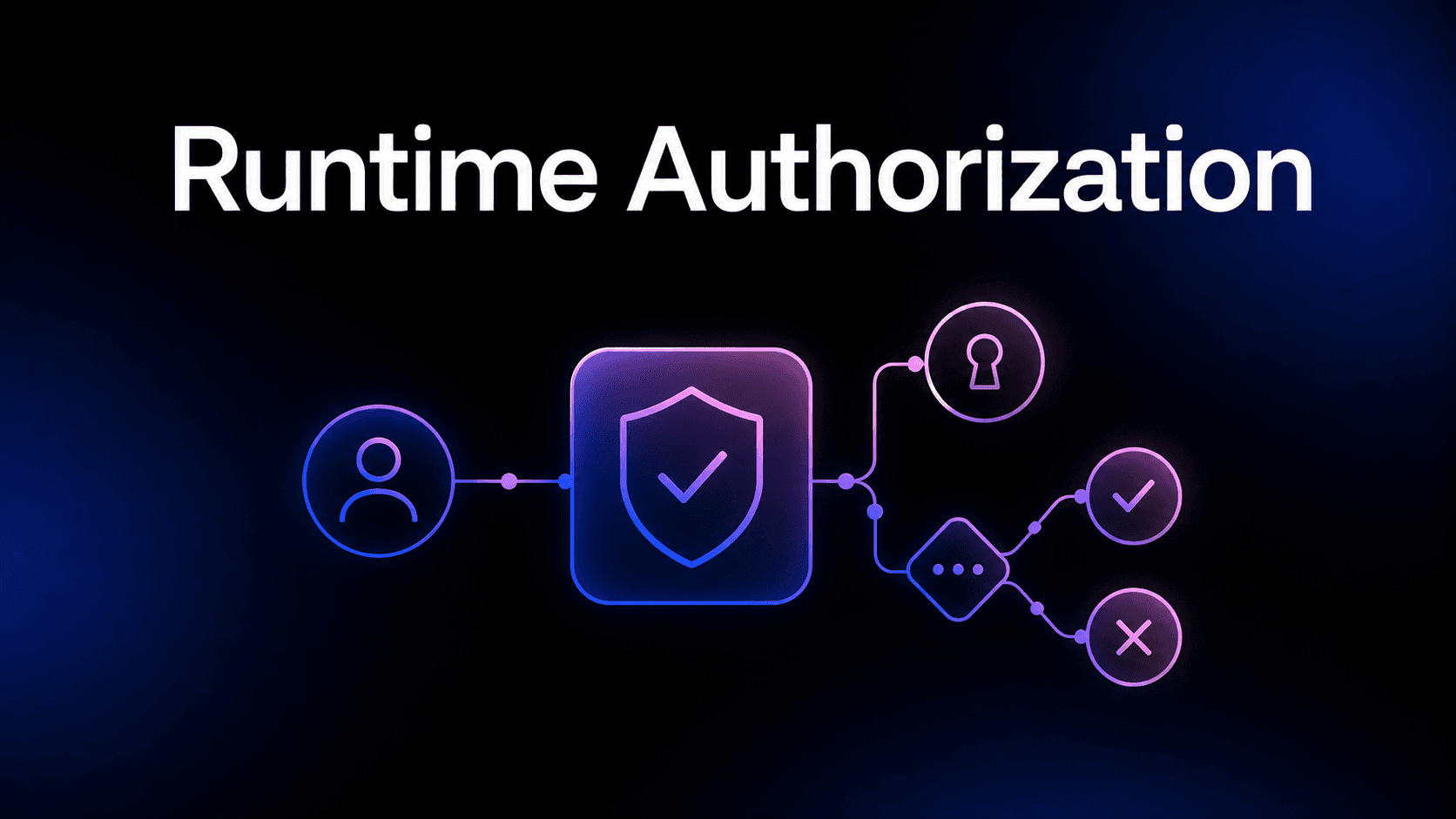
Access decisions in modern SaaS and AI products can’t rely on static rules, such as roles or groups. As identities, devices, resources, and workflows constantly change, systems need to evaluate permissions dynamically at the moment access is requested.
Users may have the right role, but it doesn't always mean they should be granted access in every context.
That is where runtime authorization comes in. It makes access decisions in real time by considering multiple factors, such as user attributes, resource sensitivity, environmental context, and risk level, before allowing or denying an action.
Runtime authorization is important for companies that manage sensitive data, shared workspaces, cloud-native infrastructure, AI agents, and non-human identities.
This guide explains the benefits of runtime authorization, why static access control is not enough, and how to implement it. We'll also discuss the need to manage runtime authorization alongside software entitlements.
TL;DR
- Runtime authorization decides whether human and non-human identities can take a specific action at the moment the request happens.
- Static checks fall short because roles, resources, workflows, and risks change after access is initially assigned and granted.
- Runtime authorization can enable fine-grained access control, adapt to real-time context, follow the principle of least privilege, support a zero-trust architecture, improve security, and enhance compliance.
- SaaS and AI companies need runtime authorization for security decisions and commercial entitlements for monetization. The latter decides what each account can access inside the product based on its plan, contract, or billing status.
- Schematic sits alongside existing security systems to manage entitlements, handle monetization policies, and enforce access in-product at runtime.
What Is Runtime Authorization?
Runtime authorization, also known as dynamic authorization, is the process of deciding whether a human user, non-human identity, or AI agent can perform a specific action when an access request happens.
It helps systems make access control decisions at execution time, based on the user, action, resource, policy, and current context.
For example, a SaaS app may check the user’s role, device security posture, location, resource owner, approval status, or risk level before allowing access. The goal is to approve or deny each action using the facts available at that exact moment.
This makes authorization more than a static role check for security and engineering teams. It becomes a live control point inside the product.
Admin-Time (Static) vs. Runtime (Dynamic) Authorization
Admin-time or static authorization is when a security administrator configures permissions in advance. For example, an admin might give a "manager" role to someone.
When a user requests access, the system simply asks, "Does this user have the manager role?" If yes, it grants access. It decides based on the configuration instead of the current context.
On the other hand, runtime or dynamic authorization checks permissions at execution time. It asks, "Can this user perform this action on a resource right now?"
Runtime authorization evaluates the user's role, resource, action, policy, and live conditions before it grants or restricts access.
For example, a user with a "manager" role can approve invoices. Runtime authorization ensures that the action is only allowed if the invoice amount is under $10,000 and the request comes from their own department.
These authorization methods are not mutually exclusive. Most companies use both approaches. Admin-time authorization provides baseline eligibility. Runtime authorization adds real-time checks to decide whether the action is allowed at that moment.
When Admin-Time Authorization Falls Short
Admin-time authorization relies on static permissions, leaving standing privileges in place long after conditions have changed. This leads to significant blind spots in daily operations.
User Roles and Responsibilities Change Over Time
Users rarely stay in the same job function. They eventually join new groups, take on temporary projects, or move to another department.
If access depends only on static roles, old permissions can remain active after the user no longer needs them. Role-based access control (RBAC) creates gaps between what a user can do and what they should be allowed to do.
Admins can try to restrict access through manual role updates, but human authorization is slow and error-prone. Updates may be delayed, overlooked, or applied inconsistently between systems.
As the number of users and roles increases, it becomes harder to track who should have access to what at any given time.
Modern SaaS Applications Have Dynamic Resources
Modern SaaS products handle dynamic resources. A customer record may move between teams. A file might become confidential. A project may shift from draft to approved. A workspace may add guests, contractors, or new owners.
Static authorization cannot always track these changes, especially when they happen in multi-tenant apps or complex cloud infrastructure. The same user may need access to one record but not another record of the same type.
SaaS access control should happen dynamically to ensure the correct permissions at the right time.
AI Agents and Automated Workflows Require Continuous Authorization
AI agents and automated workflows can take actions without a person clicking each step. They may read files, update records, send messages, or trigger tasks within milliseconds.
Admin-time authorization is incapable of securing AI agents because it cannot react instantly to behavioral anomalies.
Static authorization can also grant broad access from the start. That is risky because agents act at machine speed.
One wrong permission can lead to many high-risk actions in seconds. According to a Cloud Security Alliance survey report, 53% of organizations said that AI agents exceeded intended permissions occasionally or sometimes.
You need authorization checks for every action non-human identities perform to maintain security.
Security Risks Accumulate Silently
When permissions are static, security risks often build slowly.
A user gets added to a group. A temporary project ends. A contractor retains access. An admin grants an exception and forgets to remove it. A service account might keep permissions long after the original workflow changes.
These standing privileges can widen the "blast radius" when an attacker gains access to a compromised system. The attacker can quickly move laterally through a network and cause massive damage.
Benefits of Runtime Authorization
Static rules leave gaps as access needs change. Runtime authorization closes those gaps at the point of action. Below are the advantages of using runtime or dynamic authorization.
1. Enable Fine-Grained Access Control
Runtime authorization provides more control than static role checks. Instead of simply granting or denying the request based on roles, it evaluates different user attributes and real-time context before allowing an action.
It helps teams move away from role-based access to action-based access. A role may say that a user is an admin, analyst, or support agent. Runtime authorization goes further and asks what that user can do in one specific case.
This is useful when the same feature contains actions with different risk levels. One account may view a report, but not export it. They may update a project name, but not delete the project.
With fine-grained policies, you can enforce very specific conditions and business rules. For example, the user must have a "doctor" role, a department matching the patient's department, and multi-factor authentication (MFA) enabled before they can see specific patient records.
It's not enough to have the right role. The user should also meet dynamic requirements.
2. Adapt to Real-Time Context
Runtime authorization can react to the live conditions around each access request. The system considers the device, location, IP address, time of day, session state, resource status, risk score, or approval status before it allows the action.
This is important because access needs can change during a session. A device may switch networks. A file may become sensitive. A user may lose team membership after a role change.
Since access reviews and decisions happen at execution time, permissions can adapt immediately. The product doesn't need to rely only on what was true when the user signed in or when an admin assigned a role.
3. Enforce Just-in-Time and Least Privilege Access
Runtime authorization only grants access when it is needed. A user, service account, or AI agent can receive permission for a specific task, for a short time, and only under approved conditions.
This supports the least privilege principle. Users should not have long-term access to sensitive data or admin actions just because they may need them later.
The system can allow the action when the request matches policies, then block future activities when the need no longer exists.
This significantly reduces standing privileges. It also limits what an attacker can do if an account, token, or workflow is misused.
4. Support a Zero-Trust Architecture
A zero-trust architecture assumes that no user, device, service, or workflow should be trusted by default.
Runtime authorization fits this security model because it checks each request against policies and real-time context before granting access.
Instead of leaving users with always-on powerful permissions, runtime authorization allows for zero standing privileges. For example, a developer can only see production servers when they're handling an active incident. They don't have access by default.
Dynamic checks also work well with identity and access management (IAM) systems. IAM can handle identity, groups, and authentication. Runtime authorization can then decide what the verified identity can do inside the product at that moment.
5. Strengthen Security Posture
Runtime authorization reduces the security damage caused by stolen tokens, old roles, misused service accounts, and over-permissioned non-human identities.
This is especially important for developing an agent security strategy. AI agents and automated workflows can move fast between systems. Runtime checks can limit what they read, change, send, or trigger based on policy and context.
Access can also be automatically revoked when the user changes department, the session risk increases, or the resource moves to a locked state.
For sensitive workflows, teams can require human approval for high-risk actions, such as transferring funds, before the system proceeds. This improves security without interrupting daily tasks.
6. Improve Compliance and Auditability
Runtime authorization provides a clearer record of all access decisions, unlike static systems that only show who assigned what.
Runtime authorization generates detailed logs. Each event can show who made the request, what action they tried, which resource was involved, what policy applied, and why the system made that decision.
This helps teams face audits, internal reviews, and customer security checks with confidence. They can quickly find policy gaps before they become larger issues.
Risks and Tradeoffs of Runtime Authorization
While runtime authorization offers several benefits, it also introduces risks and challenges for businesses.
Policy Sprawl and Fragmentation
Runtime authorization policies can be harder to manage than simple role checks. Teams may need to account for user attributes, resource state, tenant rules, risk signals, approval status, and other conditions.
This makes it difficult to write policies that are clear, testable, and easy to review. As more rules are added, they can overlap or conflict. One policy may allow an action while another denies it.
Without strong ownership and version control, policy sprawl can make access behavior hard to predict.
Increased Operational Overhead
Runtime authorization changes how teams manage access. They often need to maintain both static roles and dynamic rules, which can create additional work.
Policy design, ownership, reviews, and governance processes become part of the access model. Teams also need policy-as-code practices, version control, and testing before rules go live.
Without these steps, small logic mistakes can cause actual problems. They may grant access to the wrong user or block a valid request in production.
Data Dependency
Runtime decisions depend on accurate data. The system needs to evaluate user attributes, resource metadata, tenant settings, risk signals, team membership, and approval status.
If that data is outdated, missing, or wrong, the access decision may also be wrong. A user could be blocked by mistake, or worse, allowed when they should not be.
Latency and Performance Bottlenecks
Static access checks are often fast. The app may only need to read a role from memory, a token, or a database record.
In runtime authorization, the system may need to call an external policy engine or authorization service before it allows an action.
That extra step can introduce latency to the authorization step and lead to performance bottlenecks if not managed well.
How to Implement Runtime Authorization
Here's how you can implement runtime authorization.
Identify Protected Resources
Start by listing all the resources that need access checks. These may include customer records, files, reports, projects, workspaces, billing settings, admin actions, API keys, and service accounts.
Next, map the actions users can take on each resource. Common examples include view, create, edit, delete, export, share, approve, invite, and transfer ownership.
This step helps teams define what must be checked at runtime. It also prevents vague policies. Avoid a rule like "admins can manage data" because it is too broad. Instead, a specific policy like "support agents can view tickets assigned to their queue" is easier to test.
Externalize Authorization
Move authorization out of the application code and into a dedicated external service. Doing so keeps access rules separate from business logic and helps teams manage policy changes in one place.
An externalized authorization service also offers greater flexibility and advanced security for access control decisions.
Here are the key components to look for:
- Policy Decision Point (PDP): It's the primary engine that reviews the request and returns an allow or deny result.
- Policy Enforcement Point (PEP): The PEP sits at the access point of an application, such as the middleware in an API or a webhook in a request handler. It asks the PDP for a decision before running the action.
- Policy Administration Point (PAP): The PAP is where teams create, edit, test, approve, and manage policies before they go live. Examples include a Git repository, a UI console, or any platform that stores policies as code.
Integrate Your Authorization System With Identity Providers
Connect the external authorization system to your identity provider. This gives the system access to human and non-human identities, groups, roles, tenant membership, and login state, which are important for evaluating access.
The identity provider confirms who the user is. Runtime authorization decides what the user can do inside the product.
Enforce Authorization Decisions
Add enforcement points at every place where protected actions happen. This may include frontend routes, backend APIs, admin panels, webhooks, and AI agent tools.
The app should deny the action if the policy decision says no, if the decision times out, or if required data is missing.
Log and Audit Changes
Log both policy changes and access decisions. Take note of who made the request, what action they tried, which resource was involved, what policy applied, and whether the request was allowed or denied.
Accurate logs make access behavior easier to review during audits and security incidents. You can quickly identify outdated access or unusual request patterns and fix them before they impact compliance.
Why SaaS and AI Companies Need Both Runtime Authorization and Commercial Entitlements
SaaS and AI companies need both authorization and commercial entitlements because they solve different access problems.
Runtime authorization decides whether a human or non-human identity can perform specific actions under current conditions based on their role, membership, and other context. Security teams and admins define those policies, while the product's authorization layer enforces access decisions.
SaaS entitlements determine what an account can use based on its plan, contract, or billing status. They are mainly used for monetizing software and AI products.
Entitlements are commercial access rules instead of security policies. Product, RevOps, and sales teams often shape these rules. Engineering teams build the entitlement management system that enforces access inside the product.
Entitlements are especially important for AI companies. If a customer goes over their allowed limits, either intentionally or by mistake, excess usage can drive up their bill and erode the business’s profit margins. Runtime entitlement enforcement ensures heavy users stay within their plan limits as soon as they hit them, not after the month ends.
Commercial entitlements tell a customer that they are entitled to a feature or usage allowance because they paid for it. However, runtime authorization still evaluates whether they can use the capability in a specific context.
Both protect the company's security and pricing model.
Use Schematic Alongside Your Runtime Authorization System
Runtime authorization and entitlements are designed to co-exist because they address two different access questions.
Schematic is the monetization operating system that handles commercial entitlements, not authorization. It sits alongside your existing IAM and RBAC tools, where role checks, membership, and security policies should live.
Built on Stripe, Schematic decouples billing and entitlement logic from the application code. It serves as the system of record for your plans, limits, AI credits, add-ons, trials, and exceptions.
It controls what a customer’s plan allows, how much usage they have consumed, which limits apply, and what happens when they reach a limit.
Schematic evaluates and enforces access inside the product at runtime based on what the customer has purchased.
Engineering stops maintaining complex entitlement systems. Commercial teams (e.g., sales, product, and go-to-market) can manage pricing, packaging, and entitlements without code changes.
FAQs About Runtime Authorization
What is runtime authorization?
Runtime authorization is the process of checking whether users can access resources and perform an action at the moment access is requested. It considers user attributes, resource details, policy rules, and current context to allow or deny the request.
What are the three types of authorization?
Three common authorization models are role-based access control, attribute-based access control (ABAC), and discretionary access control (DAC). RBAC reviews roles. ABAC considers user, resource, and context attributes. DAC lets resource owners decide who can access company resources.
What is the purpose of authorization?
The purpose of authorization is to control what an authenticated user or system can do. It helps protect data, features, APIs, and admin actions by allowing only approved access to the right resources.
What exactly does authorization mean?
Authorization means granting or denying permission after authenticating human and non-human identities. It decides what the user, service account, or AI agent is allowed to use or perform inside a system.