 Ryan Echternacht
It's difficult to grow revenue when teams still rely on guesswork, slow reports, and manual review. SaaS companies need a more reliable way to see what drives sales, retention, and expansion.
That is where AI revenue optimization helps. It uses artificial intelligence to analyze historical data, identify patterns, predict future business performance, and suggest better actions for sales, marketing, finance, and customer success teams.
Instead of waiting for problems to show up in monthly reports, teams can act earlier. They can see which accounts may churn, which leads are more likely to buy, and which customers may be ready to expand.
This guide explains how AI revenue optimization works and the key benefits it can bring to growing SaaS companies.
TL;DR
- AI revenue optimization refers to the use of artificial intelligence and machine learning to help companies maximize revenue.
- It works by using dynamic pricing, demand forecasting, customer segmentation, and workflow automation to find revenue opportunities and flag risks.
- The main benefits of AI revenue optimization include maximum revenue growth, stronger margins, smarter decision-making, faster responses, less manual work, easier scaling, and stronger customer satisfaction.
- Schematic helps SaaS teams continuously iterate on monetization and adjust pricing strategies to optimize revenue.
What Is AI Revenue Optimization?
AI revenue optimization uses artificial intelligence and machine learning to analyze historical and current data, predict what may happen next, and help teams improve revenue.
For SaaS companies, this means adopting AI to make smarter choices around pricing and packaging.
Instead of guessing which plans, features, or pricing models will drive the highest revenue growth, teams can rely on AI insights.
Artificial intelligence studies customer behavior, demand, product usage, and churn risks to generate smart recommendations that help revenue teams take the best possible actions.
AI can also identify patterns that are difficult to detect manually, adjust revenue strategies automatically, and optimize pricing over time as more data becomes available.
Unlike traditional revenue optimization methods that rely on manual reviews, AI systems are capable of processing vast amounts of data in real time. That empowers SaaS companies to act quickly and ensure maximum revenue.
How Does AI Optimize Revenue?
AI revenue optimization relies on several components that change how revenue operations (RevOps) teams work.
Dynamic Pricing Algorithms
AI supports a dynamic pricing strategy by helping SaaS companies adjust prices based on real-time market conditions.
Instead of charging a fixed fee, businesses can lower or increase SaaS prices depending on the product's value, customer demand, competitors' pricing strategies, seasonality, and buyer behavior.
AI tools reduce guesswork when setting prices to protect profit margins and maintain a competitive edge.
Revenue teams can immediately see when demand is rising, when a product is underpriced, or when a customer segment is willing to pay a higher price.
Predictive Analytics for Forecasting Demand
Accurate demand forecasting is a key component of revenue optimization in SaaS companies.
AI can help them review past sales, current market conditions, customer interactions, economic signals, local events, seasonality, and other factors.
It significantly improves forecast accuracy because AI tools can identify patterns that manual data analysis may miss.
Revenue leaders can use AI to identify emerging trends, mitigate risks, plan inventory levels, and optimize pricing to address future needs.
Customer Segmentation
Customer segmentation involves grouping customers by shared traits, behavior, value, or risk. AI can analyze customer data from the product, customer relationship management (CRM) software, billing systems, and support tickets.
This helps SaaS companies understand which customers are most likely to buy, renew, expand, or churn. It also shows which segments need additional support or a different offer.
Instead of treating every account the same, revenue teams can communicate the right message to a specific customer group. They can also use AI-powered insights to create new feature bundles, offer add-ons, develop better marketing campaigns, and improve sales processes.
Workflow Automation
In AI revenue optimization, automation helps SaaS teams act on insights faster. AI systems can flag a high-value lead, alert customer success about a risky account, or remind sales teams to follow up at the right time.
AI can also automate routine tasks and recommend the ideal next steps that teams can take to optimize revenue.
7 Key Benefits of Implementing AI for Revenue Optimization
AI isn’t just a tool for revenue reporting. It helps SaaS companies make strategic decisions with confidence. Below are the key benefits of adopting AI revenue optimization.
1. Maximize Revenue Potential
AI-powered revenue optimization helps SaaS companies maximize revenue earnings. It can show which customers are ready to buy, expand, renew, or move to a higher plan.
AI can also point out the products, pricing models, or feature bundles that bring in the most value. Teams can focus on effective strategies that lead to higher sales conversion rates and revenue growth.
It can increase the average order value by enabling teams to offer the right plan, add-on, or upgrade message at the right time.
2. Protect Profit Margins
AI revenue optimization can show which accounts cost more to serve than the profits they bring in to a SaaS company. For example, some customers may use high-cost features, submit many requests, or require hands-on support.
AI can compare account revenue with operational costs, product usage, support load, and renewal risk. This helps revenue teams find accounts that look valuable on paper but hurt margins over time.
Thanks to these insights, leaders can make smarter choices about service levels, discounts, plan limits, and renewal offers. They can also identify which customer groups are more profitable.
The right AI tool helps teams protect revenue streams without chasing growth that weakens profit.
3. Enhance Decision-Making
AI empowers SaaS businesses to make decisions based on patterns instead of guesses. It can review sales data, customer behavior, renewal history, support activity, and actual product usage to show what is likely to happen next.
With AI-powered predictive models, teams can see which deals may close, which customers might churn, and which accounts are likely to grow.
AI also turns complex data into actionable insights. Sales reps can focus on converting better-fit leads. Marketing departments can improve targeting. Customer success teams can act before risk grows.
4. Respond Faster to Market Conditions
Markets change fast. Product demand can rise or fall. Competitors can change SaaS pricing strategies. Buyers can shift budgets.
AI helps SaaS companies track all these changes and respond quickly before it's too late. It can analyze customer behavior, sales trends, demand signals, and market dynamics in near real time and generate actionable recommendations.
Waiting for end-of-month reports can lead to missed revenue. AI gives teams earlier signals, so they can immediately adjust sales, marketing, and go-to-market strategies.
5. Automate Routine Tasks
AI can reduce manual work for revenue teams. It can automatically score leads, flag churn risks, update revenue records, send alerts, group customers, and suggest next steps.
Sales, marketing, finance, and customer success teams spend less time on routine tasks. They can focus more on their core responsibilities and other higher-impact activities, such as strategic planning and customer engagement.
Automation is especially useful for SaaS companies with a growing customer base. It becomes difficult to analyze data manually as more leads, users, and accounts enter the system. AI handles the heavy lifting for teams.
6. Support Scalability
As your company grows and acquires more customers, you also end up dealing with more sales records, support requests, renewal dates, and account activity.
Manual review becomes harder at that stage. AI systems can easily handle growing data volumes and still generate actionable insights. They can also adapt to changing customer behavior, demand, and market conditions.
This makes AI useful for both early-stage and established SaaS companies. Startups can use AI to focus on the best actions to grow revenue quickly. Enterprise teams can use it to manage more accounts, customer segments, and revenue signals without relying on manual work.
7. Improve Customer Satisfaction and Retention
AI provides more relevant offers, messages, and product suggestions. It can review account behavior, feature usage, buying history, and submitted support tickets to understand what each customer may need next.
SaaS companies can show the right upgrade message, send a feature trial pop-up, and offer relevant add-ons based on customer data.
This can lead to a better user experience because customers are not pushed toward random offers. Instead, they receive recommendations that match their goals, account size, budget, and current product usage.
According to McKinsey research, using AI for personalization can raise customer satisfaction by 15-20%.
AI-driven personalization can also improve customer retention and boost customer loyalty because users get more value before they feel stuck or ignored.
How to Successfully Implement AI Revenue Optimization
While the benefits are clear, successful results depend on proper AI implementation. Below is a step-by-step guide you can follow.
Establish Specific Goals
Identify specific revenue optimization goals that you want to achieve with AI. Examples include increasing free-to-paid conversion rates, improving sales performance, boosting expansion revenue, and reducing operational costs.
Clear goals serve as the foundation for cross-department alignment. They make sure different teams are working toward the same outcomes.
Assess Data Readiness
AI needs clean and accurate data to provide useful insights. Poor data quality can lead to inaccurate forecasts, weak recommendations, and missed revenue signals.
Before integrating data, review your CRM, billing, marketing, and financial tools. Check for missing fields, duplicate information, old records, and unclear labels.
You should also decide which data points are important for your established goal. For churn risk, support tickets and product usage data may matter. For revenue forecasting, pipeline data and renewal history in CRM tools might be more useful.
Begin With Pilot Programs
Do not roll out AI to the entire company at once. Start with a single pilot project, such as one sales region, one product line, or a specific pricing model.
Pilot programs help you understand how AI works in actual market conditions. You can then compare AI-driven results against past performance, calculate return on investment (ROI), and gather feedback from RevOps teams.
Scale Gradually and Integrate AI Into Your Existing Workflows
Once the pilot shows positive results, you can scale AI adoption and integrate it into existing workflows.
Sales reps should see automated lead scores in the CRM. Customer success teams should see risk alerts where they manage accounts.
A gradual rollout makes adoption easier and gives revenue leaders time to address operational challenges.
Monitor AI Performance
You should regularly review AI performance and compare predictions with actual outcomes.
Track key metrics tied to your goal. These may include churn rate, net revenue retention, expansion revenue, or customer lifetime value.
If results are poor or inaccurate, check the data quality. Remember, AI tools rely on accurate data for forecasting trends and revenue growth. Make sure the system pulls from real-time and predictive signals instead of static thresholds.
Continuously Iterate and Optimize SaaS Pricing With Schematic
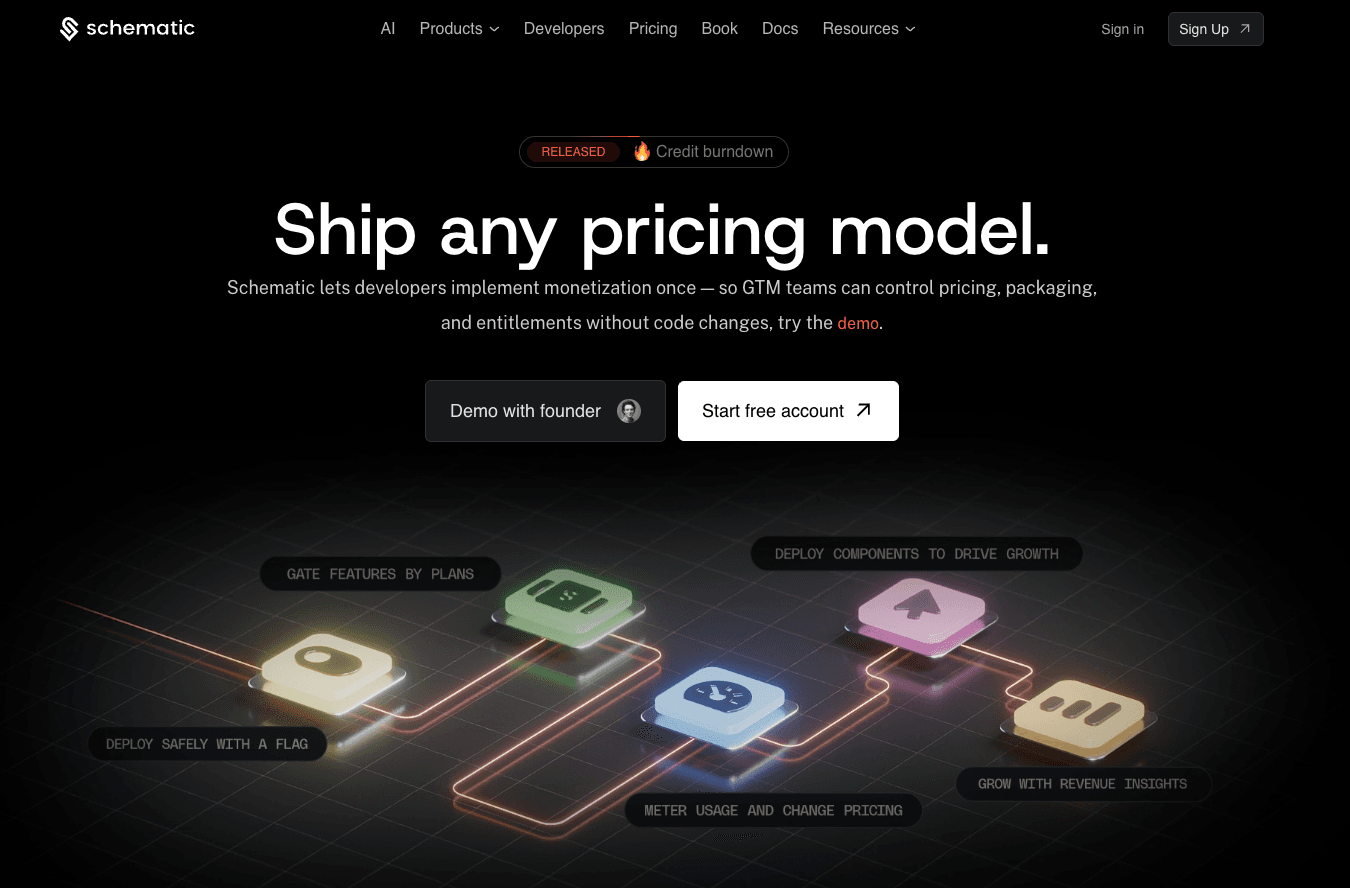
Schematic helps modern SaaS and AI companies ship pricing changes without turning every update into an engineering project. It works by decoupling billing and pricing logic from the application.
Commercial teams can create custom plans, adjust limits, manage software entitlements, and optimize pricing without code changes or new deploys.
Schematic, built on Stripe, becomes the system of record for your product catalog. Stripe continues to handle payments, invoices, and taxes.
Schematic sits above your billing infrastructure, on the product side, to monetize products with any pricing model and enforce access at runtime.
Plus, revenue insights help you understand what is happening inside each account. You can instantly know who’s overusing, underpaying, and ready to expand to make strategic decisions about pricing and packaging.
FAQs About AI Revenue Optimization
What data is needed for AI revenue optimization?
AI revenue optimization needs clean and accurate data from the product, sales software, billing platforms, customer support tickets, and marketing tools. Examples include CRM records, usage trends, churn signals, renewal dates, and campaign results.
What is the difference between AI revenue optimization and AI revenue management?
AI revenue optimization is about growing revenue with AI-powered forecasts and recommendations. Meanwhile, AI revenue management focuses on managing different revenue functions, such as pricing optimization and inventory management. The two overlap, but optimization is more action-based.
How do AI tools transform revenue management and optimization?
AI tools help teams predict customer demand, identify patterns, flag risks, automate routine tasks, and grow revenue. Companies can make strategic decisions without relying on guesswork.