All posts
AI Pricing Statistics 2026: How AI Companies Price by Stage
Blog· Bethany Stachenfeld·Oct 28, 2026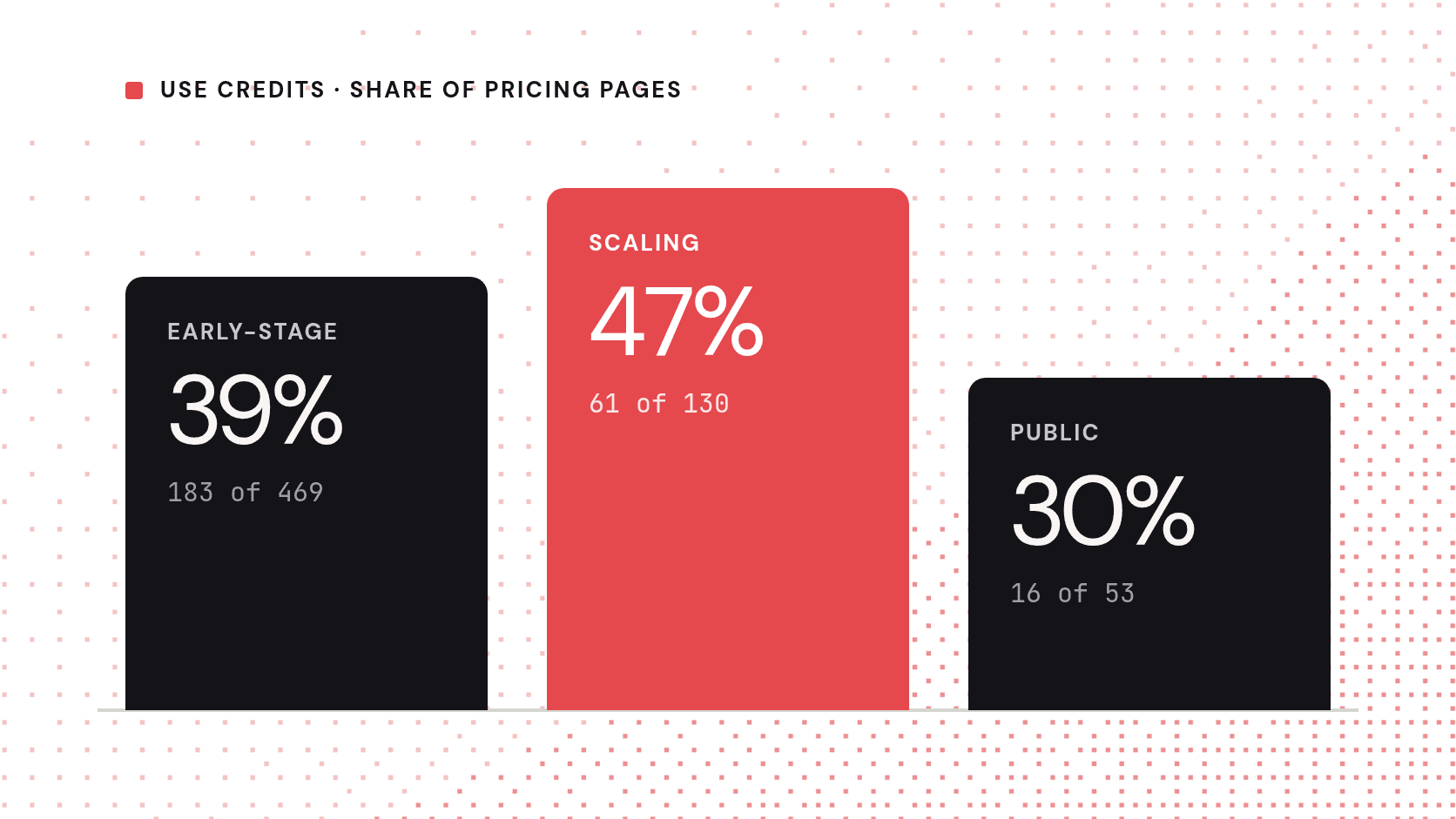
Only about one in three AI startups publish their prices, and pricing gets more layered as companies grow. We read the pricing pages of 2,087 software companies, from early-stage AI startups to public software companies, to see how pricing changes by stage. Hybrid pricing and enterprise tiers become more common with each stage, credits peak at the scaling stage, and most credit pricing pages still don't say what happens to unused credits.
Source: Schematic analysis of 2,087 AI startups, scaling AI companies and public software companies, October 2026. Pricing pages were read Oct 24–26, 2026. Methodology below.
Last updated Oct 28, 2026.
Key findings
- About 1 in 3 AI startups publish prices. 32% of early-stage AI startups publish prices on their website (469 of 1,466), versus 49% of public software companies (53 of 109).
- Hybrid pricing grows with company stage. Among companies that publish prices, 29% of early-stage AI startups combine two or more pricing metrics (136 of 469), versus 42% of public software companies (22 of 53).
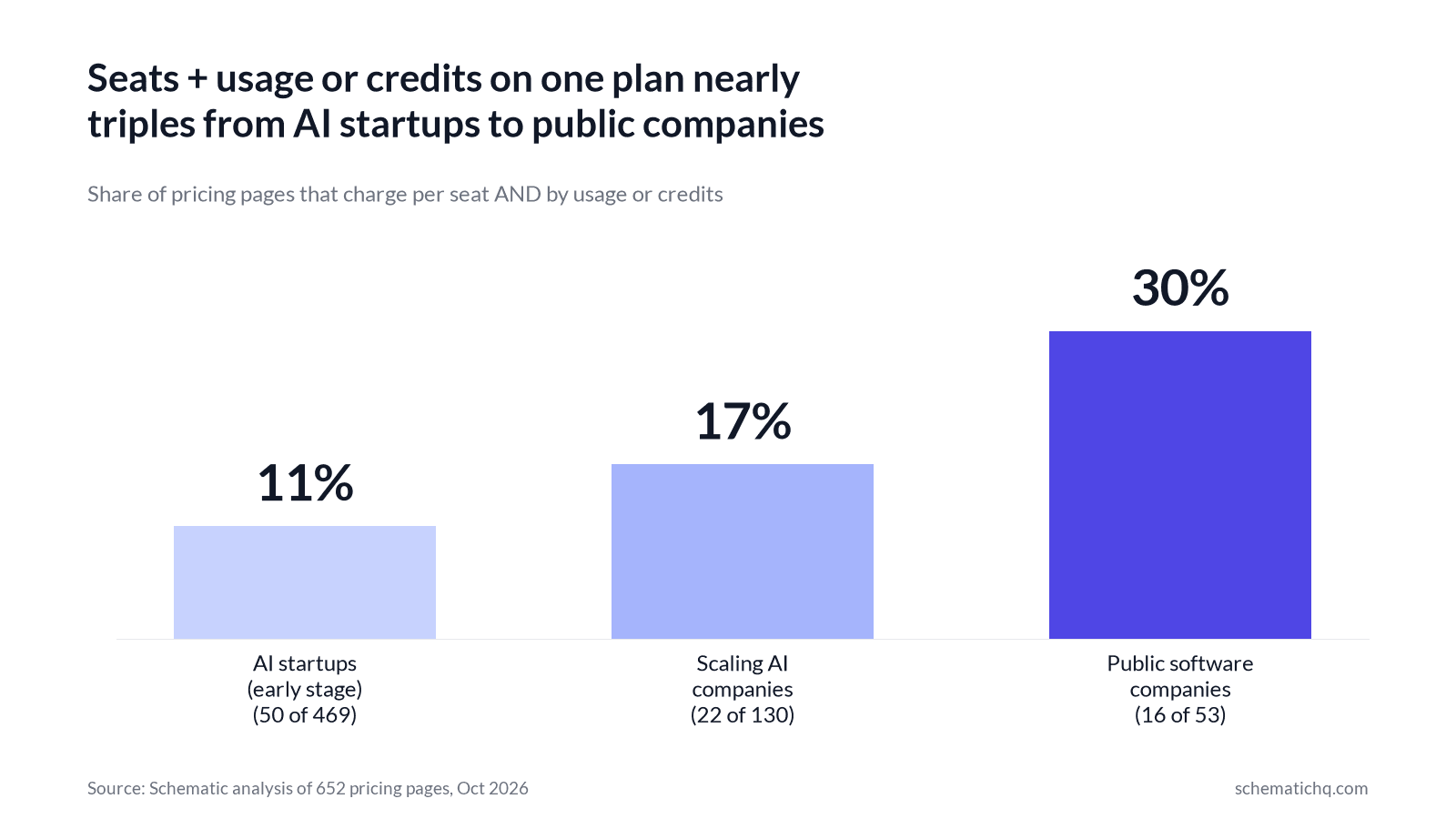
- Seats aren't going away; they're getting a meter. Pure per-seat pricing stays at 12% to 14% at every stage, while seats plus usage or credits rise from 11% of early-stage AI startups (50 of 469) to 30% of public software companies (16 of 53).
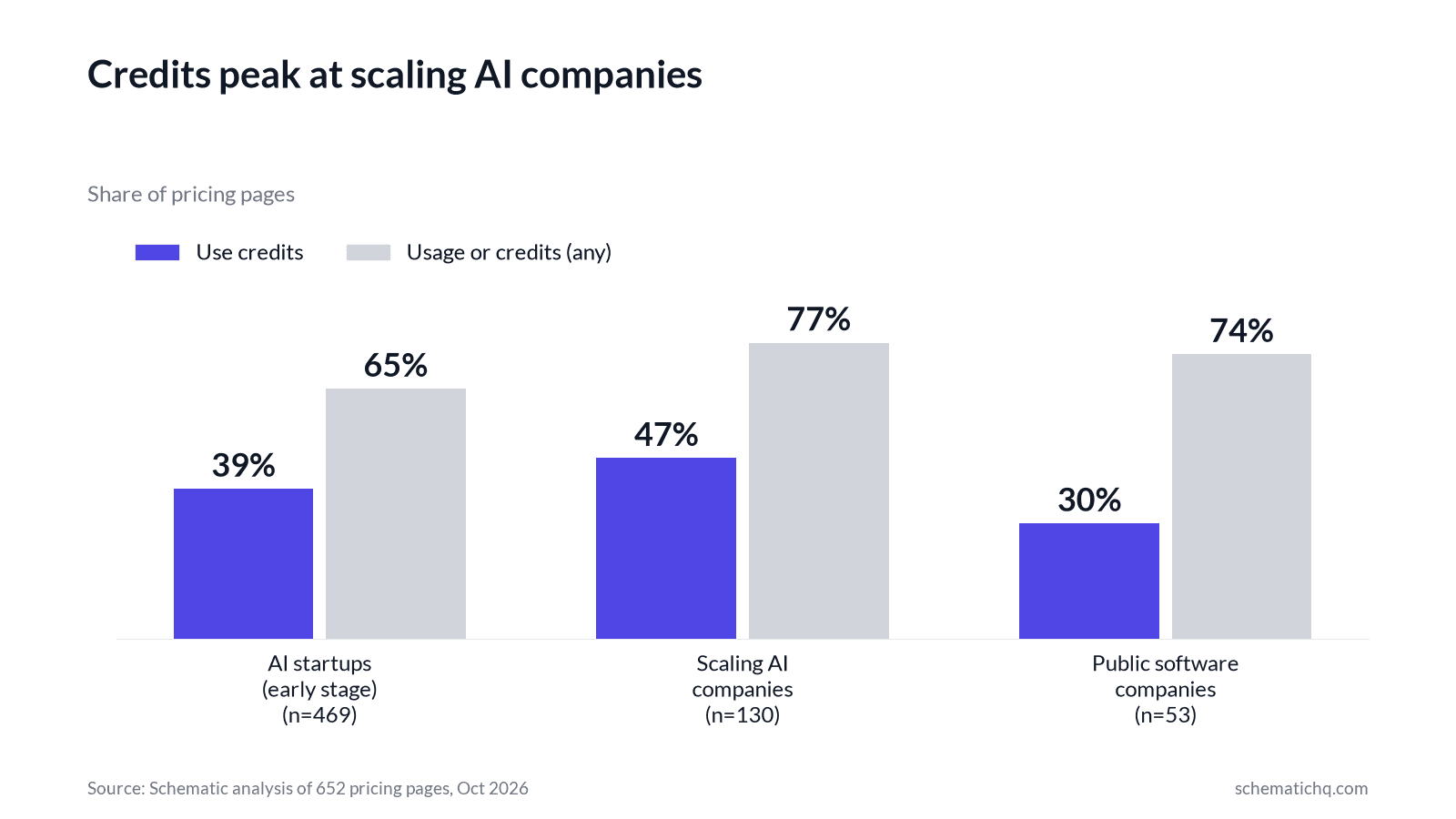
- Credits peak at the scaling stage. 47% of scaling AI companies that publish prices use credits (61 of 130), versus 39% of early-stage AI startups (183 of 469) and 30% of public software companies (16 of 53).
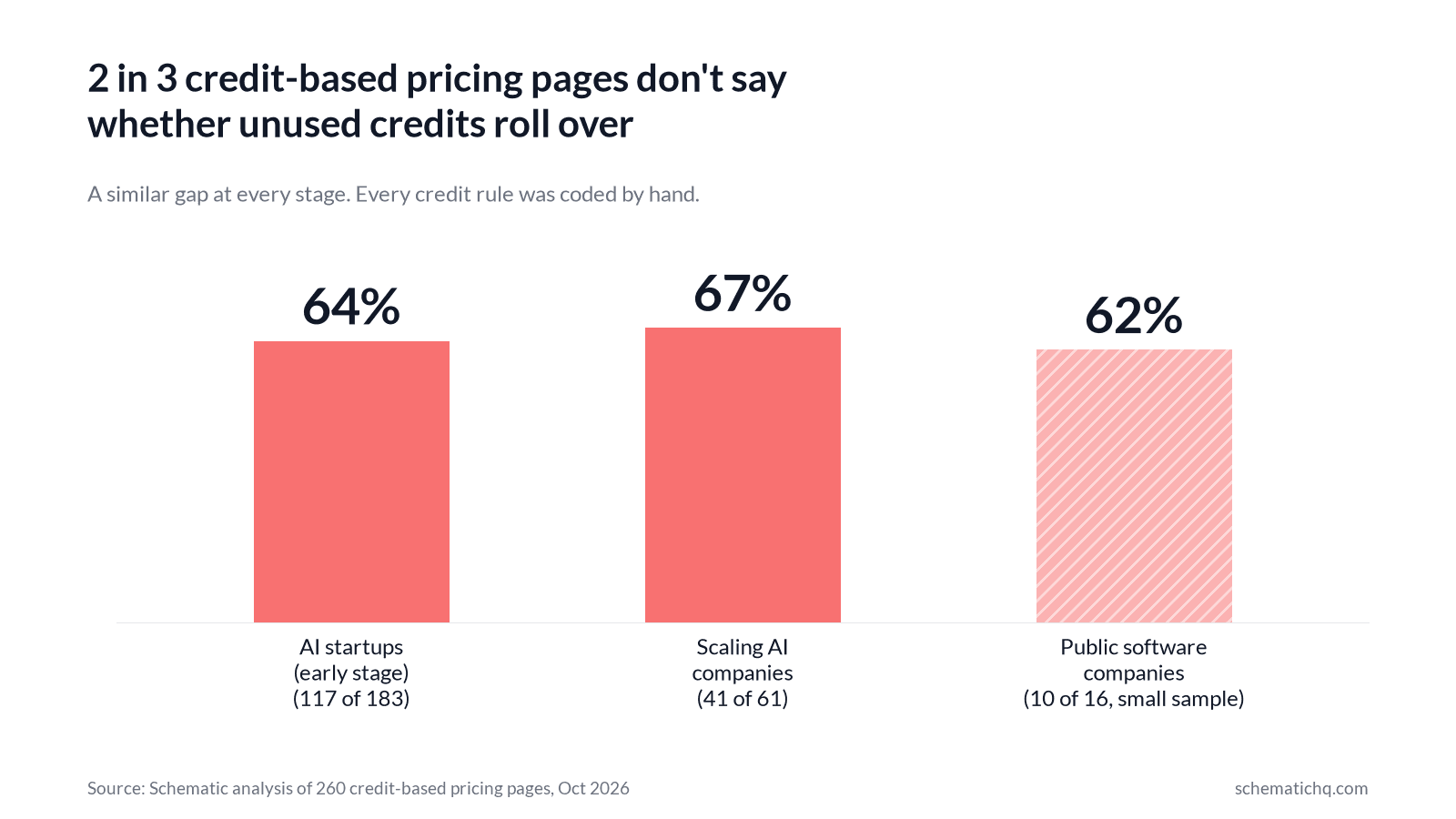
- Most credit pricing pages are silent on rollover. 64% of early-stage AI startups with credit pricing (117 of 183) and 67% of scaling AI companies (41 of 61) don't say whether unused credits roll over.
- Bundling is the most common way public companies sell AI. 44% of public software companies with a pricing page include AI in their plans or editions (29 of 66).
Who we looked at
- Early-stage AI startups: 1,540 active Y Combinator AI companies with YC's "Early" stage label, from batches W23 to F26. 1,466 had live sites, and 469 publish prices.
- Scaling AI companies: 433 companies: 366 YC AI companies with YC's "Growth" stage label, plus 67 non-YC companies from the Forbes AI 50 lists for 2024 to 2026. 417 had live sites, and 130 publish prices.
- Public software companies: 114 US-listed software companies. 109 had live sites, and 53 publish prices.
Unless a figure says otherwise, pricing-model shares are based on the companies that publish prices.
AI pricing statistics by company stage (2026)
Each cell shows the share and the count behind it. Source: Schematic analysis of 2,087 companies, October 2026.
Metric (base) | Early-stage AI startups | Scaling AI companies | Public software companies |
|---|---|---|---|
Publish prices (live sites) | 32% (469 of 1,466) | 31% (130 of 417) | 49% (53 of 109) |
No pricing page at all (live sites) | 58% (853 of 1,466) | 53% (221 of 417) | 39% (43 of 109) |
Charge partly by usage or credits (pages with prices) | 65% (305 of 469) | 77% (100 of 130) | 74% (39 of 53) |
Use credits (pages with prices) | 39% (183 of 469) | 47% (61 of 130) | 30% (16 of 53) |
Any seat pricing (pages with prices) | 24% (114 of 469) | 29% (38 of 130) | 43% (23 of 53) |
Pure per-seat pricing (pages with prices) | 14% (64 of 469) | 12% (16 of 130) | 13% (7 of 53) |
Hybrid, two or more metrics (pages with prices) | 29% (136 of 469) | 40% (52 of 130) | 42% (22 of 53) |
Seats plus usage or credits (pages with prices) | 11% (50 of 469) | 17% (22 of 130) | 30% (16 of 53) |
Free tier (pages with prices) | 62% (292 of 469) | 70% (91 of 130) | 49% (26 of 53) |
Enterprise or custom tier (pages with prices) | 77% (360 of 469) | 91% (118 of 130) | 92% (49 of 53) |
Silent on credit rollover (credit pricing pages) | 64% (117 of 183) | 67% (41 of 61) | 62% (10 of 16), small sample |
Silent on what happens at zero (credit pricing pages) | 75% (138 of 183) | 66% (40 of 61) | 50% (8 of 16), small sample |
What percentage of AI companies publish their prices?
32% of early-stage AI startups publish prices on their website (469 of 1,466), compared with 31% of scaling AI companies (130 of 417) and 49% of public software companies (53 of 109).
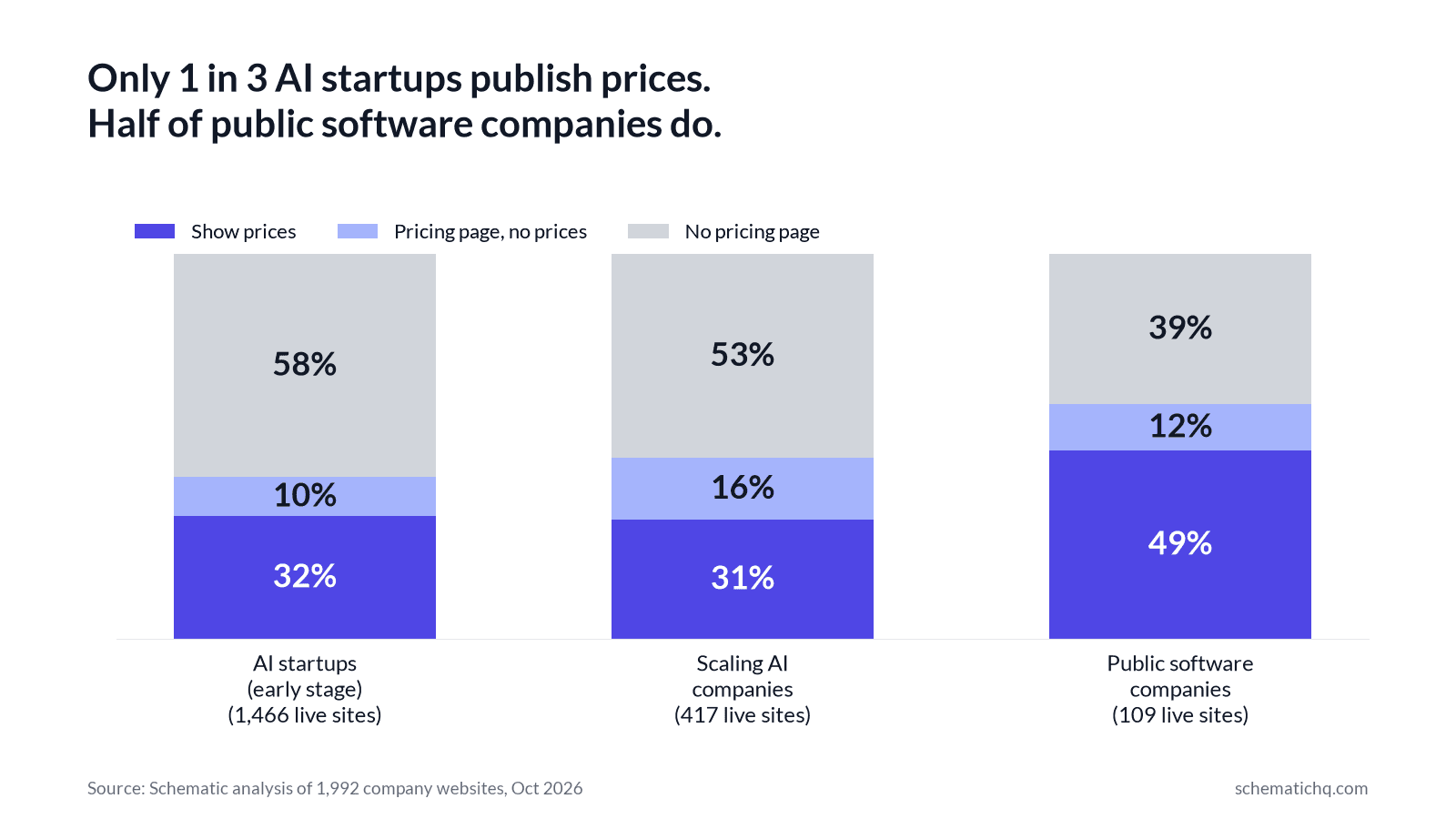
- 58% of early-stage AI startups have no pricing page at all (853 of 1,466), compared with 53% of scaling AI companies (221 of 417) and 39% of public software companies (43 of 109).
- Among scaling AI companies, Forbes AI 50 companies publish prices more often than YC Growth-stage companies: 46% (30 of 65) versus 28% (100 of 352).
What it means: most early and scaling AI companies still set prices in a sales conversation. Public companies publish more often, but about half still don't.
How common is hybrid pricing at each company stage?
29% of early-stage AI startups that publish prices use hybrid pricing (136 of 469), compared with 40% of scaling AI companies (52 of 130) and 42% of public software companies (22 of 53). Hybrid means two or more of seats, usage and credits on one pricing page. For background, see our guide to hybrid pricing models.
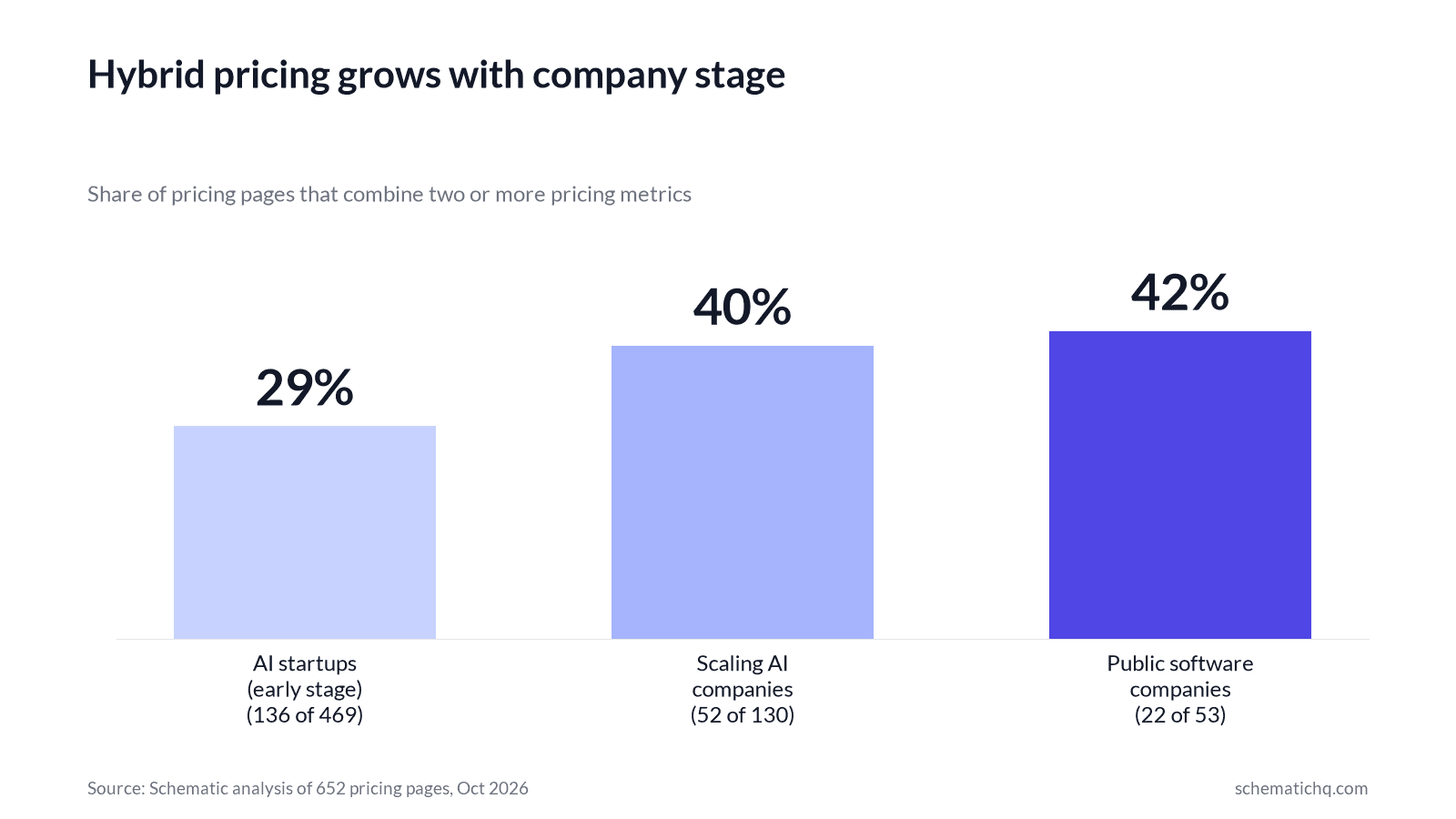
- Seats plus usage or credits on one pricing page nearly triples, from 11% at the early stage (50 of 469) to 17% at the scaling stage (22 of 130) and 30% at public companies (16 of 53).
- Flat tiers with no seat, usage or credit metric fall from 21% at the early stage (100 of 469) to 11% at the scaling stage (14 of 130) and 13% at public companies (7 of 53).
What it means: simple flat plans give way to a seat price with a meter attached.
How many software companies still charge per seat?
Among companies that publish prices, 24% of early-stage AI startups charge per seat (114 of 469), compared with 29% of scaling AI companies (38 of 130) and 43% of public software companies (23 of 53).
- Pure per-seat pricing stays flat: 14% at the early stage (64 of 469), 12% at the scaling stage (16 of 130) and 13% at public companies (7 of 53).
- The growth comes from seats paired with a meter: 16 of the 23 public software companies that charge per seat also charge for usage or credits.
What it means: seat pricing isn't dying. The seat stays as the base, and AI use is priced on top.
How many AI companies use credit-based pricing?
Among companies that publish prices, 39% of early-stage AI startups use credits (183 of 469), compared with 47% of scaling AI companies (61 of 130) and 30% of public software companies (16 of 53). For a primer, see what AI credits are.
- Image, video and creative AI startups use credits the most: 66% of the early-stage ones that publish prices (31 of 47).
- At public companies, credits usually come with a seat: 9 of the 16 public software companies that use credits also charge per seat.
What it means: credits are most common at the scaling stage, where almost half of pricing pages use them. At public companies, credits are more often added to a seat than used on their own.
Do AI pricing pages say whether unused credits roll over?
64% of early-stage AI startups with credit pricing don't say whether unused credits roll over (117 of 183), and neither do 67% of scaling AI companies (41 of 61) or 62% of public software companies (10 of 16, a small sample). Every credit rule was coded by hand.
- Early-stage pages that state a rollover rule: 70% say plan credits expire or reset each cycle (46 of 66).
- Scaling pages that state a rollover rule: 70% say plan credits expire or reset each cycle (14 of 20).
Public examples: Adobe says generative credits reset monthly and don't roll over. Salesforce says unused Flex Credits don't roll over into the next subscription term. GitLab says reserved GitLab Credits expire at the end of each month.
What it means: most credit pages leave the rules to the FAQ, the contract or the product, so buyers learn them when they hit them. More on this in AI credit overages.
How do public software companies sell AI features?
44% of public software companies with a pricing page bundle AI into their plans or editions (29 of 66), and 39% sell AI through credits, allowances or metered use (26 of 66). Companies can use more than one approach, so these shares add up to more than 100%.
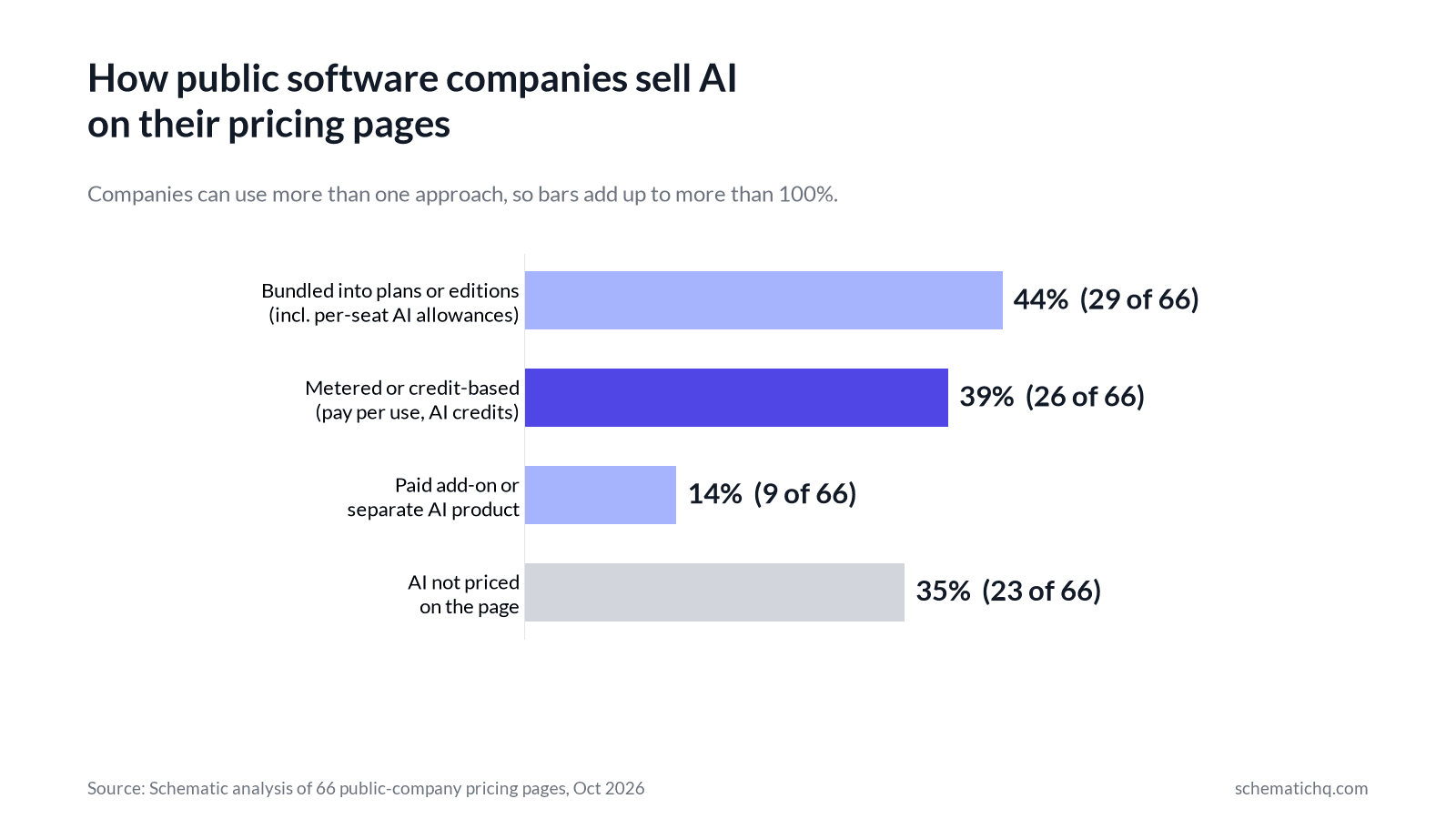
- 35% don't price AI on the pricing page at all (23 of 66).
- 14% sell AI as a paid add-on or a separate product (9 of 66).
Examples from live pricing pages, checked Oct 26, 2026: Atlassian (Jira) includes 25 to 150 Rovo credits per user per month, depending on the plan. GitLab includes $12 (Premium) or $24 (Ultimate) of GitLab Credits per user per month, then charges $1 per credit on demand. GitLab calls the included credits a limited-time promotion. Figma gives every seat a monthly AI credit allowance, and teams can buy more. Asana includes 5 AI requests per user per month, capped per account, then charges $0.50 per request prepaid or $0.60 on demand. Salesforce sells Agentforce with Flex Credits at $500 per 100,000 credits, or as per-user add-ons.
What it means: large software companies most often add AI to the plan customers already buy. When they charge for it, the charge is often tied to the seat, as in the Atlassian, GitLab, Figma and Asana examples.
How many AI companies offer an enterprise tier?
Among companies that publish prices, 77% of early-stage AI startups list an enterprise or custom tier (360 of 469), compared with 91% of scaling AI companies (118 of 130) and 92% of public software companies (49 of 53).
- Free tiers: 62% at the early stage (292 of 469), 70% at the scaling stage (91 of 130) and 49% at public companies (26 of 53).
- The median entry-level paid plan is $46 per month at the early stage and $35 per month at the scaling stage (412 and 105 pricing pages with a monthly USD price). This is the displayed price, which can be an annual-billing rate.
What it means: by the scaling stage, almost every pricing page has a "talk to us" tier, and that is where custom deals live.
What this means for pricing teams
As pricing layers up, the hard part moves from the pricing page into the product. One account can hold seats, an AI allowance per seat, a shared credit pool and an overage rule at the same time. Someone has to decide what happens when credits run out or a month ends, and the product has to apply that rule the same way every time.
Schematic is built for this. It gives AI companies one place to define the seats, credits, limits and per-customer overrides in each plan, and enforces them in the product in real time. You choose whether plan credits reset, roll over or expire, and what happens when a balance hits zero. Schematic works with Stripe through a two-way sync, so invoicing and payments stay in Stripe. See credit-based billing for AI products, plans and entitlements and Schematic for Stripe.
Cite this
Schematic. (2026, October 28). AI Pricing Statistics 2026: How AI Companies Price by Stage. https://schematichq.com/blog/ai-pricing-statistics
Or quote one finding with its source:
"32% of early-stage AI startups publish prices on their website, versus 49% of public software companies." (Schematic analysis of 2,087 companies, October 2026, https://schematichq.com/blog/ai-pricing-statistics)
You can reuse these figures under CC BY 4.0. Please attribute them to Schematic and link to this page.
Methodology
We analyzed 2,087 software companies in three stage segments: 1,540 early-stage, 433 scaling and 114 public. We read each company's public pricing page between Oct 24 and Oct 26, 2026, so this is a single snapshot.
Stage is a proxy, not revenue. Early-stage and scaling AI companies use YC's own stage label (Early or Growth) from the YC company directory. Early-stage companies are either tagged AI by YC or mention AI in their YC description. Scaling AI companies also include non-YC companies from the Forbes AI 50 lists for 2024 to 2026. Public software companies come from the holdings of three software and cloud ETFs (XSW, CLOU and SKYY) and S&P 500 software companies, after excluding non-software businesses.
A company "publishes prices" if its pricing page shows at least one plan or rate with a currency amount. Sites we couldn't read are excluded from the live base (74 early-stage, 16 scaling and 5 public).
Early-stage and scaling pages were tagged by rules, then spot-checked. A fresh check of 50 early-stage rows found at least one field error in 30% of rows (22% excluding the cheapest-price field), and a check of 43 scaling rows found errors in 14%. All sampled rows were corrected. Every public company and every credit rule (260 credit pricing pages) was coded by hand. A re-check of 11 public rows found one fix and no change to any headline stat. 11 public companies were coded on a flagship product's pricing page, such as Jira for Atlassian.
Limits: the samples skew venture-backed and US, pricing inside the app isn't visible, the public credit sample is small (16 pages), and the cheapest-price field is the least reliable.
FAQ
How do AI companies price their products?
Mostly with usage or credits. Among companies that publish prices, 65% of early-stage AI startups (305 of 469), 77% of scaling AI companies (100 of 130) and 74% of public software companies (39 of 53) charge at least partly by usage or credits.
Is seat-based pricing dying?
No. 43% of public software companies that publish prices charge per seat (23 of 53). Pure per-seat pricing holds at 12% to 14% at every stage. What changes is that seats get paired with usage or credits: 30% of public software companies (16 of 53) versus 11% of early-stage AI startups (50 of 469).
What is hybrid pricing?
Hybrid pricing combines two or more pricing metrics, such as seats plus usage or credits, on the same pricing page. 42% of public software companies that publish prices use it (22 of 53), versus 29% of early-stage AI startups (136 of 469).
What happens when AI credits run out?
Most pricing pages don't say. 75% of early-stage AI startups with credit pricing (138 of 183) and 66% of scaling AI companies (40 of 61) don't state what happens when credits run out. Among the 45 early-stage pages that do, billing an overage is the most common answer (19 of 45).
Do AI credits roll over?
Usually the pricing page doesn't say. 64% of early-stage AI startups with credit pricing don't state a rollover rule (117 of 183). When a rule is stated, plan credits expire or reset each cycle 70% of the time (46 of 66).