All posts
Early-Stage SaaS Financial Model: Importance and Components
Blog· Ryan Echternacht·Apr 13, 2026
Ryan Echternacht·Apr 13, 2026
Early-stage SaaS businesses often face a lot of uncertainty. You’re testing pricing and packaging, trying to grow revenue, and watching your cash flow at the same time. It’s hard to know whether you are on the right track.
An early-stage SaaS financial model helps you see things more clearly. It shows your company's future revenue, potential growth, and operational costs.
In this guide, we'll explain the importance and the key components of an early-stage SaaS financial model.
TL;DR
- An early-stage SaaS financial model is a structured way to forecast your revenue, costs, and growth based on recurring subscriptions and customer behavior.
- It helps you predict revenue growth, identify risks, make smarter financial decisions, manage cash flow, and support fundraising efforts.
- Core components of a SaaS financial model include your revenue model, profit and loss statements, cash flow statement, balance sheet, customer metrics, operating expenses, cost projections, and unit economics.
- You should track key metrics, such as monthly or annual recurring revenue, average revenue per user, customer acquisition cost, customer lifetime value, payback period, and churn rate, to inform financial modeling.
- Tools like Schematic help you validate assumptions with actual data by testing pricing, providing revenue insights, and identifying churn risks.
What Is an Early-Stage SaaS Financial Model?
An early-stage SaaS financial model is a structured plan that maps out your SaaS startup’s expected financial performance. It includes projections for revenue, costs, and business growth over time. This model is usually built using spreadsheets or financial tools.
It also outlines your company’s financial statements, such as income, cash flow, and balance sheet. These elements help show how money moves through your business.
Unlike traditional financial models, which focus on one-time sales and single product revenue forecasting, a SaaS financial plan is built around recurring revenue and customer subscriptions.
Due to the recurring nature of revenue, many early-stage SaaS businesses find forecasting difficult.
Revenue depends on many moving parts, such as new customers, churn, plan upgrades, and pricing changes. If any of these inputs are off, your projections can quickly become inaccurate. That can lead to poor planning, overspending, or running out of cash.
A strong financial model gives you a better understanding of your company's financial health and stability, so you can make strategic decisions as you scale.
Why Do Early-Stage SaaS Companies Need a Financial Model?
Early-stage SaaS companies need a SaaS financial model to reduce risks, avoid running out of cash, and prove to investors they can grow steadily. Here are the main reasons why this model is important.
Forecast Revenue Growth
Revenue in SaaS builds over time. It depends on how many customers you convert, how much they pay, and how long they stay. That makes it difficult to forecast how much revenue you'll generate.
Fortunately, a SaaS financial model helps you break down revenue into clear drivers.
You can input how many new customers you expect each month, your pricing, and how many customers leave. Then, the model shows how these factors combine to form your monthly or annual recurring revenue (MRR/ARR).
You can also adjust one input, like conversion rate or pricing, and see how it affects revenue growth.
This data is very useful for early-stage SaaS companies as it helps them understand what drives revenue and what needs to improve to scale faster.
Identify Financial Risks
A SaaS financial model helps you spot financial risks early.
You can see how changes in churn, customer count, or operating costs affect your company's financial stability. For example, if churn increases, your revenue may drop faster than expected.
This visibility helps you act early. You can fix issues causing customer churn or rethink your pricing model before problems get worse.
Make Informed Decisions
Early-stage SaaS companies need to make decisions with limited financial data. Should you increase marketing spend? Is it wise to hire more people? Do you need to change pricing?
A SaaS financial model helps you think through these choices before acting. You can map out how each decision affects your revenue and costs.
For example, you can compare the impact of hiring a salesperson versus increasing ad spend. You can also test pricing changes and see how they affect future growth.
This gives you a clearer basis for decisions. Instead of relying on instinct, you use numbers to guide your next move.
Manage Cash Flow
Cash flow is one of the biggest concerns for early-stage SaaS companies. Even if recurring revenue is growing, you can still run out of cash.
A SaaS financial model shows the timing and volume of money moving in and out of your business each month.
You can easily track recurring revenue, payroll, administrative expenses, and cash balance over time. Doing so helps you understand your burn rate and how long your cash will last.
With this insight, you can control spending, plan ahead and keep your SaaS business running smoothly.
Support Fundraising and Improve Investor Confidence
Investors want to see realistic financial forecasts. They need to understand how your new business will grow before investing money.
A SaaS financial model outlines a clear path to profitability and return on investment (ROI).
This can make a big difference for early-stage SaaS companies. An accurate financial model can increase your chances of raising funds and getting better terms.
Key Components of an Early-Stage SaaS Financial Model
An early-stage SaaS financial model includes several core elements. Each one helps you forecast revenue, expenses, and overall financial health.
1. Revenue Model
The revenue model shows how your SaaS business earns money over time. It is usually based on subscription-based pricing, billing cycles, and customer growth.
You define your pricing plans, such as monthly or yearly subscriptions. Then, you estimate how many customers you will have in each plan.
You should also consider plan upgrades, downgrades, and cancellations because these factors affect your total recurring revenue.
It drives your entire financial model's top-line projections and ties into key metrics, such as the average revenue per user (ARPU).
2. Profit and Loss (P&L) Statement
The P&L statement, also known as the income statement, shows your revenue, expenses, gains, and losses over a period of time.
It's structured top to bottom, starting with revenue, subtracting expenses (e.g., salaries or infrastructure costs), and ending with the net income.
The profit and loss statement helps you see if your early-stage SaaS business is making money or losing it.
3. Cash Flow Statement
The cash flow statement tracks how cash moves in and out of your SaaS company.
It shows when you receive money and when you spend it. This usually includes customer payments, salaries, and operating costs.
This statement is important because revenue and cash do not always match. For example, annual subscriptions may be paid upfront but recognized over time as deferred revenue.
It reveals whether you have enough cash to cover expenses and how long your runway will last.
4. Balance Sheet
The balance sheet is a financial statement highlighting your SaaS company's assets, liabilities, and equity at a specific point in time.
Assets refer to cash and accounts receivable, which represent the money customers still owe you.
Liabilities are accounts payable, debt, and deferred revenue. Meanwhile, equity comes in retained earnings and owner investments.
The balance sheet provides a snapshot of your current financial position.
5. Customer Metrics
Customer metrics focus on how your customer base changes over time. They track how many users you gain, lose, and retain each month.
These numbers shape the total recurring revenue of any SaaS business in the growth stage. Success depends not just on acquiring users, but also on keeping them.
6. Operating Expenses
Operating expenses include the daily costs of running your SaaS business. These usually cover salaries, marketing expenses, and hosting fees.
You also need to account for the cost of goods sold (COGS), which are the variable costs required to deliver your software product. These affect your gross margin, or how much revenue remains after subtracting delivery costs.
Some operating expenses stay fixed, while others change as you scale.
7. Cost Projections
Cost projections show how your expenses may increase over time. They are based on your current operating expenses and business growth assumptions.
You take your existing costs, such as salaries, marketing, and infrastructure, and model how they grow as your business scales. For example, hiring more employees or adding more users will increase operating expenses.
These forecasts help your SaaS business plan future spending more clearly. You can see when costs might rise and how they impact your cash flow.
8. Unit Economics
Unit economics break down the actual revenue and costs tied to one customer in your SaaS business model.
It measures the profit you earn from a customer over time (customer lifetime value) and how much it costs to acquire them (customer acquisition cost).
Unit economics are important for measuring profitability at the customer level. They show whether each user adds value or creates a loss for your early-stage SaaS company.
Important Metrics to Include in Your Early-Stage SaaS Financial Model
Below are the essential metrics that help you understand how well your SaaS business is performing financially.
Annual or Monthly Recurring Revenue
Recurring revenue is the core metric that any SaaS business should track. It measures the predictable income you earn from existing customer subscriptions.
Monthly recurring revenue refers to the revenue you expect to receive every month from active users. Annual recurring revenue is how much you expect to earn throughout one year.
If you have 100 customers paying $50 per month, your MRR is $5,000. Your ARR is 12 times that figure, which equals $60,000.
Early-stage SaaS companies rely on ARR/MRR to understand income stability and plan future growth.
Average Revenue Per User
Average revenue per user calculates how much revenue you earn from each customer over a specific period.
You calculate it by dividing total revenue by the number of customers. For example, if you earn $10,000 from 200 users, your ARPU is $50.
This metric helps you assess customer value and evaluate pricing strategies. It also reveals opportunities where you can increase revenue, either through pricing changes, upsells, or better SaaS packaging.
Customer Acquisition Cost
Customer acquisition cost (CAC) represents the total cost you've spent to get a new customer.
It includes marketing and sales expenses, such as ads, tools, and salaries. You divide total acquisition costs by the number of new customers acquired within a defined period.
Let's say you spend $5,000 and acquire 50 customers in a month. Your CAC is $100.
This financial metric shows growth efficiency. Early-stage SaaS companies need to keep CAC under control to avoid overspending on customer acquisition.
Customer Lifetime Value
Customer lifetime value (LTV) measures the total revenue a customer brings throughout their relationship with your SaaS business. It depends on how much a customer pays and their expected lifetime as an active user.
To calculate LTV, you need to multiply the ARPU by the average customer lifetime.
For example, if a customer pays $50 per month and stays for 24 months, the LTV is $1,200.
Customer lifetime value helps you predict long-term revenue streams and customer behavior. It also shows whether your acquisition efforts are sustainable and worth the cost.
CAC Payback Period
The CAC payback period estimates how long it takes to recover your customer acquisition cost.
You calculate it by dividing CAC by the gross margin per customer every month. If your CAC is $300 and your gross margin per customer is $60 per month, your payback period is five months.
A shorter payback period means faster recovery of costs for early-stage SaaS businesses. This improves cash flow and reduces financial risk.
Customer Churn Rate
Customer churn rate measures how many customers stop using your product over time.
It is usually calculated as a percentage. For example, if 5 out of 100 customers cancel in a month, your churn rate is 5%.
This metric reflects how well you retain customers. High churn can slow growth and reduce recurring revenue.
Controlling customer churn is important for any SaaS business at the growth stage. If many users leave, you must keep replacing them just to maintain revenue. That makes growth more expensive and harder to sustain.
Common Mistakes to Avoid in Early-Stage SaaS Financial Modeling
Most businesses build SaaS financial models that look good on paper but fail in practice. Avoid these common mistakes to keep your model accurate and reliable.
Unrealistic Financial Projections
Many SaaS founders assume fast growth, especially if they don't have historical data yet.
This often leads to inflated revenue forecasts. As a result, you may plan hiring or spending based on numbers that never happen.
Your SaaS financial model should reflect realistic assumptions to prevent cash shortages and poor decision-making. Use conservative estimates if your SaaS company is still in the early stages.
Hidden Expenses
Some operating costs are easy to miss or underestimate.
You may forget to include the cost of software tools, infrastructure, and marketing materials when building your financial model.
If you do not account for these costs, your total expenses will look lower than they actually are. This creates a false sense of control over your finances, which eventually affects your cash flow.
Poor Unit Economics
Some early-stage SaaS companies focus only on growth and ignore the cost per customer. They acquire users without checking if those users are profitable.
If your CAC is too high or your LTV is too low, your financial model will not hold as you scale.
According to CB Insights, 19% of startups fail due to unsustainable unit economics.
Growth may look strong, but losses increase with every new customer. This makes it difficult to build a stable and profitable business.
Failure to Model Different Scenarios
Many SaaS businesses create their financial models using a single set of assumptions. However, growth rates, customer churn, and operating expenses often change.
If you do not model different scenarios, you cannot see how these changes affect your company's finances.
This makes your financial model fragile. A small shift in customer growth or costs can break your projections.
You should test different scenarios, such as best case, expected case, and worst case. Doing so helps you plan for various outcomes and avoid financial surprises.
Schematic Enables Pricing Experimentation to Validate Your SaaS Financial Model
Many early-stage SaaS companies rely on guesswork when building their financial model. This makes projections less reliable.
Schematic helps you validate assumptions before baking them into a SaaS financial model. It lets you roll out pricing tests, feature access, and trials without waiting on developers. This allows your team to run pricing experiments quickly and adjust based on actual data.
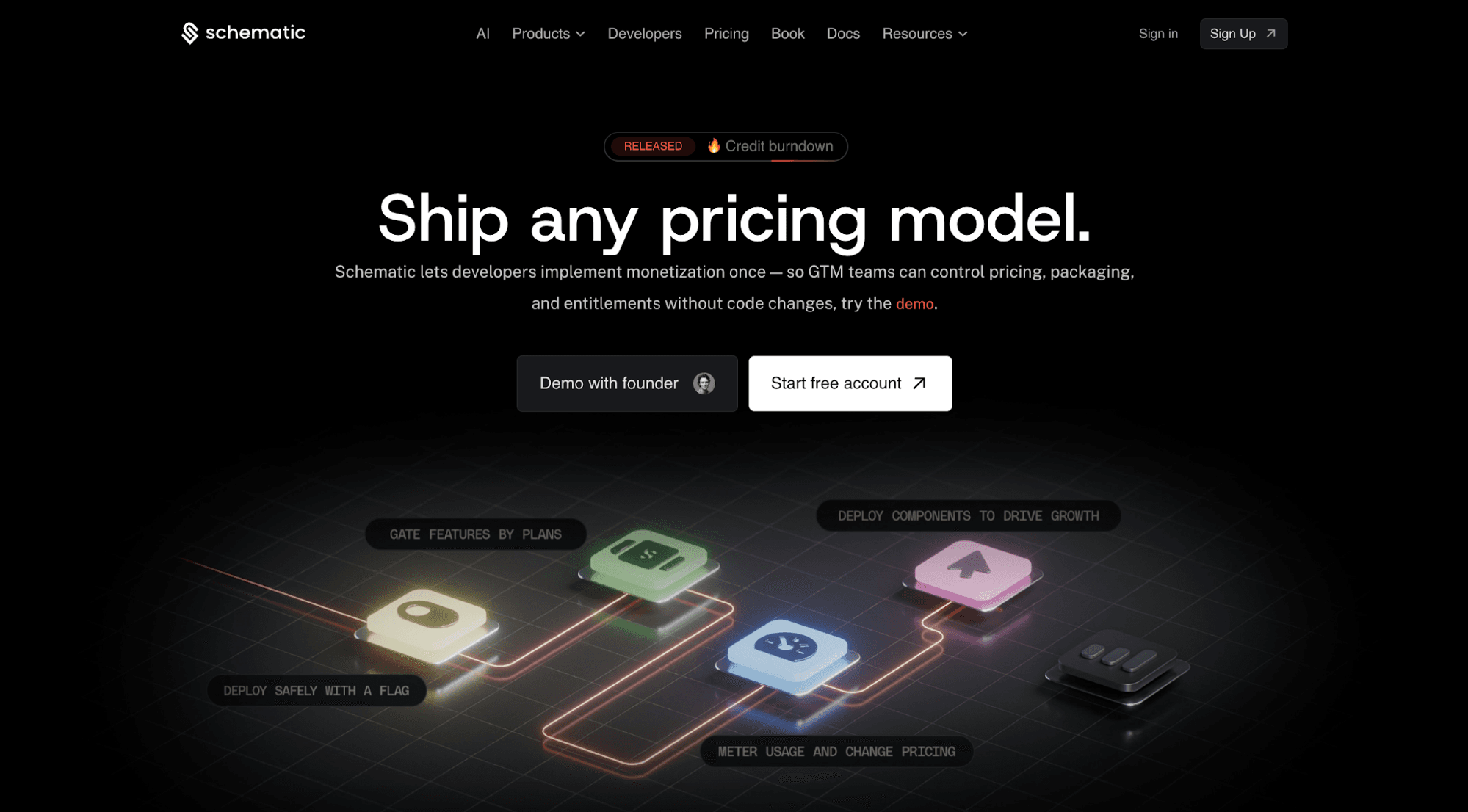
Schematic is the system of record for your plans, software entitlements, limits, trials, credits, add-ons, and overrides. The platform evaluates and enforces access in-product at runtime while making sure it matches billing and subscription state in Stripe.
Schematic also provides revenue insights that highlight upgrade opportunities and churn risks. This helps you understand where growth comes from and where you may lose customers.
You can use this data to build a SaaS financial model based on actual performance, not guesswork.
FAQs About Early-Stage SaaS Financial Model
What is a SaaS financial model template?
A SaaS financial model template refers to a pre-built spreadsheet (usually an Excel template) that helps a software company forecast its financial performance. Businesses can input data, such as pricing, customer numbers, and other key metrics, to plan revenue, costs, and future growth.
How often should you update your SaaS financial model?
You should regularly update your SaaS financial model, ideally every month. Monthly updates help early-stage SaaS companies compare actual performance against projections. These make it easier to adjust financial plans based on new data and changes.
What SaaS metrics do you need to track in a financial model?
You need to track key metrics, such as monthly or annual recurring revenue, average revenue per user, customer acquisition cost, customer lifetime value, payback period, and churn rate. These SaaS metrics help you understand revenue growth, customer value, and expenses, which are all important for financial planning and decision-making.