All posts
Schematic vs. OpenMeter: Choosing The Best Monetization Platform
Blog· Schematic·Aug 28, 2026
Schematic·Aug 28, 2026
How to decide between open-source usage infrastructure and a managed layer for the billing experience your customers actually see, and what each path costs the business.
This article lays out the differences between Schematic and OpenMeter. Both come up when a team is evaluating tools for usage-based or credit-based pricing, whether that team is moving an existing product off per-seat plans or launching an AI product that bills on credits from the start.
The two products are similar in many ways. Each meters usage in real time, meaning it counts API calls, agent actions, minutes, or tokens as they happen and turns that count into the raw data every invoice depends on. Both also model entitlements and credits, connect to Stripe, and were built for developers from the start. The sections below cover where they overlap, where they differ, and which kind of team each one fits.
The difference is in what your team is expected to build. OpenMeter (now part of Kong), is a high-scale, open-source metering engine that lives close to your infrastructure and hands your engineers the building blocks for a billing system. Schematic is a managed monetization layer that ships the entitlement logic and the customer-facing components your product needs, so the experience your customers see arrives built. One optimizes for openness and raw metering scale. The other optimizes for a complete, product-facing experience you can stand up in weeks, which keeps your engineers on your product.
OpenMeter vs Schematic Feature Comparison
OpenMeter (by Kong) | Schematic | |
|---|---|---|
Entitlements & enforcement | Boolean, static, and metered entitlements with credit grants, soft and hard limits, and rollover, scoped to the customer. Your app enforces them by calling an access-check API. A new Kong gateway plugin can block API traffic on feature access and usage limits, though not yet on credit balances. | Entitlements, feature flags, and credit balances evaluated inside your product. SDKs hold a live local copy of rules, company, and user data so a check answers in-process, with company and per-user usage controls, warnings before cutoff, kill switches, and the gating UI handled for you. |
Payments | Syncs with Stripe and other providers. Invoicing and billing profiles included. Open-source core you can self-host. | Stripe-first, with a managed path into finance systems like NetSuite. Fully hosted, with no infrastructure to run. |
Pricing models | A no-code product catalog covering usage-based, credits, commitments, and add-ons, tuned for high-volume API and AI metering. | Plans, packages, credits, overages, and hybrid models, authored in a builder and changeable by a product manager without a code deploy. |
Customer experience | Real-time usage data and a hosted customer portal. The in-app billing experience is yours to build from the APIs and SDKs. | Drop-in React components for pricing tables, customer billing portals, meters, and paywalls, embedded directly inside your product. |
Developer experience | Open source under Apache 2.0 and self-hostable, with SDKs and collectors for Kubernetes, OpenTelemetry, and LangChain. Maximum control, more assembly. | Managed and opinionated. MCP-assisted setup stands up plans, entitlements, and components in minutes. |
Best fit | Platform and API teams that want an open, self-hostable metering engine at scale, especially inside the Kong ecosystem. | Product and monetization teams that need a trustworthy customer-facing billing experience shipped quickly, without building the UI and enforcement layer themselves. |
Entitlements and enforcement
An entitlement is the rule for what a customer is allowed to use and how much of it. It is what turns a plan into an enforced promise. Enforcement is what happens when the customer reaches the limit: the product warns, slows down, cuts off, or keeps going and bills the overage. Enforcement decides whether overage gets billed or given away, and whether a cutoff feels fair to the customer.
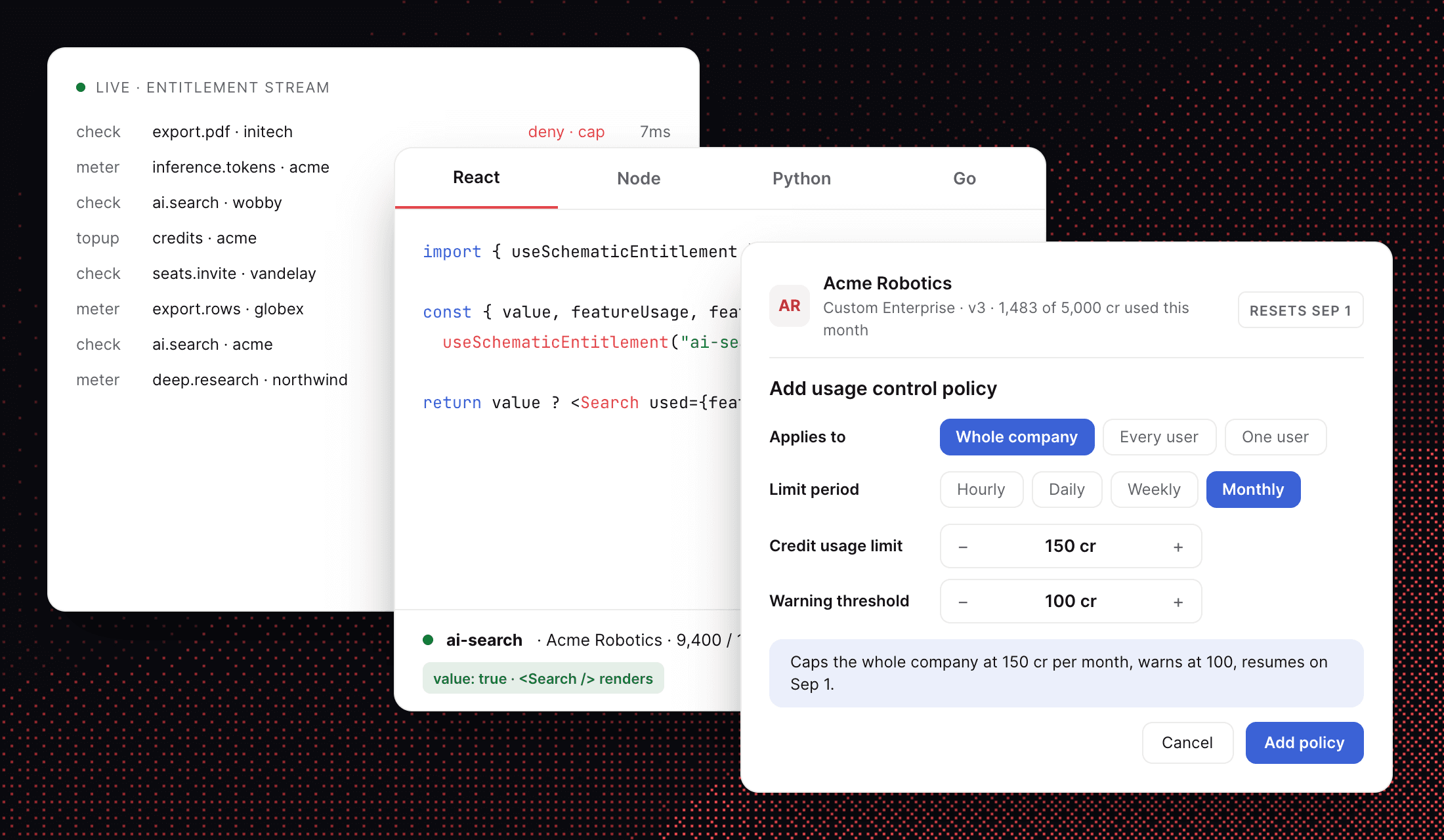
Schematic's enforcement loop: a usage control policy, the one flag check that gates the feature in React, Node, Python, or Go, and the live entitlement stream that answers it in milliseconds.
OpenMeter also models entitlements. It offers boolean, static, and metered types, credit grants that can be one-time or recurring, a soft-versus-hard limit switch, and rollover of overage into the next period. Balances update in real time. On the raw primitives, the two platforms are close.
Where they part ways is what happens at runtime. With OpenMeter, your application asks the access-check API whether a customer can use a feature and gets back hasAccess plus the balance. OpenMeter serves those reads from a globally distributed edge layer, and its own launch post notes that the metered balance is eventually consistent and can take multiple seconds to reflect the latest events. Kong now documents a Konnect gateway plugin that blocks API requests when a customer is over a usage limit or lacks access to a feature. It polls the entitlement API on an interval and caches the result, fails open by default, does not enforce credit balances yet, and only sees traffic that passes through the gateway. The paywall and the warning banner inside your product are still yours to build on top of the API response.
Schematic treats the check itself as infrastructure. Its SDKs open a datastream connection and hold a local copy of flag rules, company data, and user data, so a flag check is evaluated in-process by a rules engine with no network round trip. For fleets of services, the replicator keeps that data in a shared Redis cache, so many application instances share one connection, replay missed updates after a reconnect, and keep answering while Schematic is unreachable. If nothing is cached, checks fall back to the defaults you set, so a billing outage does not become a product outage. The same check runs in React, Node, Python, and Go, and it answers from the ledger that bills, so the UI and the API never disagree.
The second difference is what you can do with the entitlements themselves. A common scenario: a customer buys a block of 50,000 credits, which is prepaid usage the product draws down with each action. Most AI pricing works this way, because credits let you charge for value without exposing your unit costs. Three AI agents draw the block down all month, and every event carries both the company and the user who triggered it. Then the customer's admin notices one user is burning through the pool. What can they do?
With OpenMeter, entitlements are scoped to the customer, meaning the company as a whole. Applying a limit to one user inside a company's shared balance, warning that user as they approach it, and cutting them off automatically at the line is a design your engineers build on top of the access-check API. That works, and your team then owns and maintains it.
Schematic treats that last mile as the product. Companies and users are both first-class, and usage controls, in beta since September 2026, are policies on how fast credits can be consumed, separate from how many credits a company holds. A policy applies to the whole company, to every user individually, or to one named user, over an hourly, daily, weekly, or monthly period, with a limit and an optional warning threshold. A company with a million credits a month can hold any one user to a fraction of that, warn them before they reach the line, and stop them at it, all as configuration. You can advertise a fair-use number and enforce a higher one, and a policy takes effect the moment you save it.
Overrides work the same way. They apply instantly and expire on a schedule, which matters when a deal needs an exception today and the exception should not live forever. In OpenMeter, a customer can hold one entitlement per feature, so a change means replacing it.
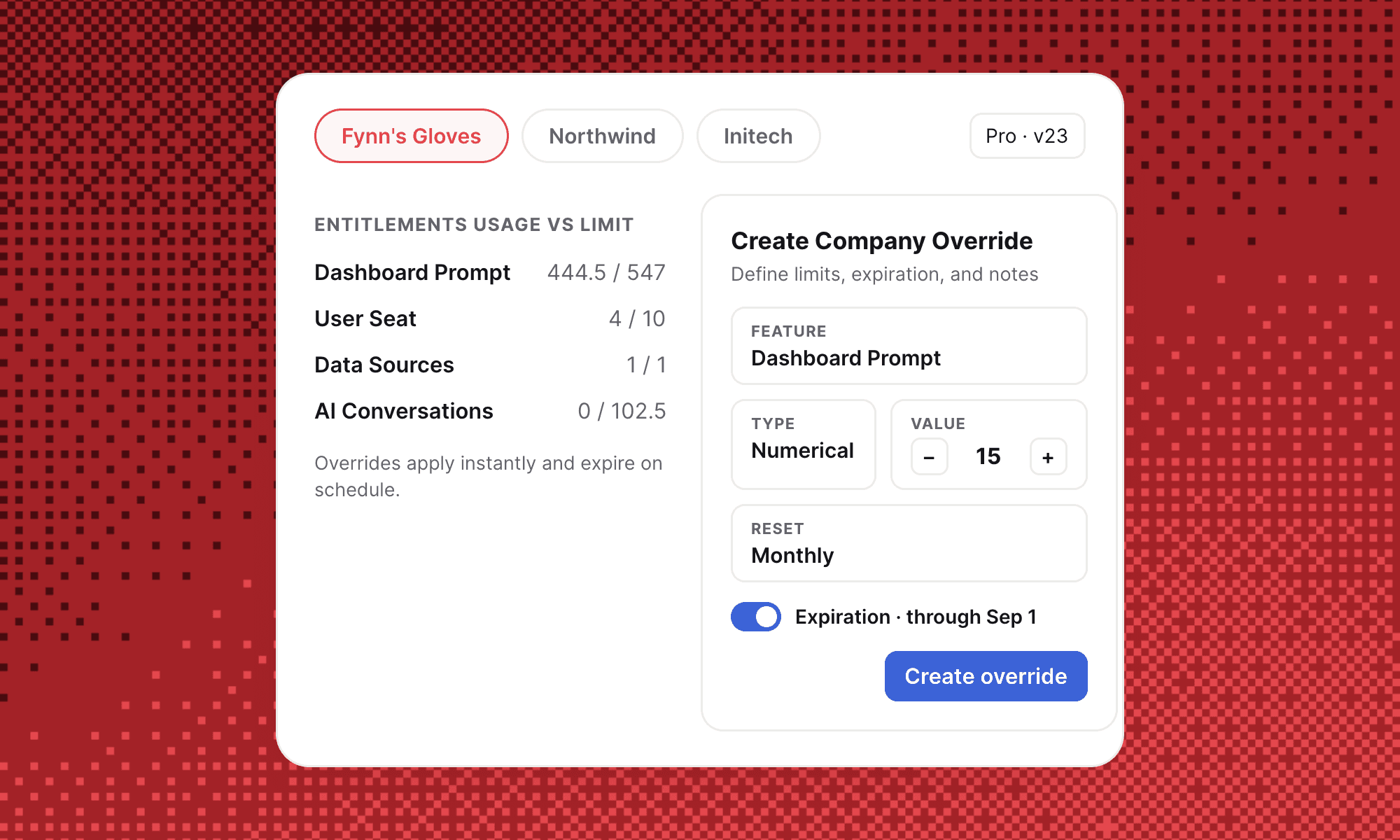
Entitlement usage against limits for one company, and a company override with its own value, reset period, and expiration.
Where this hits the business. Per-user controls keep one power user from draining a customer's budget and turning a renewal conversation into a refund conversation. A warning before cutoff is the difference between a support ticket and a churn risk. Instant, expiring overrides let sales close a custom deal on the call. And a check that is answered inside your own process keeps working when the network to your billing vendor does not.
"Too many teams think pricing can easily fit into perfect SKUs. More often than not you need overrides, credits, and custom levers for individual customers. Schematic provides that and more."— Zach Hawtof, CEO & Co-Founder, Tightknit
Payments and finance integrations
OpenMeter connects to Stripe and other payment providers, generates invoices, and manages billing profiles. Because the core is open source, you can self-host the whole pipeline. Schematic is Stripe-first and fully managed, with a supported path into finance systems like NetSuite so revenue lands where your finance team already works. If self-hosting the metering layer is a hard requirement, OpenMeter was built for it. If running less infrastructure is the goal, Schematic removes it entirely.
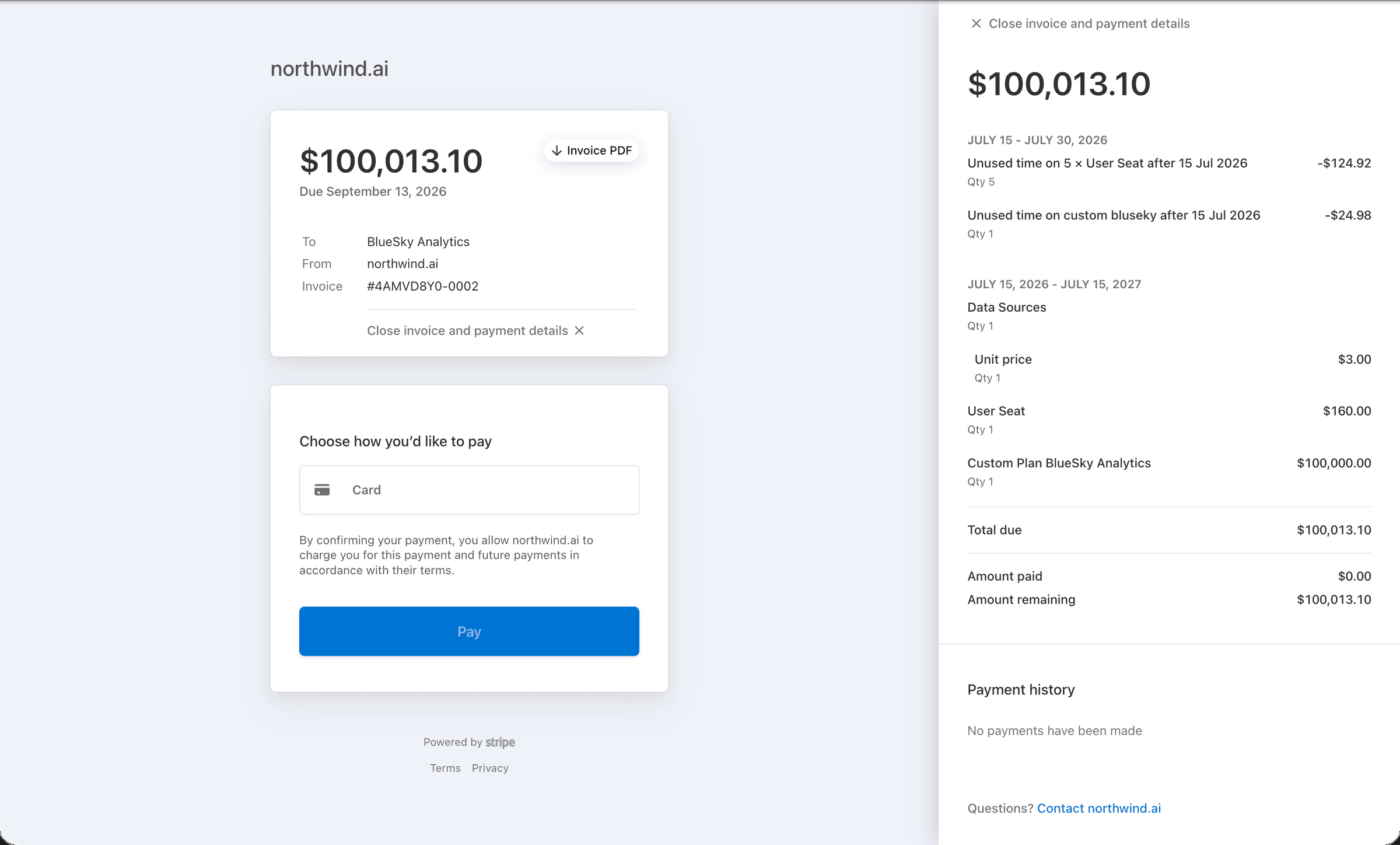
Invoice generated from a Schematic subscription and paid through Stripe, with proration line items.
Where this hits the business. For finance, the question is how usage becomes an invoice becomes a journal entry. Every hop that requires a custom integration is a place where numbers drift and someone reconciles by hand at month-end. A managed path from usage to your ERP shortens close and makes revenue recognition defensible.
Developer experience
OpenMeter is open source under Apache 2.0, self-hostable, and rich in infrastructure-grade tooling: SDKs for TypeScript, Python, and Go, and collectors for Kubernetes, OpenTelemetry, S3, and LangChain. Running it yourself means running its API server and workers plus Kafka, ClickHouse, and PostgreSQL, and the official Helm chart bundles Kafka and ClickHouse for development deployments. It rewards teams that want deep control and are comfortable assembling and operating the surrounding system, and it fits naturally for organizations already standardized on Kong's API platform.
Schematic trades some of that openness for velocity. It is a managed service with an opinionated model, and its MCP-assisted setup can stand up plans, entitlements, and embeddable components in minutes. The same MCP server keeps working after setup: your agents and your coding assistant can read balances, usage, plan state, and history, find the companies near their limits, and grant credits, all from the data that produces the invoice. You give up self-hosting. You get back the weeks it takes to build and maintain the layer yourself.
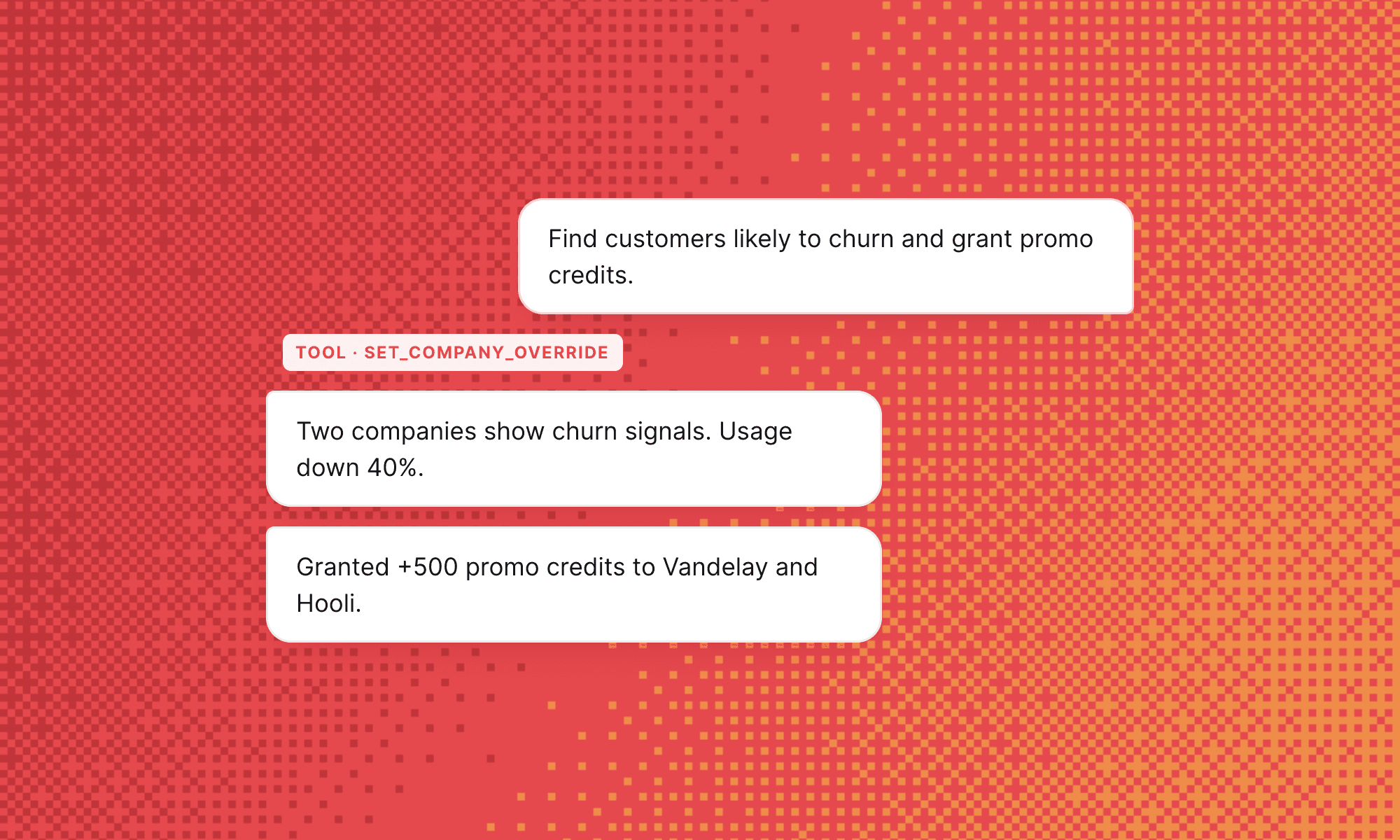
An agent asks Schematic over MCP to find customers likely to churn and grant them promotional credits, using the same billing data that produces the invoice.
Where this hits the business. "Open source" reads as free, and the license is. The engineering time to assemble, deploy, secure, scale, and upgrade a billing pipeline is not, and it recurs every quarter. That time comes from the same team you need building the product your customers are paying for. Compare total cost of ownership and time to revenue.
"We didn't want to burden our engineering team with building and managing a metering system, and Schematic solved that for us."— Rahul Gill, Customer Experience Lead, Macabacus
Customer experience
The biggest difference is what your customers actually see. Whether you are moving an existing customer base off seats or asking a new one to trust a credit balance from the first invoice, trust is the hard problem. Customers want transparency into what they are consuming, predictability in what they will pay, and control over how their team spends. Deliver all three and usage pricing feels fair. Miss one and you are renegotiating contracts in six months.
Delivering them means UI: usage meters, spend caps a customer can set themselves, alerts before a limit hits, and a billing portal that makes the whole thing legible. OpenMeter gives you the data and a hosted customer portal, and leaves the in-product experience for your engineers and designers to build from its APIs and SDKs. Schematic delivers that experience as drop-in components (pricing tables, customer and billing portals, meters, and paywalls) that embed directly inside your application and are styled to match it. Each component comes from research into what end customers ask for during a usage-based transition, so you don't rebuild them.
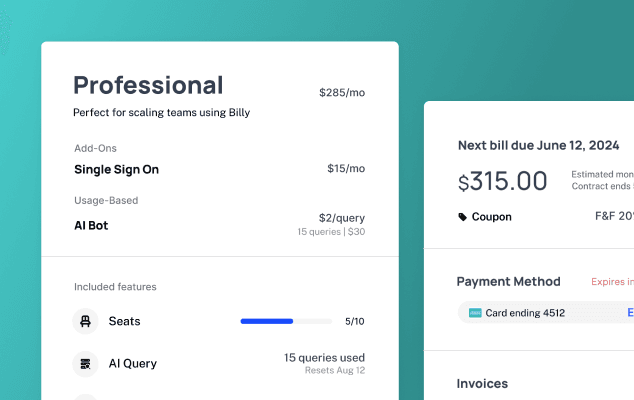
The customer billing portal component. Plan, add-ons, usage-based charges, feature meters, and next bill in one drop-in view.
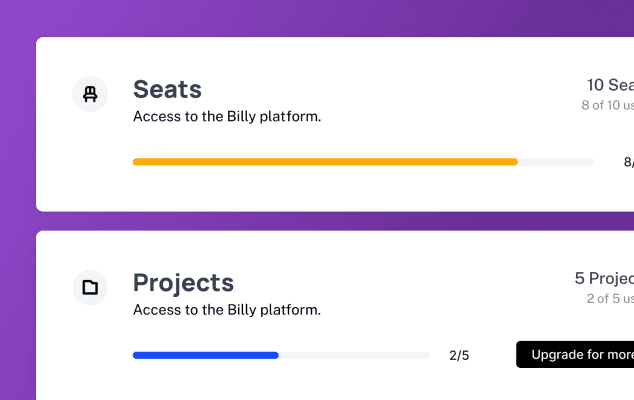
Usage meters with an upgrade prompt, shown before the customer hits a limit.
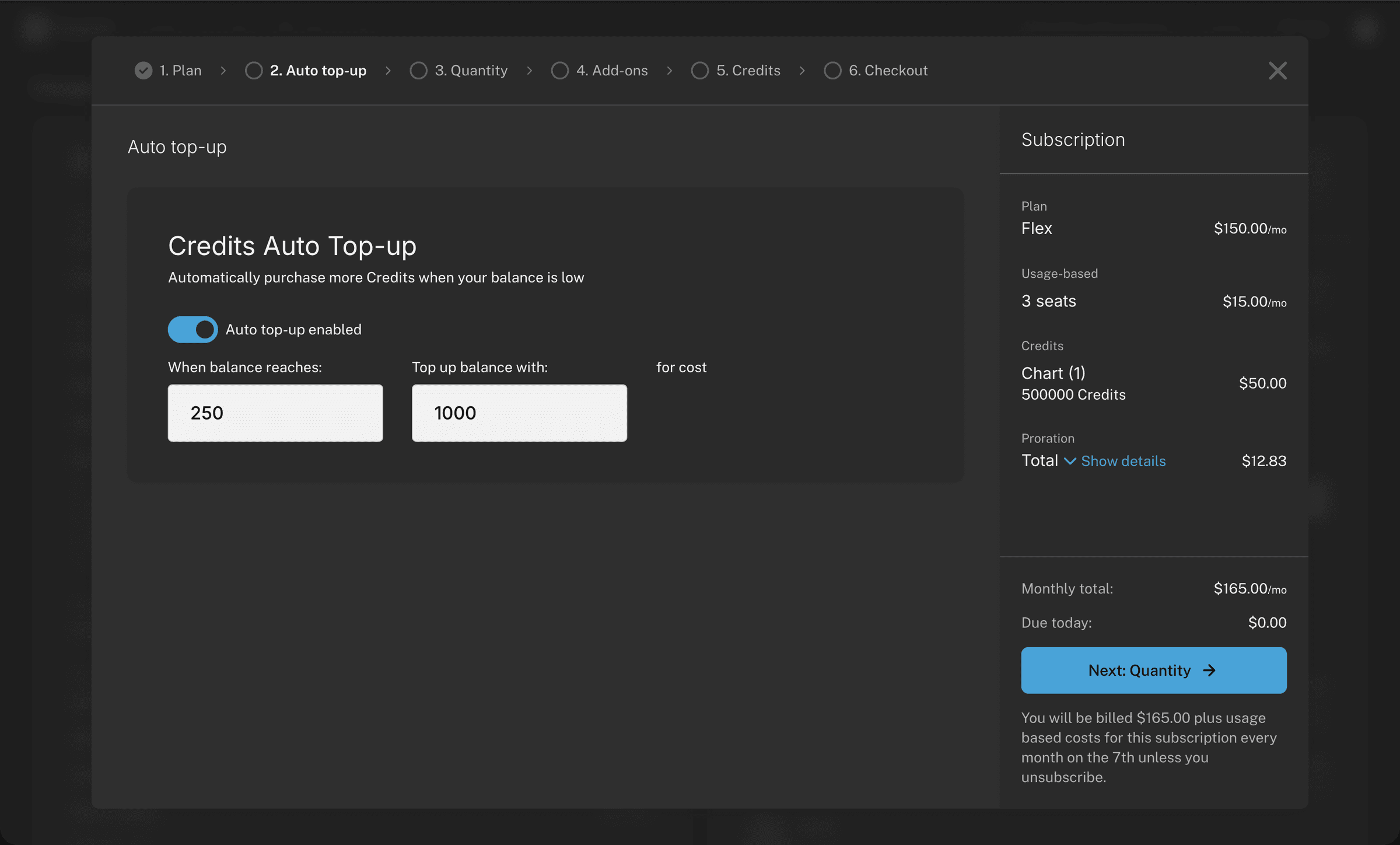
Auto top-up. The customer sets the balance that triggers a refill and how much to add. Demo environment.
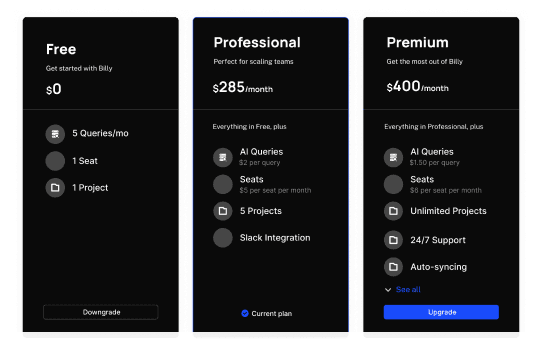
The pricing table component, with the customer's current plan marked.
Where this hits the business. The customer-facing layer is where a pricing change succeeds or fails. It is what your customers screenshot when they are confused and what your account managers point to when they are not. Shipping it built puts the product team in control of the rollout timing.
"The setup was quick, and now it's dead simple to change plans or enforce usage limits."— Simon Persson, Pagos
Questions to ask yourself
As you're considering both platforms, ask yourself these questions.
Do you want to run billing infrastructure yourself, or have it managed?
If you have a platform team that wants to own and self-host the metering pipeline, OpenMeter is a genuine option. Most companies don't. Billing is the one system that can't go down, and every hour your engineers spend keeping it up is an hour they're not spending on the product customers pay for. Schematic is fully managed. There is nothing to deploy, scale, or upgrade.
Who owns the customer-facing billing UI, and how fast does it need to ship?
OpenMeter gives you the data and a hosted portal; the experience inside your product is a project for your engineers and designers. Schematic ships it: pricing tables, billing portals, usage meters, and paywalls that drop into your app and match your styling. Your product team owns the rollout from day one.
What governance do your customers need: spend caps, per-user limits, fair-use alerts?
If your customers are asking to control how their own team spends, you need controls at the user level as well as the company level. Schematic treats companies and users as first-class. An admin can cap one user by the hour, day, week, or month, get warned before the pool runs dry, and cut a user off automatically, all as configuration. That is how your customers protect their own budgets without calling your support team, and how one power user stops turning a renewal into a refund.
What happens inside your product when the billing service is slow or down?
With an API-only check, every gated request waits on a network call, and an outage forces a choice between failing open, which gives usage away, and failing closed, which locks out paying customers. Schematic's SDKs answer from a local copy of the rules and fall back to the defaults you choose, so the product keeps working, and keeps enforcing, while the connection recovers.
When a deal needs an exception, how fast can you grant it?
Custom deals are the norm. Schematic overrides apply instantly and expire on a schedule, so sales can grant an exception on the call and it cleans itself up. No ticket, and no forgotten discount still living in someone's account a year later.
How does usage become an invoice in the system your finance team already lives in?
Every custom hop between usage and your ERP is a reconciliation step at close. Schematic runs Stripe-first with a managed path into finance systems like NetSuite, so finance gets numbers they can defend without a hand-built pipeline behind them.
What's your timeline, and what has to be provable before then?
If the answer is "this quarter," the question is how much arrives built. With Schematic, plans, entitlements, and components stand up in minutes through MCP-assisted setup, and a proof of concept runs in weeks. You walk into the leadership meeting with a working billing experience.
Are you standardized on Kong's API platform today?
If you are, OpenMeter is the native path and worth a serious look. If you're not, you're evaluating a metering engine that's being folded into an API gateway company's platform. Monetization is the whole company at Schematic, so the roadmap follows your billing needs.
If your answers are "we want to own the infrastructure" and "we're on Kong," OpenMeter deserves the look. If your answers are "we want the experience delivered," "our customers need control," and "we need this live soon," we built Schematic for you.
Which should you choose?
- Choose OpenMeter if you want an open-source, self-hostable metering engine built for very high event volume, you have the engineering capacity to assemble the customer-facing experience and the in-product enforcement yourself, and an API-gateway-centric or Kong-based stack is where you want your monetization to live.
- Choose Schematic if you need a complete, managed monetization layer, with entitlements enforced inside your product at runtime, usage controls per company and per user, and embeddable customer-facing components, that ships fast and lets a product team stand up a trustworthy usage-based experience without pulling engineers off the product to build the billing layer.
One is infrastructure you extend, the other a monetization layer you plug in. Which one fits comes down to what your engineering time is worth.