2025 was a big year for Schematic. We evolved from a feature management tool to an end-to-end monetization OS. That evolution was powered by customer feedback and by gaps we found in the modern monetization stack.
What is a monetization OS? Put simply: it is one platform to roll out features, manage the product catalog (plans, add-ons), define and enforce entitlements (usage-based metering, credits, limits), and manage the entire customer lifecycle (access, billing, and usage).
We and our customers believe pricing is product. Every time you ship a new feature, you have to monetize it (Is it included in a plan or add-on? Is it usage-based?) and understand how customers buy and use it. Our customers pushed Schematic to support that entire workflow. As a result, they can launch new pricing models, iterate on packaging, grant customer-level exceptions, and identify whitespace, no longer leaving money on the table.
Here are some highlights of what we shipped in 2025. Read on for a preview of what’s coming in 2026. And don’t forget to view and vote on the public roadmap and release notes.
Schematic now supports every major SaaS and AI pricing model
- Schematic now makes it easy to launch new pricing models, evolve existing ones, meet customers where they are, and respond to competitive pressure.
- We also launched a robust credit-based pricing model with auto top-ups, an auditable ledger, promotional credits, and more.
Fuller release notes for pricing models and strategies:
- Pay as you go
- Pay in advance
- Overages
- Trials
- One-time fee add ons
- Tiered pricing
- Usage-based add ons
- Billing thresholds
- Credit burndown
- Credit top ups
We’ve invested heavily in developer tooling to ensure Schematic is reliable, scalable, and easy to work with for developers.
- We invested heavily in developer tooling to ensure Schematic is reliable, scalable, and easy to work with.
- We launched streaming client-side rule evaluation, which keeps entitlements and flags up to date in real time while evaluating locally. This eliminates repeated network calls and significantly reduces latency and backend load.
- We rolled out entitlement checks for React and other SDKs, so you can check entitlements (for example, company access to a feature) using a flag check. With the useSchematicEntitlement hook, you can also retrieve usage and limits to render precise feature states.
- We launched Replicator for Go (with other SDKs coming soon), which syncs Schematic data into your own infrastructure to reduce calls to the Schematic API. Replicator tracks changes to flags, companies, and users to ensure evaluations stay as close to real time as possible.
Developer tooling released in 2025 includes:
- Java SDK
- Entitlement flag checks for React
- Streaming client-side evaluation for Go
- Streaming client-side evaluation for C#
- Cloudflare KV integration
- Vue SDK
- Replicator for Go
- Replicator for C#
We’ve revamped and extended billing components and checkout to be more customizable, more user-friendly, and convert better.
- We revamped and extended billing components and checkout to be more customizable, easier to integrate, and better at conversion.
- Components now support custom buttons and text, unsubscribe flows, taxes, coupons, add-ons, credit top-ups, and more.
- Schematic customers can trigger checkout from any button in their app, collect additional data during checkout, and apply custom styling.
Component and checkout improvements include:
- Custom plans (schedule a demo instead of self-serve)
- Coupons
- Unsubscribe flows
- Multiple payment methods
- Reorder and control feature visibility in pricing tables and checkout
- Custom buttons and text in the customer portal
- Trigger checkout from any button
- Collect more customer data at checkout (address, email, phone)
- Stripe Tax and other tax add-ons
Schematic now makes it possible to manage, monitor, and expand customers all from the dashboard
- Schematic now makes it possible to manage, monitor, and expand customers directly from the dashboard.
- Get a unified view of customer usage, limits, and billing status. Set overrides with timers, leave internal notes, manage subscriptions, discounts, and exceptions.
- Get alerted when customers approach or hit limits. View a complete activity log of upgrades, downgrades, and plan changes. Filter customers by usage and proximity to limits, and pull reports to identify expansion opportunities and churn risk.
Customer management features shipped in 2025 include:
- Override notes
- Initial, fallback, and trial expiry plans
- Plan history and webhooks
- Stripe Tax integration
- Manage Plan v2
- Entitlement Form v2
- Credit limit webhook
- Data export
- Filtered company lists
We reinvigorated and doubled down on our product and content marketing
- We launched a new marketing site with a refreshed brand iterated towards a multi product approach, monetization schemes, developer tooling and more
- We hosted Monetizing AI, a summit in San Francisco focused on tactical pricing & packaging lessons for AI founders with speakers like Kyle Poyar, Marcos Rivera, and Gaurav Vohra
- We launched Pricing Therapy to help companies with feedback on their pricing model, packaging, pricing page, billing infra audit, and recommendations.
- We launched a Youtube channel complete with a library of resources for developers to help with building and launching pricing models
- We doubled down on the Monetizing AI podcast with even more great guests like Kevin Gruneberg from Supabase, Claire Vo from ChatPRD, Gaurav Vohra from Superhuman, and many more.
In 2026, we'll evolve even more
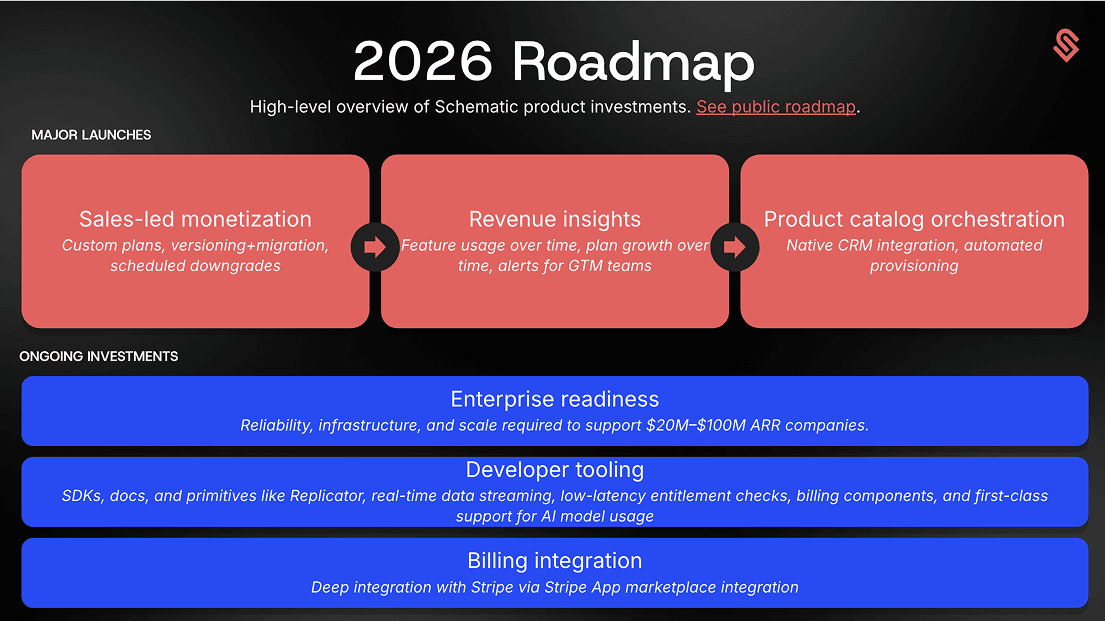
As Schematic brings on more customer, supports more scale, and deepens its power and flexibility as a monetization OS, the product roadmap must focus on:
- Ongoing
- Enterprise readiness: Reliability, infrastructure, and scale required to support $20M–$100M ARR companies.
- Developer tooling: SDKs, docs, and primitives like Replicator, real-time data streaming, low-latency entitlement checks, billing components, and first-class support for AI model usage
- Billing integration: Deep integration with Stripe via Stripe App marketplace integration
- Initiatives
- Sales-led monetization: Custom plans, versioning+migration, scheduled downgrades
- Revenue insights: Feature usage over time, plan growth over time, alerts for GTM teams
- Product catalog orchestration: Native CRM integration, automated provisioning
That's a preview of everything we can talk about publicly right now. Much more to come!